


Ethereum (ETHUSD) Is up 1.15% on Jul 21: Key Drivers to Watch



Ethereum (ETHUSD) is up 1.15% at Jul 21 00:00(ET), now at $1924.15, with a 7-day up of 2.74%.
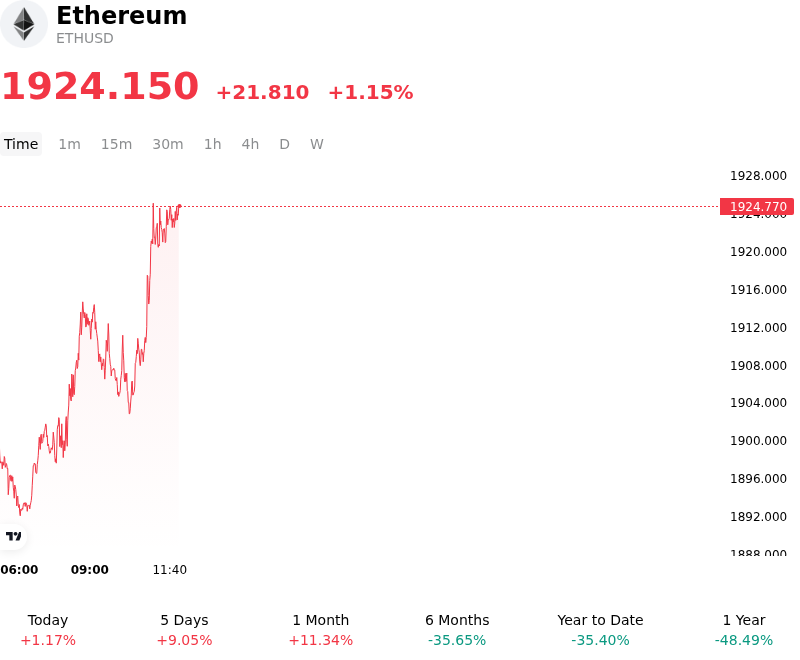
What is driving Ethereum (ETHUSD)’s stock price up today?
The advance in Ether is primarily supported by a stabilizing macroeconomic backdrop and a slight retracement in the U.S. Dollar Index. As global liquidity conditions remain conducive to risk-on assets, institutional investors are increasingly viewing Ethereum as the primary gateway for decentralized finance and institutional-grade tokenization. The cooling of U.S. Treasury yields has further lowered the opportunity cost of holding staked digital assets, driving capital toward the upper end of the crypto risk curve as market participants seek yield-bearing alternatives to traditional fixed income.
A significant driver for the current intraday strength is the sustained positive net inflow into spot Ethereum ETFs. Institutional demand appears to be shifting from speculative trading toward long-term structural positioning, particularly as expectations grow for the broader integration of staking rewards within regulated investment vehicles. This narrative is attracting a broader base of capital from traditional asset managers who are prioritizing assets with high network utility and established regulatory status. The move reflects a broader rotation of capital into the ecosystem as investors anticipate further clarity regarding the treatment of proof-of-stake assets.
On-chain metrics indicate a robust expansion in Layer-2 activity and total value locked, reflecting the continued success of the network’s rollup-centric roadmap. The increased burn rate of ETH through the base fee mechanism, coupled with a steady reduction in exchange-held supply, has tightened the available liquidity. This supply-side constraint, when met with rising institutional demand for decentralized infrastructure, creates an environment where capital inflows result in meaningful upward price pressure. Furthermore, the growth of the liquid staking sector continues to lock up a significant portion of the circulating supply, reinforcing the asset's scarcity.
In the derivatives market, the funding rate for Ether perpetual swaps remains positive but not overextended, suggesting that the current move is driven more by spot accumulation than excessive leverage. Market sentiment is further bolstered by protocol optimizations that have lowered transaction costs and improved network efficiency, making the network more attractive for corporate treasury adoption. While macroeconomic risks such as persistent inflation data remain, the relative resilience of Ethereum highlights its role as a core institutional holding within a diversified digital asset portfolio.
Technical Analysis of Ethereum (ETHUSD)
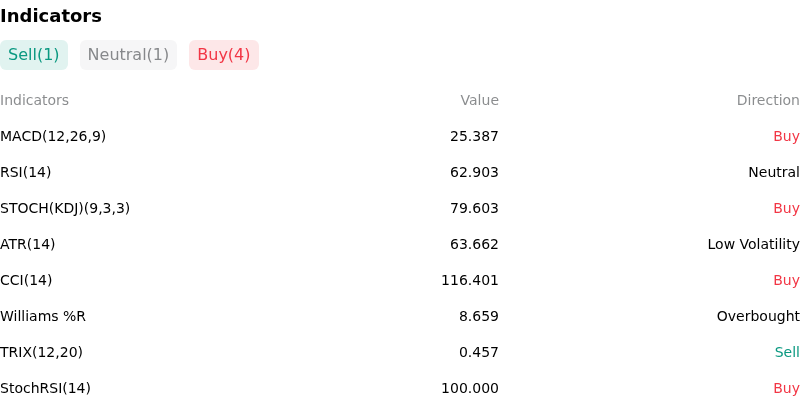
Technically, Ethereum (ETHUSD) shows a MACD (12,26,9) value of 25.387, indicating a buy signal. The RSI at 62.903 suggests neutral condition and the Williams %R at 8.659 suggests overbought condition. Please monitor closely.
More details about Ethereum (ETHUSD)
Recent Events and Risks:
- Spot ETF Outflow Pressure: Recent trading sessions have recorded a resumption of net outflows from U.S.-based spot Ethereum ETFs, largely driven by persistent liquidations from the Grayscale Ethereum Trust (ETHE) and a lack of sufficient institutional inflow to offset the sell-side volume.
- ETH/BTC Ratio Technical Breakdown: The Ethereum-to-Bitcoin exchange rate has recently breached critical multi-year support levels, signaling a significant loss of relative strength and triggering concerns among market participants regarding a structural rotation of capital toward Bitcoin and alternative Layer-1 assets.
- Whale and Foundation Exchange Inflows: On-chain monitoring has identified substantial transfers of ETH from long-dormant whale addresses and wallets associated with the Ethereum Foundation to centralized exchanges, creating immediate overhead supply concerns and heightening the risk of an intraday price correction.
- Decline in Network Fee Burn: Persistently low gas prices and a migration of activity to Layer-2 scaling solutions have drastically reduced the amount of ETH being burned, leading to an inflationary supply trend that weakens the "ultrasound money" fundamental narrative during periods of broader market volatility.
This article may include AI-generated content that is human-reviewed, which is for reference and general information purposes only and does not constitute investment advice.
Recommended Articles








Comments (0)
Click the $ button, enter the symbol, and select to link a stock, ETF, or other ticker.