


SAP SE Stock (SAP) Closed Up by 3.87% on Jul 16: What Signal Does It Send?



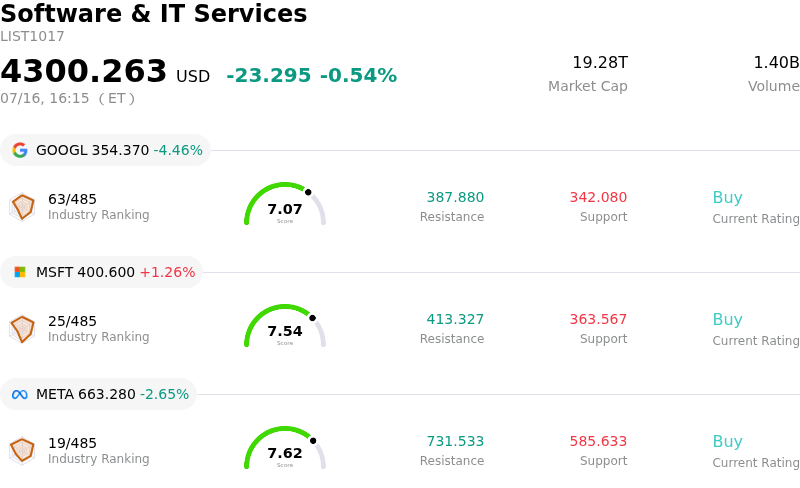
SAP SE (SAP) closed up by 3.87%. The Software & IT Services sector is down by 0.54%. The company outperformed the industry. Top 3 stocks by turnover in the sector: Alphabet Inc Class A (GOOGL) down 4.46%; Microsoft Corp (MSFT) up 1.26%; Meta Platforms Inc (META) down 2.65%.
What is driving SAP SE (SAP)’s stock price up today?
The upward momentum observed in today's trading session is primarily driven by the company's robust quarterly financial results, which showcased a significant acceleration in cloud revenue. This growth highlights the successful execution of the long-term transition from on-premise licensing to a subscription-based model. Investors are particularly encouraged by the expansion of the current cloud backlog, which serves as a reliable indicator of future revenue predictability and market share gains within the enterprise resource planning sector.
Central to this performance is the increasing integration of generative artificial intelligence across the core software suite. The rapid adoption of the company's proprietary AI assistant and automated business process tools has led to higher contract values and improved customer retention rates. By embedding advanced analytics directly into its business applications, the firm has successfully differentiated its offerings from competitors, allowing for premium pricing and enhanced margins as clients seek to modernize their digital infrastructure.
Furthermore, the upward revision of the full-year operating profit guidance has acted as a significant catalyst for institutional buying. This improved outlook suggests that the restructuring program initiated in previous periods is yielding substantial cost efficiencies and operational leverage. Market participants are interpreting the updated guidance as a signal of management's confidence in maintaining profitability targets despite potential macroeconomic headwinds, leading to a wave of positive rating adjustments from several prominent sell-side analysts.
The broader market sentiment also reflects a rotation into high-quality software stocks as interest rate volatility begins to stabilize. With the company's valuation metrics appearing increasingly attractive relative to its historical averages and projected growth rates, large-scale portfolio rebalancing by exchange-traded funds and institutional managers has provided additional support. The combination of strong fundamental execution and a favorable technical setup has positioned the stock as a preferred choice for investors looking for exposure to the enterprise technology recovery.
Technical Analysis of SAP SE (SAP)
Technically, SAP SE (SAP) shows a MACD (12,26,9) value of 1.125, indicating a neutral signal. The RSI at 43.408 suggests neutral condition and the Williams %R at 56.121 suggests sell condition. Please monitor closely.
Fundamental Analysis of SAP SE (SAP)
SAP SE (SAP) is in the Software & IT Services industry. Its latest annual revenue is $41.49B, ranking 14 in the industry. The net profit is $8.07B, ranking 13 in the industry. Company Profile
Over the past month, multiple analysts have rated the company as Buy, with an average price target of $271.49, a high of $367.98, and a low of $154.99.
More details about SAP SE (SAP)
Company Specific Risks:
- Executive Board Instability: The abrupt departure of Scott Russell, Head of Customer Success, and Julia White, Chief Marketing and Solutions Officer, has created a leadership vacuum in key revenue-generating divisions, raising concerns about the stability of the management team during a critical strategic pivot.
- Restructuring Execution Hazards: The ongoing transformation program involving 8,000 positions faces heightened execution risk, as the loss of institutional knowledge and potential internal culture clashes may disrupt the delivery of SAP’s core "Business AI" product roadmap.
- Regulatory Litigation Overhang: Continued investigations by the U.S. Department of Justice into alleged price-fixing and bid-rigging within government software contracts present significant legal liabilities and the risk of debarment from lucrative public sector opportunities.
- Cloud Margin Compression: Analysts remain cautious regarding the financial impact of the accelerated cloud transition, where the high upfront costs of re-skilling and infrastructure migration could lead to mid-term margin erosion despite consistent topline growth in cloud backlogs.
This article may include AI-generated content that is human-reviewed, which is for reference and general information purposes only and does not constitute investment advice.
Recommended Articles









Comments (0)
Click the $ button, enter the symbol, and select to link a stock, ETF, or other ticker.