


NZD/USD (NZDUSD) Volatility Intensified on Jul 15: Factors to Watch



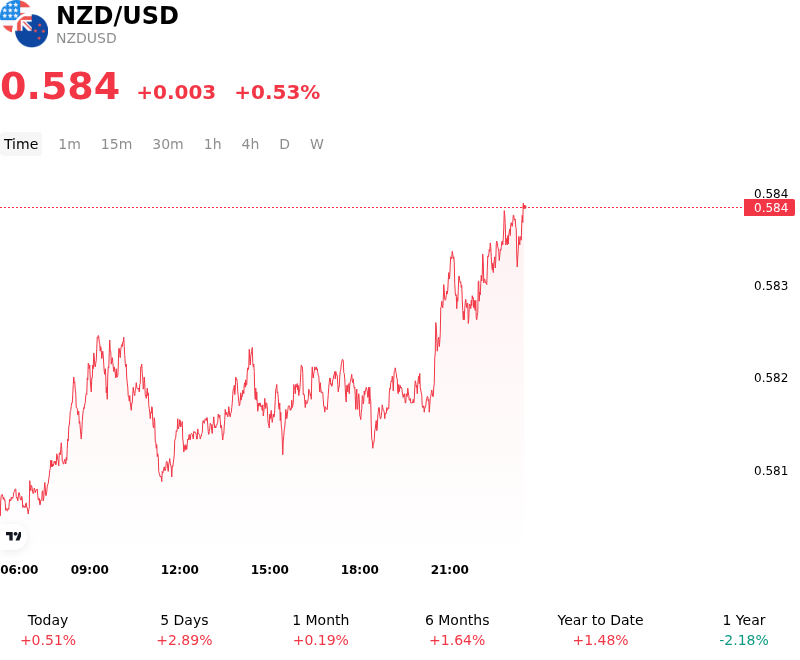
NZD/USD (NZDUSD) is up 0.53% at Jul 15 11:30(ET), now at $0.58407, with a 7-day up of 2.53%.
What is driving NZD/USD (NZDUSD)’s stock price up today?
The advance in NZDUSD is primarily driven by a hawkish recalibration of Reserve Bank of New Zealand policy expectations following the latest monetary policy communication. While the central bank maintained the Official Cash Rate at current levels, the accompanying statement highlighted persistent domestic inflation pressures, particularly within the services sector. This hawkish tilt effectively pushed back against market pricing for imminent rate cuts, causing a sharp repricing in the New Zealand OIS curve and widening the interest-rate differential in favor of the kiwi as local front-end yields climbed.
Simultaneously, the U.S. dollar faced broad-based downward pressure following a batch of softer-than-anticipated macroeconomic data. Lower-than-expected industrial production and cooling wholesale inflation indicators have reinforced the narrative that the Federal Reserve’s restrictive stance is successfully moderating economic activity. The resulting decline in U.S. Treasury yields, particularly at the short end of the curve, reduced the greenback's yield advantage and encouraged institutional capital flows into high-beta, commodity-linked currencies.
The pair’s upside momentum was further supported by a distinct improvement in global risk sentiment. Renewed optimism regarding fiscal support measures in major Asian economies provided a tailwind for the New Zealand dollar, given its significant sensitivity to regional trade dynamics and commodity demand. As a pro-cyclical currency, the NZD benefited from the shift toward a risk-on environment, which saw a rotation out of safe-haven assets and into growth-sensitive proxies.
Institutional positioning also played a role in the intraday volatility. Short-covering by systematic macro funds likely exacerbated the move as the pair breached key technical resistance levels, triggering stop-loss orders. Looking ahead, investors remain focused on the divergence between the RBNZ’s "higher-for-longer" rhetoric and the Federal Reserve’s data-dependent path. The sustainability of this move will likely depend on whether upcoming employment figures confirm the resilience of the New Zealand economy relative to the cooling trend observed in U.S. labor markets.
Technical Analysis of NZD/USD (NZDUSD)
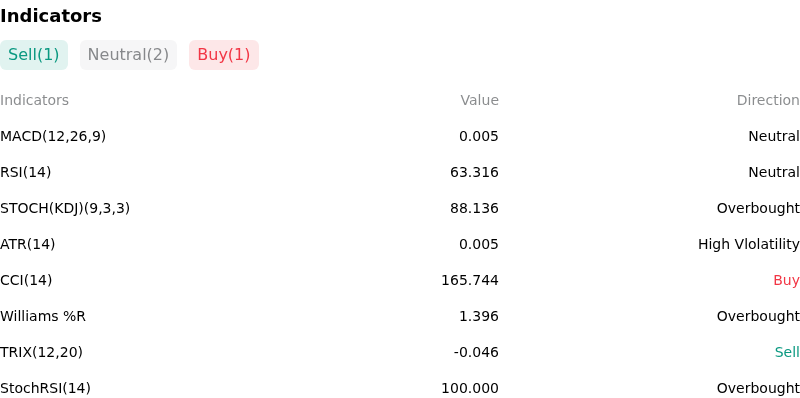
Technically, NZD/USD (NZDUSD) shows a MACD (12,26,9) value of 0.005, indicating a neutral signal. The RSI at 63.316 suggests neutral condition and the Williams %R at 1.396 suggests overbought condition. Please monitor closely.
More details about NZD/USD (NZDUSD)
Recent Events and Risks:
- Domestic Growth Contraction: New Zealand's latest quarterly retail sales volumes showed a surprise decline, signaling that the Reserve Bank of New Zealand's (RBNZ) prolonged restrictive stance is severely impacting consumer spending and heightening the risk of a deeper technical recession.
- China Economic Fragility: As a primary proxy for Chinese growth, the NZD remains highly vulnerable to underwhelming stimulus signals from Beijing and soft industrial data over the last 72 hours, which threatens the demand outlook for New Zealand’s dairy and agricultural exports.
- US Interest Rate Divergence: Resurgent US Dollar strength, fueled by hawkish FOMC minutes and robust US manufacturing PMI data, has widened the yield spread disadvantage for the Kiwi, triggering technical sell-offs as the pair struggles to maintain support levels near 0.6100.
- Carry Trade Unwinding: Heightened global market volatility and a tactical shift toward "risk-off" sentiment have prompted institutional investors to trim high-beta positions, leading to liquidations in NZD-funded carry trades in favor of safe-haven assets.
This article may include AI-generated content that is human-reviewed, which is for reference and general information purposes only and does not constitute investment advice.
Recommended Articles






Comments (0)
Click the $ button, enter the symbol, and select to link a stock, ETF, or other ticker.