


Ethereum (ETHUSD) Volatility Intensified on Jul 10: What You Should Know



Ethereum (ETHUSD) is up 1.57% at Jul 10 00:00(ET), now at $1773.62, with a 7-day up of 0.57%.
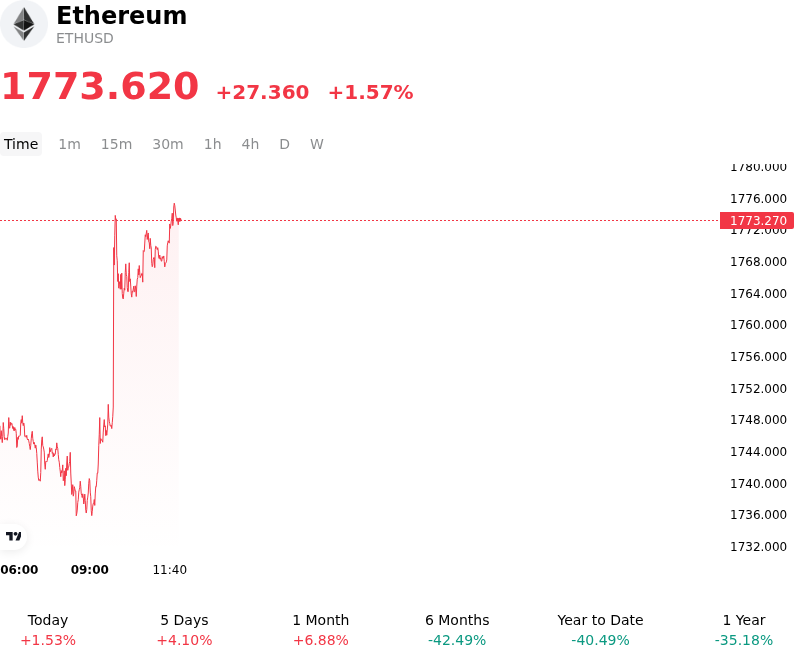
What is driving Ethereum (ETHUSD)’s stock price up today?
The appreciation in Ethereum is largely attributed to a sustained uptick in net inflows across global spot ETFs, signaling a shift in institutional capital allocation toward programmable collateral. This demand is increasingly driven by professional investors seeking exposure to the network's yield-bearing properties, as the gap between US Treasury yields and Ethereum staking rewards continues to narrow. The narrowing spread has incentivized a rotation out of traditional fixed-income instruments into digital assets with verifiable scarcity and cash-flow-like characteristics, particularly as market expectations for a more accommodative Federal Reserve policy gain momentum.
On-chain metrics suggest that a significant portion of the intraday volatility was fueled by a reduction in liquid exchange supply. The persistent growth of the liquid staking sector has effectively locked a larger percentage of the circulating supply, creating a thinner market where modest buy-side pressure results in outsized price movements. Furthermore, the expansion of Layer-2 ecosystems has reached a critical mass, with aggregate transaction volume on major rollups hitting new highs. This validates the long-term scalability roadmap and reinforces the network's position as the primary settlement layer for decentralized finance and institutional tokenization projects.
From a derivatives perspective, the price action was exacerbated by a wave of short-covering in the perpetual futures market. As Ethereum cleared key psychological resistance levels, high-leverage bearish positions were liquidated, providing a mechanical bid that accelerated the move higher. This technical breakout was supported by a broader improvement in risk sentiment across the digital asset class, often correlated with a softening US Dollar Index. Investors are increasingly viewing Ethereum not just as a speculative asset, but as a core infrastructure play, especially as regulatory frameworks in major jurisdictions provide clearer paths for institutional custody and staking integration.
Market participants remain focused on the interplay between deflationary burn mechanisms and network activity. With gas fees stabilizing at levels that encourage high-throughput dApp usage while maintaining a net-negative issuance during periods of peak demand, the ultrasound money narrative continues to resonate with long-term holders. While macroeconomic uncertainty remains a factor, the current trajectory reflects a structural repricing of Ethereum based on its maturing ecosystem and its evolving role as a foundational asset within the global digital economy.
Technical Analysis of Ethereum (ETHUSD)
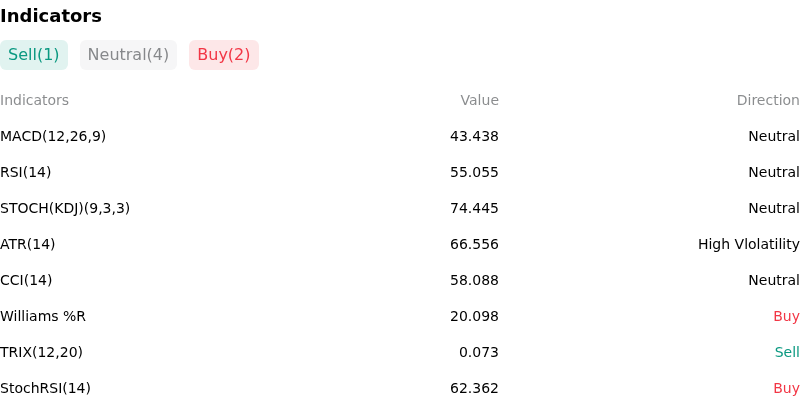
Technically, Ethereum (ETHUSD) shows a MACD (12,26,9) value of 43.438, indicating a neutral signal. The RSI at 55.055 suggests neutral condition and the Williams %R at 20.098 suggests buy condition. Please monitor closely.
More details about Ethereum (ETHUSD)
Recent Events and Risks:
- Spot ETF Approval Volatility: With the SEC's final deadline for spot Ethereum ETF applications reaching its climax, there is a heightened risk of a "sell the news" reaction; market participants fear that if approvals are granted, the lack of immediate staking rewards in the fund structures may lead to lower-than-expected institutional demand.
- Derivatives Leverage and Liquidation Risk: Total open interest in Ethereum futures has spiked alongside a surge in funding rates over the last 48 hours, creating a fragile market structure where a minor price retracement could trigger a massive liquidation cascade of over-leveraged long positions.
- Increased Exchange Inflows: On-chain monitoring has detected significant transfers of ETH from large "whale" wallets to centralized exchanges within the last 24 hours, signaling potential distribution and preparations for a large-scale exit should the regulatory outcome fail to meet market expectations.
- Concentration Risk and Gas Spikes: Recent network congestion and rising Layer-1 gas fees, driven by speculative activity surrounding the ETF decision, are pricing out retail users and increasing the risk of failed transactions during periods of high intraday volatility.
This article may include AI-generated content that is human-reviewed, which is for reference and general information purposes only and does not constitute investment advice.
Recommended Articles







Comments (0)
Click the $ button, enter the symbol, and select to link a stock, ETF, or other ticker.