


USD/MXN (USDMXN) Surges on Jul 8: Was It the Dollar, Rates, or Data?



USD/MXN (USDMXN) is up 0.59% at Jul 8 05:10(ET), now at $17.6111, with a 7-day up of 0.36%.
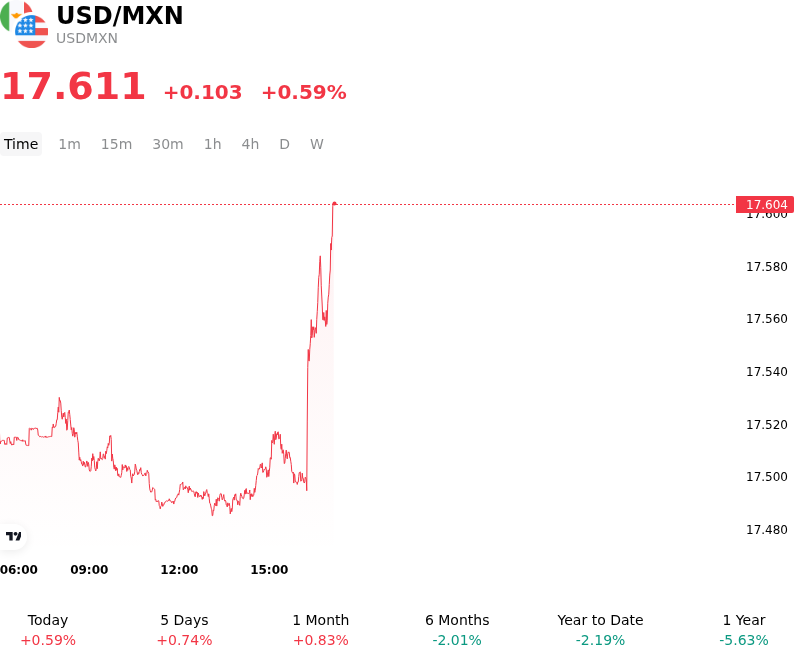
What is driving USD/MXN (USDMXN)’s stock price up today?
The advance of the USDMXN currency pair was primarily driven by a combination of recovering demand for the US dollar, shifting central bank policy expectations, and lingering trade-related uncertainties that weighed on the Mexican peso.
A key catalyst supporting the US dollar was the stabilization of US interest-rate expectations. Following a period of softer labor market data, the dollar found a firmer footing as resilient US services sector data continued to point toward a moderate economic expansion. This reduced the immediate pressure on the Federal Reserve to implement aggressive monetary easing, lending support to US Treasury yields and enhancing the relative appeal of the greenback.
In contrast, the macroeconomic backdrop in Mexico has fueled a more dovish outlook for the Bank of Mexico (Banxico). Recent domestic inflation data revealed that headline and core inflation have eased faster than anticipated, reaching multi-month lows. While Banxico recently held its benchmark rate steady at 6.50%, the cooling inflation path has reinforced expectations that the central bank may resume rate cuts to support sluggish domestic growth. This prospective narrowing of the interest-rate differential between the US and Mexico has started to erode the peso’s highly lucrative carry-trade appeal.
Trade-related and geopolitical uncertainties have also placed downward pressure on the peso. The recent review of the United States-Mexico-Canada Agreement (USMCA) on July 1 ended without an automatic extension, introducing a framework of annual reviews and raising concerns over future negotiations regarding automotive rules of origin and tariffs. Because of Mexico's heavy reliance on exports to the United States, this regulatory ambiguity has prompted investors to demand a higher risk premium on peso-denominated assets. Additionally, minor flare-ups in global risk aversion, linked to geopolitical tensions in the Middle East, further stimulated defensive flows into safe-haven assets, boosting the US dollar at the expense of emerging market currencies.
The upward move in USDMXN reflects a broader macro trend of the dollar recovering on resilient US economic fundamentals, while the peso remains constrained by domestic disinflation, potential monetary easing by Banxico, and ongoing trade-review negotiations.
Technical Analysis of USD/MXN (USDMXN)
Technically, USD/MXN (USDMXN) shows a MACD (12,26,9) value of 0.017, indicating a buy signal. The RSI at 59.639 suggests neutral condition and the Williams %R at 22.009 suggests buy condition. Please monitor closely.
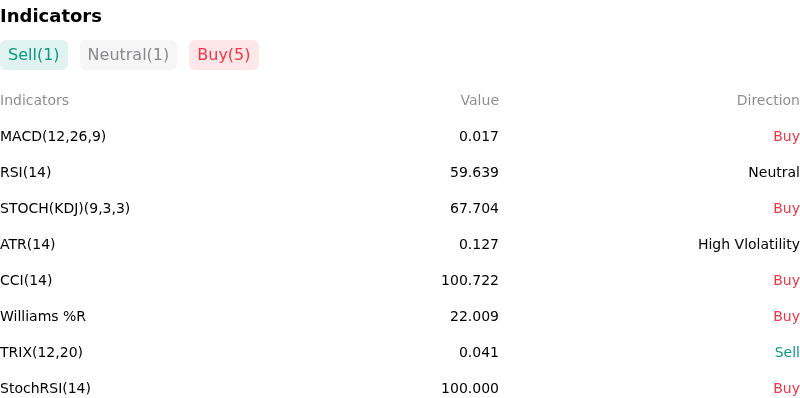
More details about USD/MXN (USDMXN)
Recent Events and Risks:
- Trade and USMCA Regulatory Friction: Following the U.S. decision on July 1 to shift the United States-Mexico-Canada Agreement (USMCA) into a process of periodic, annual reviews rather than a straightforward extension, the Mexican Peso is facing heightened regulatory and trade-policy risk. Uncertainty surrounding rules-of-origin disputes and automobile industry quotas continues to inject a volatile trade-risk premium into USD/MXN.
- Erosion of Carry Appeal via Dovish Banxico Pivot: While Banco de México (Banxico) recently paused its rate cuts to hold the benchmark interest rate at 6.50%, market participants are pricing in an eventual resumption of monetary easing. The combination of slowing domestic GDP, cooling core inflation, and weak gross investment is expected to force Banxico to lower rates, compressing the high-yield spread that has historically anchored MXN’s carry-trade advantage.
- Sluggish Domestic Growth Indicators: A series of weak economic indicators in Mexico—including a drop in vehicle exports and auto production for June—has prompted analysts to lower full-year GDP growth estimates to around 1.10% to 1.20%. This loss of export momentum leaves the highly liquid currency vulnerable to sharp, risk-off depreciation episodes.
- Resilient Fed Outlook and Geopolitical Risk Aversion: Downside pressure on MXN has been exacerbated by stabilizing U.S. interest rate expectations. Stronger-than-expected services sector data has diminished expectations for near-term Federal Reserve easing, while safe-haven demand stemming from Middle East geopolitical tensions continues to support a stronger U.S. dollar over emerging market assets.
This article may include AI-generated content that is human-reviewed, which is for reference and general information purposes only and does not constitute investment advice.
Recommended Articles







Comments (0)
Click the $ button, enter the symbol, and select to link a stock, ETF, or other ticker.