


SAP SE Stock (SAP) Moved Down by 3.02% on Jun 22: Key Drivers Unveiled



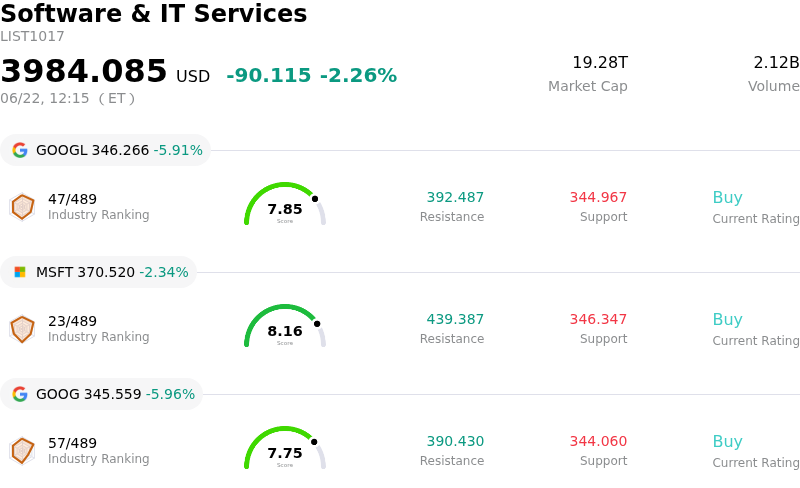
SAP SE (SAP) moved down by 3.02%. The Software & IT Services sector is down by 2.26%. The company underperformed the industry. Top 3 stocks by turnover in the sector: Alphabet Inc Class A (GOOGL) down 5.91%; Microsoft Corp (MSFT) down 2.34%; Alphabet Inc Class C (GOOG) down 5.96%.
What is driving SAP SE (SAP)’s stock price down today?
The recent downward pressure and significant intraday volatility in SAP's stock are driven by a combination of macroeconomic headwinds, escalating industry competition, and company-specific cost concerns. A primary catalyst is the shifting macroeconomic sentiment following the Federal Reserve's monetary policy meeting. The central bank's hawkish signaling and updated projections—indicating that a significant portion of policymakers anticipate potential rate hikes later in the year—caught market participants off guard. This unexpected policy stance has sparked a broader sell-off in high-multiple technology and growth stocks, as higher-for-longer interest rates lift the discount rates applied to value future enterprise cash flows.
In addition to broader macro pressures, sector-wide capital expenditure concerns are weighing heavily on investor sentiment. High-profile, aggressive capital expenditure forecasts from major enterprise software competitors have intensified fears of margin compression across the cloud and database industry. Investors worry that SAP will be forced to aggressively increase its own infrastructure spending to stay competitive in the generative artificial intelligence race. This dynamic has led to renewed scrutiny of software-sector profit margins, especially as companies scramble to scale their artificial intelligence capabilities.
These sector-wide worries are further amplified by recent analyst adjustments. Notably, investment analysts trimmed gross margin forecasts for SAP for the second half of the year, citing anticipated headwinds from rising hardware and component pricing alongside elevated cloud infrastructure costs. These factors could restrict the company's near-term profitability even as cloud and platform revenues continue to expand.
Operationally, despite SAP's continued push of its newly introduced Business AI Platform, structural and transition barriers are tempering market optimism. Many legacy enterprise customers remain on older, on-premise systems, facing high migration costs and stringent data sovereignty regulations that limit immediate, widespread cloud-AI adoption. Compounding these structural headwinds, reports highlighted critical cybersecurity vulnerabilities in SAP's system architectures, including high-severity flaws requiring immediate kernel-level patching. This has introduced additional operational risks and disrupted near-term investor confidence.
Technically, the downward move has pushed the stock below key short- and medium-term moving averages, reinforcing a bearish daily setup and prompting automated and institutional selling. The combination of monetary tightening fears, escalating industry-wide AI infrastructure costs, margin-trimming analyst revisions, and lingering integration friction has collectively fueled the stock's recent decline and heightened intraday trading volatility.
Technical Analysis of SAP SE (SAP)
Technically, SAP SE (SAP) shows a MACD (12,26,9) value of -5.735, indicating a sell signal. The RSI at 33.568 suggests neutral condition and the Williams %R at 97.409 suggests oversold condition. Please monitor closely.
Fundamental Analysis of SAP SE (SAP)
SAP SE (SAP) is in the Software & IT Services industry. Its latest annual revenue is $41.49B, ranking 14 in the industry. The net profit is $8.07B, ranking 13 in the industry. Company Profile
Over the past month, multiple analysts have rated the company as Buy, with an average price target of $271.49, a high of $367.98, and a low of $154.99.
More details about SAP SE (SAP)
Company Specific Risks:
- **AI Implementation Bottlenecks and Legacy Customer Exclusion:** While SAP heavily promotes its "Autonomous Enterprise" and Joule AI features, these capabilities are restricted to customers running current S/4HANA cloud releases. This architecture effectively excludes a vast segment of SAP's legacy ECC install base due to high transformation costs, data sovereignty concerns, and strict regulatory barriers, leading to sluggish near-term AI adoption and analyst target price cuts.
- **Erosion of Proprietary Data Lock-in via Antitrust Pressures:** SAP's lucrative "closed ecosystem" model is under severe regulatory and legal pressure following a mid-June 2026 data-access cease-fire with competitor Celonis. This agreement, combined with an ongoing federal antitrust lawsuit scheduled for trial in late 2026 and formal European Commission investigations, threatens to dismantle SAP's ability to restrict third-party integration and levy heavy indirect data extraction fees.
- **Gross Margin Compression and Hyper-Scale Capex Pressures:** Goldman Sachs recently downgraded SAP's gross margin forecast for the second half of 2026, citing elevated hardware and infrastructure costs. These margin worries are severely aggravated by rival Oracle’s massive $95 billion capital expenditure plans, triggering fears that SAP will be forced into a highly capital-intensive AI spending race to protect its market share.
- **Critical Security Exploits and Software Supply Chain Vulnerabilities:** SAP's June 2026 security patch cycle revealed critical vulnerabilities, including a CVSS 9.8 memory corruption flaw in SAP Kernel RFC protocols and SAML XML signature wrapping issues. These security loopholes, combined with ongoing threats from malicious packages in the software supply chain, expose SAP's core ERP environments to unauthorized access, identity impersonation, and severe operational disruptions.
This article may include AI-generated content that is human-reviewed, which is for reference and general information purposes only and does not constitute investment advice.
Recommended Articles







Comments (0)
Click the $ button, enter the symbol, and select to link a stock, ETF, or other ticker.