


NZD/USD Price Forecast: Cooling NZ inflation expectations push Kiwi under pressure



- NZD/USD trades lower against its major peers as NZ inflation expectations cool down.
- The RBNZ Q3 inflation expectations for the two-year timeframe cool down to 2.34% YoY from 2.53%.
- Soft US CPI data for July could dampen the US Dollar’s outlook.
The New Zealand Dollar (NZD) underperforms its major currency peers, trading 0.45% down at around 0.5830 against the US Dollar (USD) during the European trading session on Thursday. The antipodean faces sharp selling pressure as downwardly revised Reserve Bank of New Zealand (RBNZ) two-year inflation expectations in the third quarter this year have raised doubts over expectations of interest rate hikes.
Earlier in the day, RBNZ Q3 inflation expectations for the two-year timeframe arrived lower at 2.34% Year-on-Year (YoY) from prior projections of 2.53% released in the previous quarter this year.
Lower New Zealand (NZ) inflation expectations are expected to raise doubts over expectations of an interest rate hike by the RBNZ at the September policy meeting.
Earlier, financial markets were seen confident about the RBNZ raising policy rates in September.
RBNZ seen retaining hawkish bias despite mixed labour data
According to TD Securities, the latest labour market figures, while mixed, are unlikely to derail the Reserve Bank of New Zealand’s tightening bias. The bank argues that “despite the mixed report today, we believe the RBNZ has the room to hike again by 25bps in September given that economic activity continues to recover in Q3,” suggesting policymakers can look through near-term labour market noise as long as the broader recovery remains intact.
Meanwhile, the US Dollar (USD) holds onto Wednesday’s gains, driven by ongoing Middle East tensions.
On the domestic front, both the United States (US) headline and core Consumer Price Index (CPI) cooled down, as expected, in July, which could dampen the strength in the US Dollar.
NZD/USD Technical Analysis
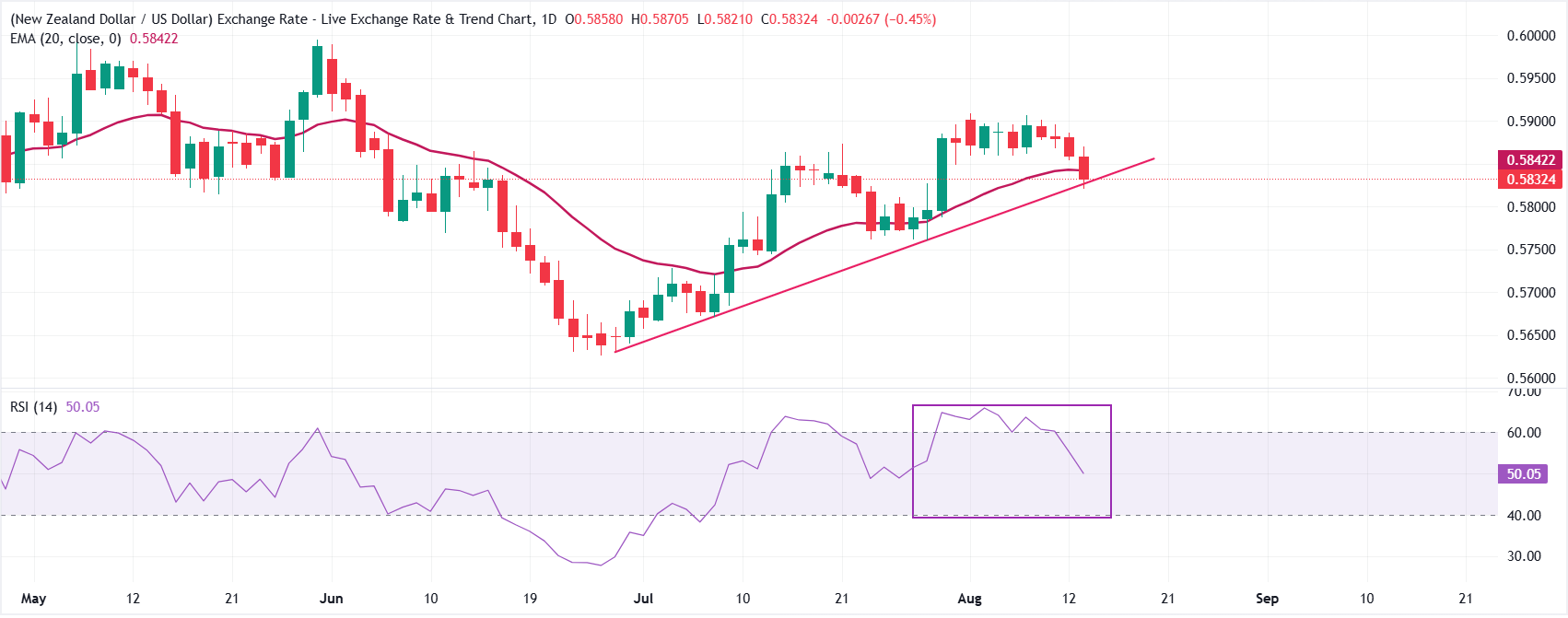
NZD/USD extends its correction to near the downward-sloping trend line at 0.5827 after slipping below the 20-period Exponential Moving Average (EMA), which is at 0.5842.
The Relative Strength Index (RSI) around 50.1 points to neutral momentum after the recent pullback from the 0.5890 area.
On the topside, the intraday high at 0.5870 is the immediate resistance, which needs to be broken decisively to revisit the August 7 high at 0.5907. On the downside, first support is seen at the upward-sloping trendline break level at 0.5827; a failure there would likely expose the pair to a deeper correction toward 0.5800, followed by the July 29 low at 0.5761.
(The technical analysis of this story was written with the help of an AI tool. Know more.)
RBNZ FAQs
The Reserve Bank of New Zealand (RBNZ) is the country’s central bank. Its economic objectives are achieving and maintaining price stability – achieved when inflation, measured by the Consumer Price Index (CPI), falls within the band of between 1% and 3% – and supporting maximum sustainable employment.
The Reserve Bank of New Zealand’s (RBNZ) Monetary Policy Committee (MPC) decides the appropriate level of the Official Cash Rate (OCR) according to its objectives. When inflation is above target, the bank will attempt to tame it by raising its key OCR, making it more expensive for households and businesses to borrow money and thus cooling the economy. Higher interest rates are generally positive for the New Zealand Dollar (NZD) as they lead to higher yields, making the country a more attractive place for investors. On the contrary, lower interest rates tend to weaken NZD.
Employment is important for the Reserve Bank of New Zealand (RBNZ) because a tight labor market can fuel inflation. The RBNZ’s goal of “maximum sustainable employment” is defined as the highest use of labor resources that can be sustained over time without creating an acceleration in inflation. “When employment is at its maximum sustainable level, there will be low and stable inflation. However, if employment is above the maximum sustainable level for too long, it will eventually cause prices to rise more and more quickly, requiring the MPC to raise interest rates to keep inflation under control,” the bank says.
In extreme situations, the Reserve Bank of New Zealand (RBNZ) can enact a monetary policy tool called Quantitative Easing. QE is the process by which the RBNZ prints local currency and uses it to buy assets – usually government or corporate bonds – from banks and other financial institutions with the aim to increase the domestic money supply and spur economic activity. QE usually results in a weaker New Zealand Dollar (NZD). QE is a last resort when simply lowering interest rates is unlikely to achieve the objectives of the central bank. The RBNZ used it during the Covid-19 pandemic.
Recommended Articles








Comments (0)
Click the $ button, enter the symbol, and select to link a stock, ETF, or other ticker.