


 할인


Justin Drake's 2028 goal leaves Ethereum two years for three hard forks



According to Ethereum Foundation researcher Justin Drake, developers have 24 months from Glamsterdam to implement three hard forks in order to complete the network’s transition to post-quantum and post-AI by December 2028.
Drake made these remarks during Devcon 8 in Mumbai on Tuesday.
The foundation’s official deadline is December 2029, so the goal is a year early.
“Our hope is that by December 2028 we’ll be able to wrap up the full post-quantum and post-AI transition,” Drake said at the start of the event.
The Ethereum Foundation keeps December 2029 as its official goal
The official date is derived from the foundation’s September 7 post on protocol priorities. According to the post, the Protocol cluster aims to make all of Ethereum’s execution, consensus, and data layers resistant to quantum computing by December 2029.
The Ethereum Foundation team promised that the December 2029 deadline is “non-negotiable at least until January 2027.” The team plans to recheck quantum progress with outside experts in January 2027.
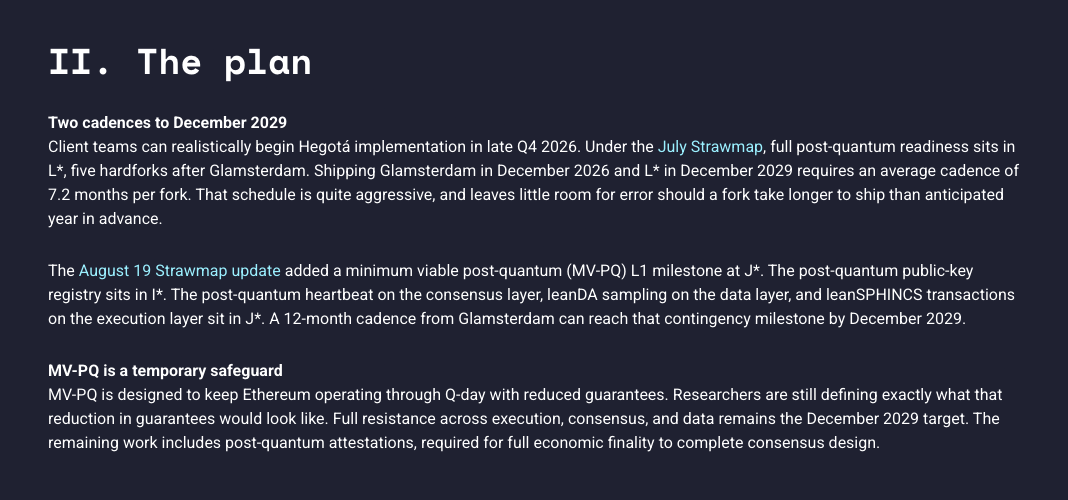
The schedule for 2029 was already described as “quite aggressive” in the September post. Full post-quantum readiness requires five hard forks after the Glamsterdam upgrade.
If Glamsterdam ships in December 2026 and the fifth fork arrives in December 2029, forks would need to come at an average rate of one every 7.2 months. Drake’s plan has three forks in 24 months, or one every eight months.
A minimum viable post-quantum milestone can be achieved by December 2029 using a 12-month fork cadence.
Hash-based signatures to replace today’s keys by 2028
In August, Drake said leanVM technology would be ready for real use in 2027. He said quantum-safe upgrades would then reach all three parts of the network in 2028.
The plan relies on hash-based signatures, which quantum computers are not expected to break. One of them, leanSPHINCS, would be used to sign transactions.
Currently, Ethereum uses BLS signatures for validators and ECDSA for user accounts. A very large quantum computer could break both of these elliptic-curve methods.
Validators also have a setting that instructs Ethereum where to send their staked ETH when they withdraw, and some of these settings still use BLS keys. EIP-8365 begins phasing them out now, before the entire quantum-safe design for validators is completed.
Ethereum co-founder Vitalik Buterin warned in October that progress in AI-driven math could weaken lattice cryptography, which is the primary candidate to replace today’s signatures. This could happen within two years, according to Buterin. He still advised crypto holders not to rush to transfer their money to new wallets.
After auditors discovered gas-accounting flaws in two of Glamsterdam’s proposals, its activation on the Hoodi testnet, scheduled for October 26, was postponed. This reduces the likelihood that the fork will occur on the mainnet in December.
Don’t just read crypto news. Understand it. Subscribe to our newsletter. It's free.
추천 기사




코멘트 (0)
$ 버튼을 클릭하고, 종목 코드를 입력한 후 주식, ETF 또는 기타 티커를 연결합니다.