


 Discount


Micron Shares Rebound After Hitting Lower Bound of Descending Channel as 26 Long-Term Agreements Poised to Support New Rally



AI Podcast


Micron Technology faces market sell-offs amid fears of slowing AI capital expenditures. However, multi-year take-or-pay agreements covering over 35% of cumulative revenue through 2030 mitigate downside cyclical risks through guaranteed volumes and price floors. HSBC highlights robust cloud provider spending on semiconductors and AI servers, supporting continued memory demand. While near-term earnings volatility depends on DRAM price resilience outside contractual protections, technical indicators show Micron finding support near its descending channel boundary, maintaining a neutral-to-positive moving average structure. Key downside risks include breaching support levels and persistent price weakness.

TradingKey - Memory stocks have recently faced a sell-off as investors worry that once AI capital expenditures slow, memory prices and profits at Micron Technology (MU) could decline as rapidly as in past cycles.
However, the market has underestimated a change in this cycle. Micron has signed 26 multi-year 'take-or-pay' agreements with customers, which are expected to cover more than 35% of cumulative revenue through 2030. Even if memory prices pull back, procurement volumes and minimum selling prices for certain orders are already contractually guaranteed.
HSBC noted that following the sell-off, the 12-month forward P/E ratio for the U.S. semiconductor sector has fallen to 9.8 times, contracting roughly 60% from June. However, looking at downstream spending, Bloomberg supply chain data cited by the bank shows that approximately 78% of major cloud providers' capital expenditures in 2027 are expected to flow into semiconductors and AI servers. For Micron, as long as customers continue deploying servers, model training and inference will drive memory procurement demand, leaving Micron's revenue relatively less dependent on the success of any single AI application.
What truly impacts the magnitude of Micron's earnings volatility is the price at which these purchases are executed. Under 'take-or-pay' terms, customers commit to purchasing agreed-upon volumes over multiple years and remain obligated to make payments even if they take fewer deliveries. Of the projected revenue corresponding to these 26 agreements, approximately three-quarters have explicit pricing mechanisms, most of which feature price caps and floors. When market prices fall, the price floor protects gross margins on certain orders; when prices surge, the cap also limits the room for price increases on the same batch of orders.
Therefore, the near-term indicator HSBC is watching most closely remains DRAM prices. The bank observed that memory industry earnings are still growing, albeit at a slower pace, while DRAM prices have remained resilient during the stock price decline. If subsequent price quotes continue to weaken, sales outside contractual protections will be the first to face pressure; if prices remain stable, market concerns over a rapid decline in Micron's earnings will be harder to validate.
From a technical perspective, Micron opened lower yesterday and dipped to $548.13, refreshing its previous interim low of $585.25, before finding support near the lower boundary of the descending channel and closing at $601.25. On the positive side, despite hitting a lower low intraday, the stock rebounded after its lower shadow touched near the channel's lower rail, still closing within the channel.
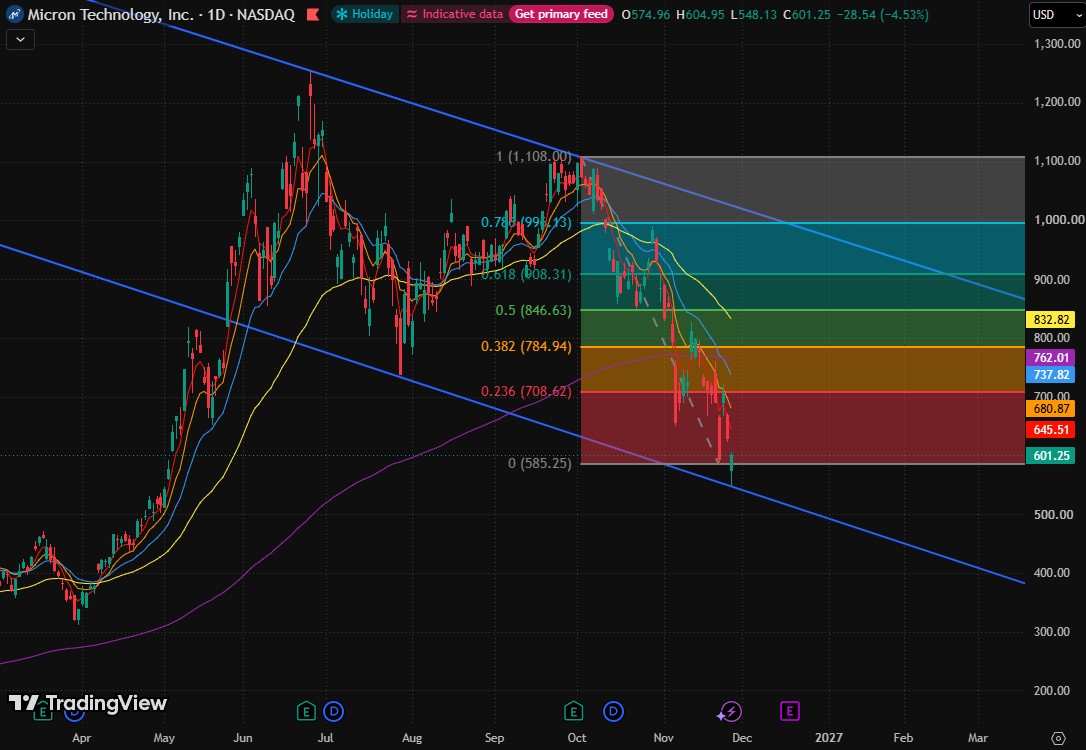
Micron stock chart, Source: TradingView
Regarding moving averages, the 50-day exponential moving average remains above the 200-day exponential moving average, and the five moving averages have not yet formed a full bearish alignment.
In terms of rebound room, if the stock holds above $585.25 on a pullback and subsequently fills the downside gap, the rebound is expected to further test the 5-day exponential moving average. The greatest risk is that the stock falls back below $585.25 and subsequently breaks below the new low and the lower boundary of the channel. Once the daily candle closes outside the channel and fails to reclaim it on a bounce, the downward trend could deepen.
This content was translated using AI and reviewed for clarity. It is for informational purposes only.
Recommended Articles












Comments (0)
Click the $ button, enter the symbol, and select to link a stock, ETF, or other ticker.