


 Discount


US Stocks Plunge Again, Nasdaq Drops Over 4% Intraday Nearing Last Week's Low: What Caused the Stock Market Drop?



AI Podcast


On November 25, Eastern Time, the Nasdaq Composite Index fell over 4% amid higher-than-expected core PCE inflation and new U.S. tariff proposals, while the VIX climbed above 30. Elevated interest rates and uncertain returns on AI computing investments are pressuring tech valuations and cloud service margins. Meanwhile, Federal Reserve divisions over tightening and looming fiscal deadlines, including a December government funding expiration, heighten near-term market volatility risks.
TradingKey - On November 25, Eastern Time, the Nasdaq Composite Index fell over 4% intraday, giving back most of Monday's gains and once again nearing last Friday's low. Wall Street's "fear gauge," the VIX, climbed back above 30.
Tech stocks face twin pressures in the near term. With higher-than-expected core inflation and new U.S. tariff proposals, the Federal Reserve has a stronger case to keep interest rates elevated. Meanwhile, investors are still assessing how much customers will be willing to pay for AI computing power in the coming years. If revenue growth fails to keep pace with data center construction and financing costs, high interest rates will simultaneously depress tech stock valuations and actual returns on AI projects.
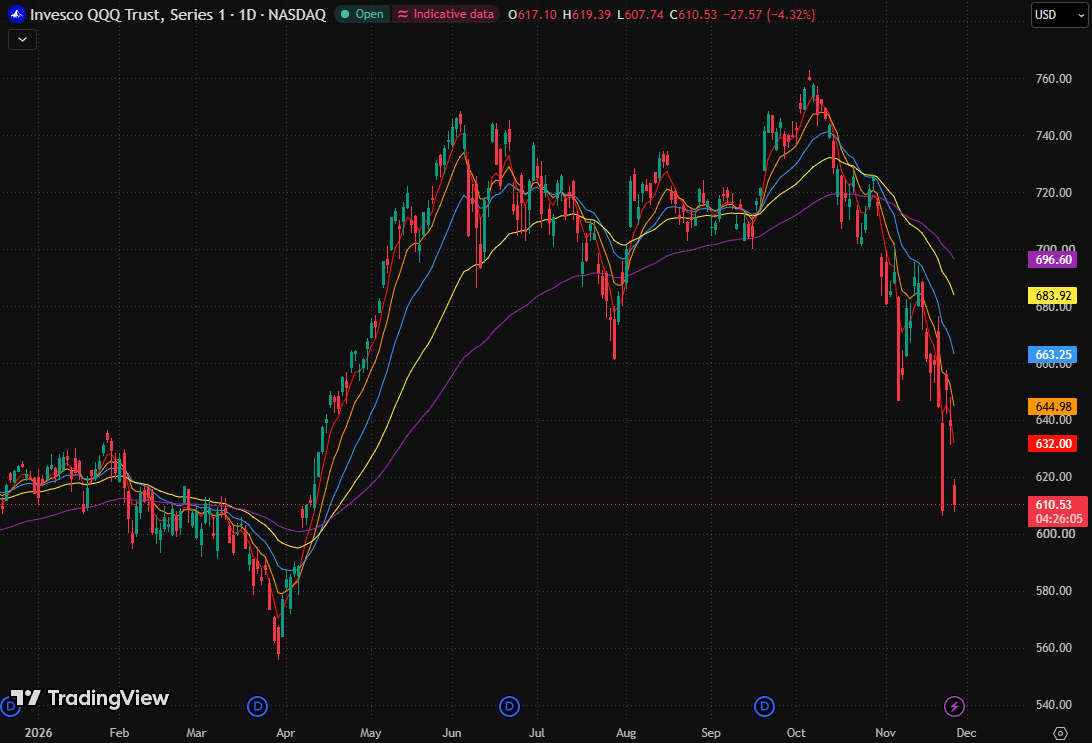
Nasdaq 100 Index, Source: TradingView
Core Inflation Tops Estimates as New Tariff Proposals Add Price Pressure
The US Personal Consumption Expenditures (PCE) price index rose 3.8% year-over-year in October. Excluding food and energy, core PCE rose 0.3% month-over-month and 3.3% year-over-year, coming in higher than the market expectation of 3.2%. On the same day, the US proposed tariff measures against 14 trading partners, including China, the European Union, and Japan. If importers pass the increased costs on to consumers, it may take longer for inflation to recede.
Divisions within the Federal Reserve centered on the timing and magnitude of tightening. Minutes from the October meeting showed that nearly all participants at the time expected a 25-basis-point interest rate hike would be needed in December, while some officials believed action should have been taken in October. Meanwhile, the minutes also noted uncertainty surrounding the outlook for AI investment. Federal Reserve Chair Kevin Warsh stated that the Fed is making contingency preparations for the varying outcomes AI development could bring to the economy and employment. Until inflation cools sustainably, it will be difficult for the market to establish stable easing expectations.
The bond market reacted cautiously to the prospect of rate hikes. In early Wednesday trading, the 2-year US Treasury yield retreated by about 6.5 basis points to 4.61%, likely reflecting rising safe-haven demand as well as investor concerns over a medium- to long-term economic slowdown. For the market to further bet on aggressive tightening, it may need to see clear policy signals reminiscent of the early 1980s—namely, that the Federal Reserve is willing to continue raising rates to curb inflation even in the face of slowing growth. The interest rate meeting on December 8-9 will be the first window to test this expectation.
AI Computing Investment Returns Yet to Be Proven, Financing Pressure May Spill Over to 2027 Chip Orders
For AI stocks, one view is that short-term policy shocks from the midterm elections have largely been priced into share prices, and what warrants closer attention next are computing power orders for 2027. If customer spending growth falls short of expectations, the returns cloud service providers generate from new computing capacity will decline. Should financing continue to tighten at this stage, some data centers may delay expansions, and chip and server makers that stocked inventory according to original production schedules will also face pressure from delayed orders and slower inventory digestion.
Beyond AI orders, there are two other dates following the December rate meeting that could affect short-term trading. On December 11, the U.S. federal government's stopgap funding expires, and whether Congress can extend it in time will affect the risk of a government shutdown. December 18 is "Triple Witching," when stock index futures, stock index options, and single-stock options expire simultaneously, and position unwinding and rollover trades could amplify volatility that day.
This content was translated using AI and reviewed for clarity. It is for informational purposes only.
Recommended Articles








Comments (0)
Click the $ button, enter the symbol, and select to link a stock, ETF, or other ticker.