


 Discount


Nvidia Rises Over 3% Pre-Market as Q3 Results and Guidance Both Beat Expectations, Wall Street Bullish on Growth but Wary of Multiple Risks



AI Podcast


Nvidia shares rallied following third-quarter results that surpassed estimates, driven by robust data center demand and strong fourth-quarter guidance projecting $130 billion in revenue. The rollout of the Vera Rubin platform and an authorized $227 billion share repurchase program further reinforced confidence in long-term AI growth and cash flow. However, analysts caution that geopolitical export controls affecting the Chinese market, massive AI infrastructure financing needs, supply chain capacity limits, and leadership transition uncertainties could drive near-term stock volatility despite strong operational fundamentals.
TradingKey - Nvidia (NVDA) rose more than 3% in U.S. premarket trading on Wednesday to $160.73, extending its gains following its earnings release.
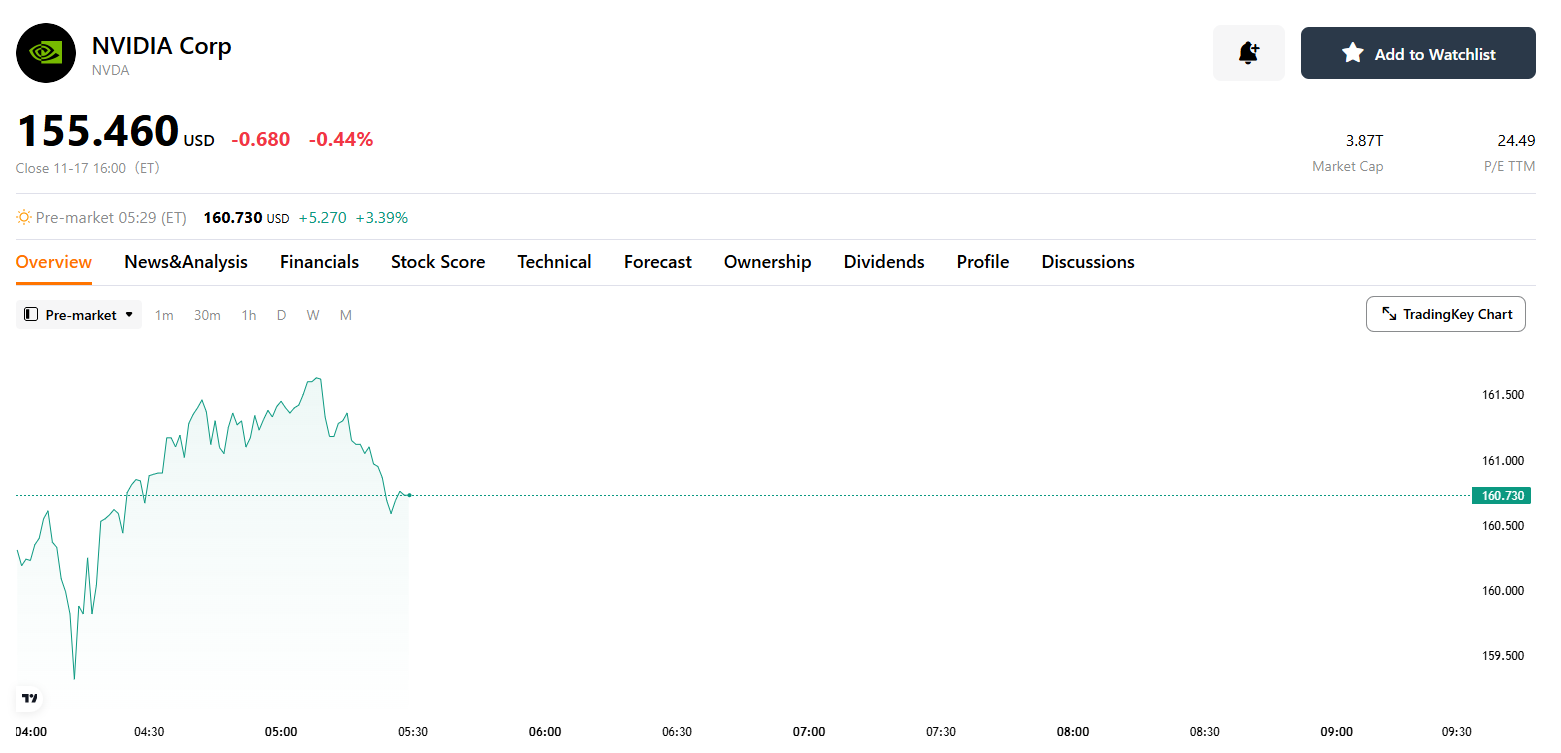
Source: TradingKay
The company's shares jumped more than 4% in after-hours trading on Tuesday, driving a broad rally across AI chip, data center, and cloud computing stocks. Better-than-expected quarterly results and fourth-quarter guidance that topped market forecasts served as the primary catalysts for the stock's strength.
Specifically, Nvidia's third-quarter revenue reached $115.8 billion, exceeding analysts' average estimate of $109.1 billion, while net income came in at $65.3 billion, also topping market expectations of $60.406 billion. Attracting even more market attention, the company remained optimistic about its growth outlook for the upcoming quarter, forecasting fourth-quarter revenue of $130 billion, above Wall Street's prior average estimate of $125.25 billion. Revenue from its data center business more than doubled year-over-year, further underscoring that big tech companies' demand for AI computing power remains robust.
In addition to beating expectations across the board for the current quarter, Nvidia's fourth-quarter guidance also bolstered market confidence. The company expects next-quarter revenue of approximately $130 billion, plus or minus 3%, notably higher than Wall Street's average estimate of $125.25 billion. Management also projects an adjusted gross margin of approximately 72% for the fourth quarter, indicating that its high-end AI accelerators and networking products continue to command strong pricing power.
On product progress, the next-generation Vera Rubin platform has begun shipping to customers and has entered the data centers of several major cloud computing and AI infrastructure operators. The steadily expanding deployment scale indicates that cloud service providers' investments in training and inference computing power have not cooled noticeably, while also partly easing earlier market concerns that the AI capital expenditure cycle had peaked.
However, analysts at JPMorgan (JPM) pointed out that although several of the company's metrics beat expectations this quarter and its revenue outlook was further raised, management still failed to adequately address several key questions on the earnings call, including the absence of revenue from China, the scale of financing needed for AI infrastructure buildouts, supply chain expansion capabilities, and how the company will complete the CEO handover following Jensen Huang's departure. These factors may continue to influence investors' judgment regarding the certainty of Nvidia's future growth, meaning the stock could still see significant volatility in the near term.
Among these, uncertainty in the Chinese market is particularly noteworthy. U.S. restrictions on exports of advanced AI chips continue to affect Nvidia's business layout in China, and the company's current guidance has not yet factored in potential revenue from the Chinese market. This means that even if AI demand remains strong, Nvidia's actual room for future growth could still be impacted by shifts in geopolitical policies and export controls.
Meanwhile, the capital investments required for AI infrastructure buildouts have also become a focal point for analysts. As cloud giants continue to expand the scale of their data centers, massive capital expenditures are needed across areas such as GPU procurement, power supply, cooling systems, and networking equipment. Although Nvidia benefits from this, its financing partnerships with certain AI cloud service providers have also led the market to scrutinize debt levels and funding sustainability across the broader ecosystem. In addition, whether the chip supply chain can expand capacity in a timely manner to meet growing order demand is another realistic challenge the company must confront.
Despite these risks, some Wall Street institutions still evaluated Nvidia's earnings performance positively.
Goldman Sachs (GS) analysts believe that the strong earnings report and management's remarks on future business will help bolster investor confidence in Nvidia's operational health and the growth prospects of the broader AI value chain. The firm also specifically noted that the company reaffirmed its commitment to shareholder returns and authorized up to $227 billion in share repurchases through the end of 2027, demonstrating management's continued confidence in future cash flow and profitability.
Morgan Stanley (MS) analyst Joseph Moore noted that while Nvidia's current strong business performance is not surprising in itself, what is truly commendable is that management provided a relatively positive outlook for future growth on the call. Rather than simply delivering a beat-and-raise report, the company's willingness to further clarify its forward-looking business prospects better helps the market evaluate the sustainability of the AI investment cycle.
This content was translated using AI and reviewed for clarity. It is for informational purposes only.
Recommended Articles









Comments (0)
Click the $ button, enter the symbol, and select to link a stock, ETF, or other ticker.