


Nasdaq Drops 0.74% to Near Seven-Month Intraday Low, Dow Falls Over 800 Points as Chip Stocks Sell Off



AI Podcast


On Eastern Time November 17, U.S. stocks closed lower as investors trimmed semiconductor holdings ahead of Nvidia’s earnings and an NSA network outage spurred infrastructure stability concerns. The Dow fell 1.64%, the S&P 500 declined 1.03%, and the Nasdaq dropped 0.74%. Corporate highlights included former Nvidia CEO Jensen Huang expressing willingness to return if invited, OpenAI launching GPT-6.2 Astra and Sol with price cuts, and Microsoft debuting low-cost enterprise AI models. Meanwhile, Fed officials offered divergent monetary policy views, with John Williams stressing the need to curb inflation and Alberto Musalem signaling potential rate hikes.

TradingKey - U.S. stocks moved lower on Tuesday, November 17, Eastern Time. Investors trimmed semiconductor stocks ahead of Nvidia's earnings report, and the Nasdaq Composite Index touched a roughly seven-month low intraday. News of an internal network outage at the National Security Agency (NSA) also added to market concerns over the stability of critical technology infrastructure.
At the close, the Dow Jones Industrial Average fell 1.64% to 50,759.42 points; the Nasdaq Composite Index fell 0.74% to 24,328.38 points; and the S&P 500 Index declined 1.03% to 7,340.53 points.
Tech Stock Performance
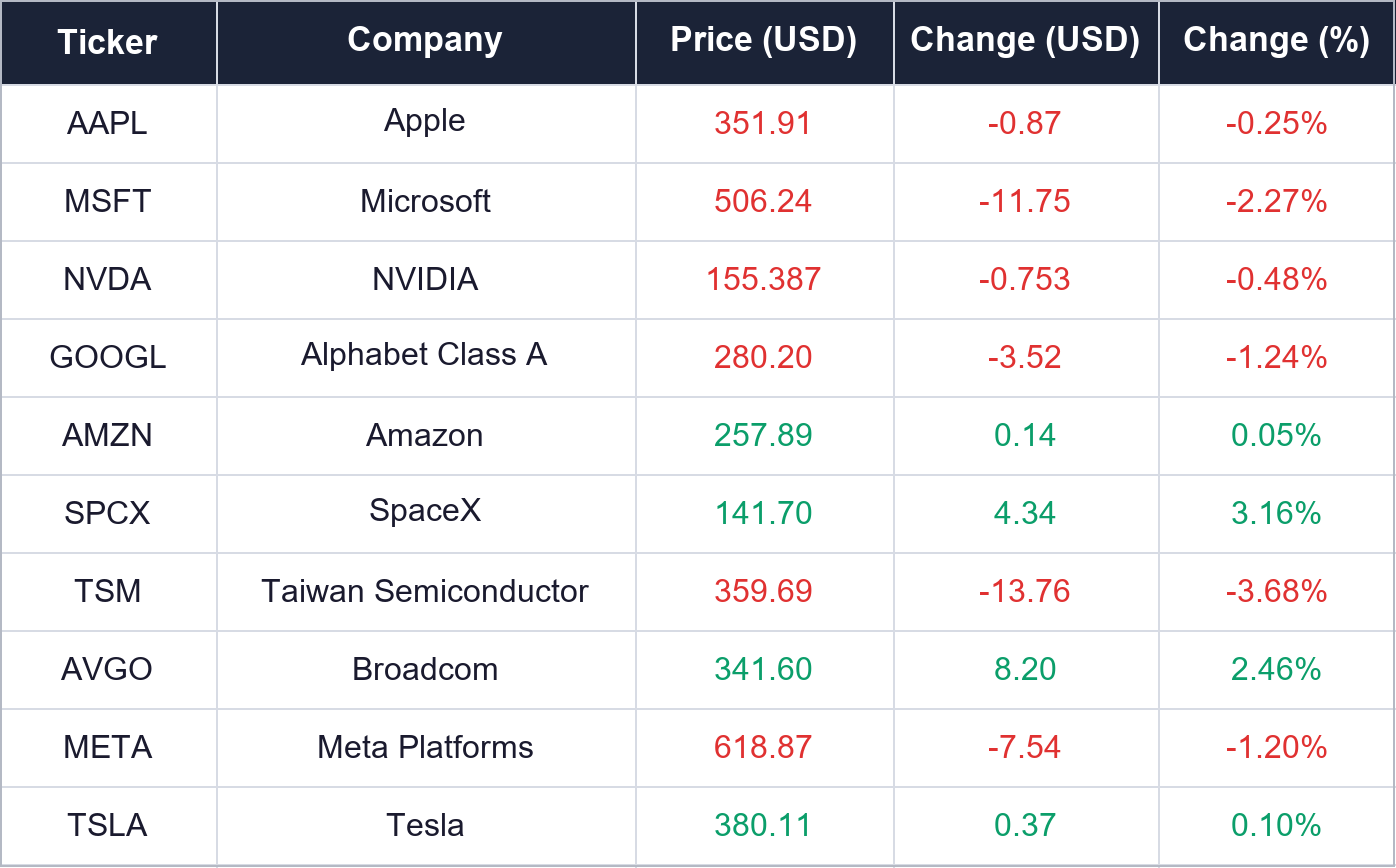
The performance of mega-cap tech stocks today is shown in the chart below:
The Philadelphia Semiconductor Index rose 0.34% to 9,642.88 points. Among its 30 constituents, 19 advanced and 11 declined. Among them, Arm Holdings (ARM) rose 4.76%; ASML (ASML) fell 1.68%, Micron Technology (MU) fell 0.92%, and Intel (INTC) fell 0.54%.
Company News
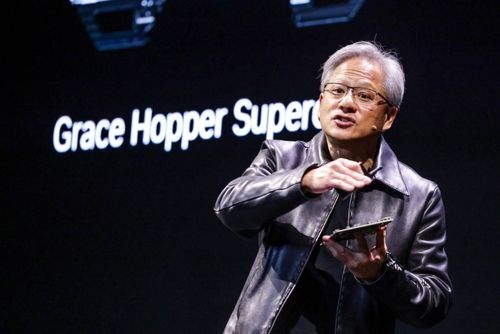
Jensen Huang speaks publicly for the first time since resignation, says he is willing to return to Nvidia if invited by the board
Former Nvidia CEO Jensen Huang said in a statement on Tuesday that he has received numerous calls to return from employees, investors, business partners, and customers since stepping down. If the board determines that his return is in the best interests of shareholders, employees, the company, and the United States, he is willing to return as CEO. Huang acknowledged that his conduct fell short of the company's expectations for employees and pledged to cooperate with the board's independent investigation. Earlier, The Washington Post reported on Monday, citing people familiar with the matter, that the board was not considering reinstating him at the time.
OpenAI releases GPT-6.2 Astra and Sol, cutting Astra standard API input and output prices by 20%
OpenAI launched two models on Tuesday. GPT-6.2 Astra is designed for complex professional tasks, with a focus on improving performance in documents, presentations, spreadsheets, coding, and scientific research. According to disclosures from the company, Astra scored 5.2 points higher than GPT-6 Astra on evaluations of multi-step professional tasks, while the cost per single task is less than one-third that of its predecessor. GPT-6.2 Sol focuses on everyday office tasks and multi-step workflows.
Priced per million tokens, Astra's standard API input, cached input, and output rates are $8, $0.40, and $40, respectively, representing a 20% cut for input and output and a 60% cut for cached input compared with the previous generation. Sol maintains its predecessor's pricing, with the three rates at $2, $0.10, and $10, respectively. Both models are now available to eligible ChatGPT Work and Codex users, alongside API access.
Microsoft launches multiple in-house AI models at Ignite, highlighting low-cost coding
Microsoft (MSFT) introduced new models spanning coding, cybersecurity, imaging, and voice. Based on four enterprise coding benchmarks released by Microsoft, MAI Code 2 delivers approximately 98% of GPT-6.1 Sol's performance at roughly 40% of the price; compared with Claude Opus 5.5, its performance reaches about 96% at roughly 5% of the price. Microsoft also stated that MAI Image 2.7 ranked first on Artificial Analysis's image-editing leaderboard.
Mustafa Suleyman, head of Microsoft AI, told Axios that the company is also developing in-house general-purpose AI models. Microsoft will license certain model weights to enterprise customers, allowing them to customize models using their own data and deploy them on Azure.
SpaceX's roughly $40 billion AI chip financing: Some securities reportedly could be offered as soon as this week
According to Bloomberg, citing people familiar with the matter, in SpaceX's roughly $40 billion financing to procure AI chips, some asset-backed securities could be offered as early as this week, with Goldman Sachs and Apollo Global Management slated to act as underwriters. Under the structure disclosed in the report, a special purpose entity managed by Apollo-backed Atlas SP will purchase Nvidia chips and issue asset-backed securities. SpaceX previously announced that it had reached a binding finance lease commitment with an Apollo-managed entity.
Industry & Macro News
NSA Internal Network Experiences Outage, Agency Says Critical Operations Remain Functional
According to CNN, citing people familiar with the matter, the U.S. National Security Agency's network used for internal classified communications experienced an outage on Tuesday, with no evidence at the time indicating the incident was caused by a cyberattack. The NSA later stated that some internal systems were temporarily affected during planned routine maintenance, but functions required to execute critical missions remained operational.
Williams Says Inflation Still Needs to Be Curbed, Musalem Sees Multiple Rate Hikes Likely Needed by Next Spring
New York Fed President John Williams said on Tuesday that the U.S. economy and labor market remain resilient, yet inflation continues to run above target, with signs that tariffs and energy shocks are transmitting into broader prices. He believes the Fed still needs to take action to bring inflation back to 2%, but aggressive adjustments are unnecessary at this stage, as financial conditions continue to support economic growth.
St. Louis Fed President Alberto Musalem, however, argued that current interest rates have not yet effectively curbed inflation and the Fed may need to raise rates multiple times before the spring of 2027. He stated that acting early while inflation expectations remain relatively anchored is more likely to restore price stability without harming employment and economic growth.
This content was translated using AI and reviewed for clarity. It is for informational purposes only.
Recommended Articles






Comments (0)
Click the $ button, enter the symbol, and select to link a stock, ETF, or other ticker.