


Oracle Shares Drop Over 7%: September CPI Beats Expectations to Raise Rate Hike Odds, AI Infrastructure Financing Amplifies Rate Shock



AI Podcast


On October 14 Eastern Time, Oracle’s stock plummeted over 7% following hotter-than-expected September U.S. inflation data, which elevated Federal Reserve rate-hike expectations. This macroeconomic shift significantly increases Oracle's financing costs as it pursues massive debt-funded investments in AI infrastructure, notably for its capital-intensive Project Jupiter. Furthermore, regulatory delays threatening Project Jupiter's energy supply amplify fundamental concerns regarding cash flow, capital payback periods, and return on investment. The compounding effects of rising interest rates and project execution risks have heightened valuation pressure and credit risk scrutiny for the company.
TradingKey - U.S. inflation data heated up again, driving markets to reprice the Federal Reserve's rate path, and Oracle (ORCL)'s stock came under pressure as a result. On October 14 Eastern Time, Oracle's stock dropped over 7% intraday.
From pre-market trading, the stock plunged sharply after the U.S. Bureau of Labor Statistics released September's Consumer Price Index (CPI) data at 8:30 a.m. ET, coinciding almost exactly with the release of the inflation data.
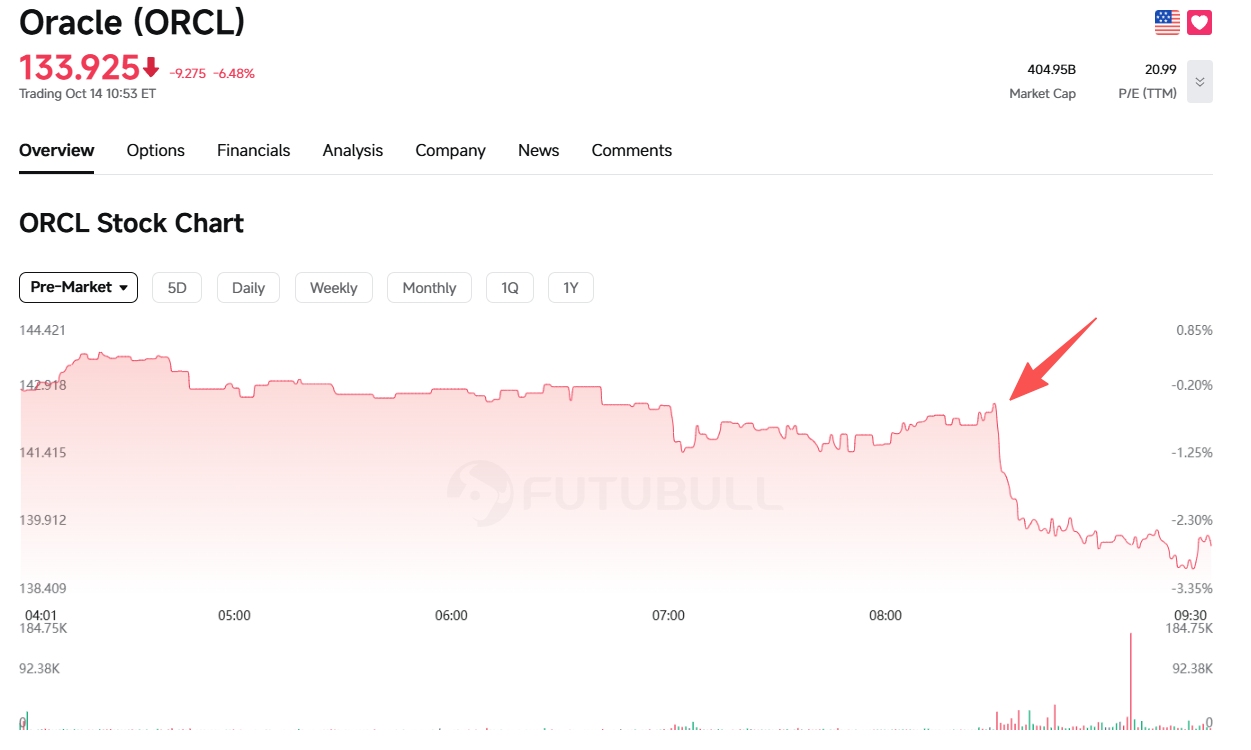
Oracle pre-market stock chart, source: FUTUBULL
Hot Inflation Data Drives Up Rate Hike Expectations
According to data released by the U.S. Bureau of Labor Statistics, the U.S. core CPI rose 2.6% year-over-year in September, higher than the market expectation of 2.5%, and gained 0.3% month-over-month; headline CPI rose 3.7% year-over-year and 0.6% month-over-month.
Following the data release, interest rate futures markets indicated that the implied probability of a 25-basis-point rate hike by the Federal Reserve at its October meeting rose to about 45%, up from approximately 22% previously.
For tech stocks, the market is pricing in not just a single rate hike, but the possibility of rates staying higher for longer. Rising rate expectations increase the discount rate for future cash flows, making high-valuation growth companies with a larger proportion of long-dated profits more vulnerable to shocks.
Oracle’s Financing Needs Amplify Interest Rate Impact
Shifting interest rate expectations have exerted greater pressure on Oracle due to the company's ongoing expansion of artificial intelligence infrastructure investments.
Public reports show that Oracle raised approximately $43 billion in debt and $5 billion in equity financing in fiscal year 2026, and is expected to need roughly another $40 billion to support subsequent expansion plans. While this large-scale financing funded the expansion of its AI cloud business, it also heightened the company's sensitivity to changes in interest rates and credit markets.
When the market expects interest rates to continue rising, interest costs on new debt, refinancing costs on existing debt, and capital costs for data center projects are all likely to increase. Rising financing costs first compress free cash flow and subsequently raise the rate of return required by investors, thereby driving down the valuation multiples the market is willing to assign to future growth.
If revenue growth from the AI business fails to quickly cover new debt and capital expenditures, investors may reassess the company's credit risk, return on capital, and cash flow position.
Project Jupiter Becomes Focal Point of Fundamental Concerns
According to Bloomberg, Oracle has once again urged federal regulators to quickly approve a natural gas pipeline to meet the power demands of its large-scale data center project in New Mexico. Oracle noted that if the commission continues to delay approval of the pipeline project, which is operated by a subsidiary of Energy Transfer LP, it will threaten the operational timeline of Project Jupiter.
Project Jupiter is massive in scale, with high upfront construction, energy supply, and financing requirements. As a result, the market remains focused on the project's progress, commissioning timeline, and customer delivery schedule.
For data center projects of this nature, revenues usually take a considerable amount of time to offset upfront construction and equipment investments. If the project faces delays or cost overruns, the capital payback period could be extended further—an impact that becomes even more pronounced in a high interest rate environment.
Therefore, concerns surrounding Project Jupiter have created a compounding effect with rate-hike expectations: the former increases market skepticism regarding Oracle's return on capital and cash flow, while the latter elevates financing costs and valuation pressure.
This content was translated using AI and reviewed for clarity. It is for informational purposes only.
Recommended Articles










Comments (0)
Click the $ button, enter the symbol, and select to link a stock, ETF, or other ticker.