


Tesla Stock Price Prediction: Cybercab Faces Regulatory Inquiry, Will Waymo's Accelerated Expansion Drag Down TSLA?



AI Podcast


Tesla’s Robotaxi venture faces mounting pressures as competitor Waymo accelerates its global expansion, targeting Tokyo by 2027 and managing 500,000 weekly rides. Concurrently, Tesla’s Cybercab confronts regulatory scrutiny from the NHTSA regarding compliance for its steering-wheel-free design. Technically, Tesla stock closed at $358.08, exhibiting short-term consolidation near converging moving averages. Resistance is established between $363.83 and $365, while initial downside support rests at $351–$352. A decisive breakout above $384.87 is required to target $400, whereas failure to hold key support levels risks further retracement toward $340 and below.

TradingKey - Tesla's (TSLA) Robotaxi business has recently faced a new stress test.
On one hand, Waymo continues to expand its driverless taxi network and has announced plans to enter the Tokyo market in 2027. On the other hand, just as Tesla's Cybercab commercialization gets off the ground, it faces further scrutiny from the National Highway Traffic Safety Administration (NHTSA).
Ross Gerber, CEO of Gerber Kawasaki, recently posted photos on social media stating he discovered a facility in Santa Monica housing a large number of new Waymo vehicles, concluding that Waymo is preparing for a new round of expansion. At the same time, he criticized Tesla for failing to apply in advance for regulatory exemptions from requirements such as traditional braking systems, which could slow down the Cybercab rollout.
Waymo Accelerates Expansion as Tokyo Market Becomes New Battleground
The parking lot photos published by Gerber do not in themselves prove that Waymo has officially entered the mass production phase, but judging from Waymo's recent business moves, its pace of expansion is indeed accelerating.
Latest data show that its service now covers about 15 US cities, completing approximately 500,000 paid rides per week with a fleet of over 4,000 vehicles, and aiming to reach 1 million rides per week by the end of the year.
Waymo also plans to partner with Japanese ride-hailing platform GO and Nihon Kotsu to launch a fully driverless taxi service in Tokyo in 2027. The project will start with small-scale operations and gradually expand to around 100 vehicles after obtaining regulatory approvals and completing safety verification.
Waymo currently operates commercial Robotaxi services across multiple US cities and continues to expand its operational scope. The company recently further entered the Las Vegas market while announcing a partnership with Japanese taxi platform GO and Nihon Kotsu to launch a fully driverless commercial taxi service in Tokyo in 2027.
In contrast, Tesla's Robotaxi remains in its early expansion stage. According to autonomous vehicle registration data from Texas, as of September 11, Waymo had 988 autonomous vehicles registered in Texas, compared with Tesla's 420 vehicles, which include the Cybercab.
What Regulatory Issues Does Cybercab Face?
The Cybercab differs significantly from traditional vehicles. This two-seater Robotaxi has no steering wheel, traditional pedals, or traditional rearview mirrors, and its design goal is to allow the vehicle to complete all driving tasks without a driver. Tesla hopes to rely on cameras and artificial intelligence systems to reduce hardware costs, ultimately achieving large-scale deployment of Robotaxis through lower vehicle costs.
However, this design also means the Cybercab must face more complex regulatory issues.
The NHTSA has required Tesla to provide further clarification regarding the Cybercab's certification process and requested that the company answer relevant questions by September 30. Regulators are focusing on whether the Cybercab used temporary manual driving control equipment during the certification process, and how the vehicle meets existing Federal Motor Vehicle Safety Standards.
Since the Cybercab eliminates traditional driving controls such as the steering wheel and brake pedal, whether it complies with current safety regulations has become a core focus of regulatory review. The NHTSA is also inquiring about issues such as touchscreen controls, braking, turn signals, rear visibility, and vehicle stability control.
However, this does not mean that the NHTSA has determined the Cybercab to be non-compliant. A more accurate statement at present is that regulators are reviewing Tesla's self-certification process and whether the Cybercab complies with relevant safety requirements.
Tesla Stock Technical Analysis
Source: TradingView
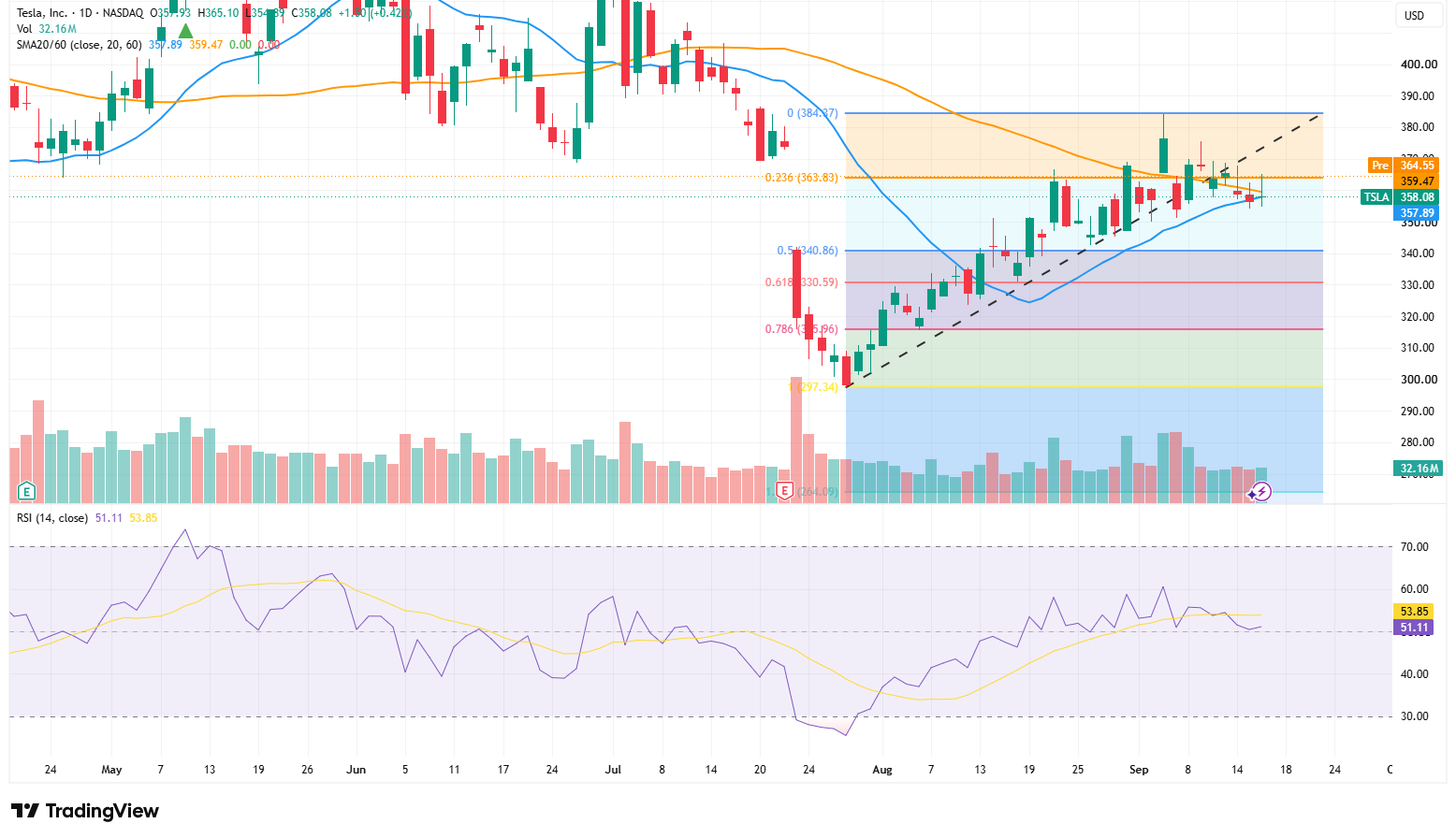
Tesla last closed at $358.08, pulling back after touching an intraday high of $365.10, which indicates noticeable selling pressure in the $363.83–$365 range. The stock price currently sits near its 20-day moving average of $357.89 while remaining slightly below its 60-day moving average of $359.47. With the two moving averages nearly converging, short-term forces between bulls and bears appear relatively balanced, with no clear trend established for now.
The $363.83 level is the immediate resistance to break. If Tesla can close above $365 on heavy volume, the stock price may further test $375 and its previous high of $384.87; only a breakout above $384.87 would open up further upside toward around $400.
In terms of momentum, the 14-day RSI stands at 51.11, slightly above the neutral 50 mark but below its signal line at 53.85, indicating that upward momentum is weakening. However, as the RSI has not yet fallen into weak territory, the current price action resembles high-level consolidation rather than a confirmed new leg down.
On the downside, initial focus is on $351–$352, which corresponds to the 0.382 Fibonacci retracement level and the lower boundary of recent consolidation. If regulatory and competition concerns push the stock below $351 on heavy volume, the next support will shift down to $340.86. If $340 is also lost, the pullback could extend further to $330.59 and $315.96. Meanwhile, $297.34 serves as a key medium-term line of defense for the current rally that should not be easily breached.
This content was translated using AI and reviewed for clarity. It is for informational purposes only.
Recommended Articles






Comments (0)
Click the $ button, enter the symbol, and select to link a stock, ETF, or other ticker.