


Salesforce (CRM) Stock Analysis: After a Blowout Earnings Beat and the Claudeforce Deal, Is CRM Back?



For most of 2026, Salesforce (CRM) was the stock Wall Street had given up on. While the rest of the Dow climbed on the AI trade, Salesforce fell as much as 45% from its highs, at one point trading as the index's single worst performer. The reason wasn't a broken business; it was a broken narrative. Investors had decided that agentic AI, the very technology Salesforce was betting its future on, would end up cannibalizing the seat-based subscription model that built the company.
That narrative took a direct hit on August 26, when Salesforce reported second-quarter fiscal 2027 results that beat across the board, raised full-year guidance, and unveiled a sweeping new partnership with Anthropic called Claudeforce, all on the same day. Shares jumped roughly 21% in the session that followed, and the stock has continued to climb since, closing near $258 on September 1, not far off its 52-week high of $269.11 and well above its 52-week low of $146.32.
So is the turnaround real, or is this a one-quarter relief rally in a stock that still has to prove its AI products can carry the business? Here's what the numbers, the Claudeforce deal, and Wall Street's reaction say.
The Bear Case Salesforce Had to Answer
The pessimism around Salesforce wasn't irrational. As enterprises began experimenting with AI agents that can complete tasks autonomously, the fear was straightforward: if a single AI agent can do the work of several licensed seats, why would a company keep paying for all of them? Salesforce's entire revenue base is built on per-seat subscription pricing, and for a stretch of 2025 and 2026, that fear showed up directly in the stock.
Salesforce spent time as the Dow's worst-performing component, with some estimates putting the drawdown near 45% from its peak. Deceleration in core subscription growth in prior quarters gave the bears more ammunition, and skepticism about whether Agentforce, the company's flagship AI agent platform, could monetize fast enough to offset any seat erosion became the dominant question hanging over the stock.
Marc Benioff pushed back hard on this framing throughout the year, arguing that agentic AI would expand Salesforce's addressable market rather than shrink it, turning a seat-based business into a consumption-based one, where usage, not headcount, drives revenue. Q2 was the first quarter where the data mostly agreed with him.
Salesforce Earnings Beat Expectations as Agentforce and Data 360 ARR Surges Over 210%
Salesforce's fiscal Q2 2027 results, covering the quarter ended July 31, 2026, were a clean beat-and-raise:
- Total revenue came in at $11.3 billion, up 11% year-over-year.
- Subscription and support revenue: the core of the business, grew 12% year-over-year (11% in constant currency) to $10.8 billion.
- Current remaining performance obligation (cRPO): a forward-looking measure of contracted, unrecognized revenue - rose 14% year-over-year to $33.5 billion, signaling accelerating bookings rather than a business in decline.
- Profitability expanded sharply: non-GAAP operating margin hit 34.1%, GAAP diluted EPS rose 119% year-over-year to $4.29, and non-GAAP diluted EPS climbed 103% to $5.90.
- Cash generation surged: operating cash flow rose 71% year-over-year to $1.3 billion, with free cash flow up 81% to $1.1 billion.
Management didn't just beat the quarter; it raised full-year revenue guidance to $46.1–$46.4 billion (11–12% growth), while holding its non-GAAP operating margin guidance steady at 34.3%. Part of that revenue guidance bump includes roughly $200 million in expected revenue from the pending acquisitions of Contentful and Fin, both set to close in Q3.
But the number that mattered most to the AI-cannibalization debate was this: combined Agentforce and Data 360 annual recurring revenue reached nearly $3.9 billion, up more than 210% year-over-year. Agentforce ARR alone topped $1.5 billion, up over 240%. Salesforce also disclosed that customers had run 7.0 billion "Agentic Work Units" cumulatively, with 3.2 billion of those completed in Q2 alone, 97% quarter-over-quarter growth. Data 360, the company's data foundation product, ingested 104 trillion records in the quarter, up 355% year-over-year.
Overall, for a bear thesis built on the idea that AI adoption would show up as revenue pressure, a tripling-plus of AI-linked ARR in a single quarter is a difficult data point to explain away.
Claudeforce: The Same-Day AI Announcement That Added Fuel
Salesforce didn't stop at earnings. On the same day, it announced Claudeforce, an expanded strategic partnership with Anthropic that goes well beyond a typical model-licensing deal. The partnership runs in both directions: "Claude in Salesforce" makes Anthropic's Claude the reasoning engine inside Agentforce, including availability through Amazon Bedrock within Salesforce's Trust Boundary for regulated industries. "Salesforce in Claude" is essentially a new plugin, launching with 37 prebuilt sales skills, that lets sellers pull revenue data and automate pipeline tasks directly from within Claude. Claude is also becoming the default AI model across Slack.
Salesforce disclosed one striking internal data point to back up the deal's practical value: Slackbot has already generated 8.1 million annualized productivity hours for Salesforce's own employees, more than double the prior quarter. CEO Marc Benioff described the partnership as delivering "a dynamic interface that thinks, reasons, and acts," while Anthropic CEO Dario Amodei framed it as letting companies "point Claude at the customer information and business context they've been building in Salesforce for decades." Select pilots are live now, with a broader open beta expected in September.
The timing wasn't a coincidence; pairing the earnings beat with a headline AI partnership gave investors two separate reasons to re-rate the stock in the same 24-hour window, rather than one.
Wall Street's Reaction, and What Could Still Go Wrong
The market's response was immediate and, so far, durable. Beyond the initial 21% pop, multiple analysts raised price targets in the days that followed, with both TD Cowen and Argus lifting their targets to $300. JPMorgan, already bullish on the stock heading into the print, followed up by lifting its price target to $265 from $250. As of early September, the analyst consensus across 55 covering analysts sits at a "Buy" rating with an average price target near $268, modest upside from current levels, though the spread between the Street's low ($160) and high ($475) targets shows just how unresolved the AI-monetization debate still is beneath the surface.
Still, one strong quarter doesn't retire a thesis this deep-rooted. Agentforce and Data 360 revenue, while growing fast, is still a small fraction of Salesforce's roughly $46 billion annual revenue base. The core subscription business still has to hold up as AI usage scales. Investors will also want to see whether the acceleration in cRPO and Agentic Work Units continues into Q3 and Q4, rather than proving to be a single standout quarter. And the Claudeforce partnership, while strategically significant, is still in pilot and early beta. Its financial contribution won't show up in reported numbers for at least another quarter or two.
CRM Stock Technical Analysis: Can the Bullish Trend Continue?
来源:TradingView
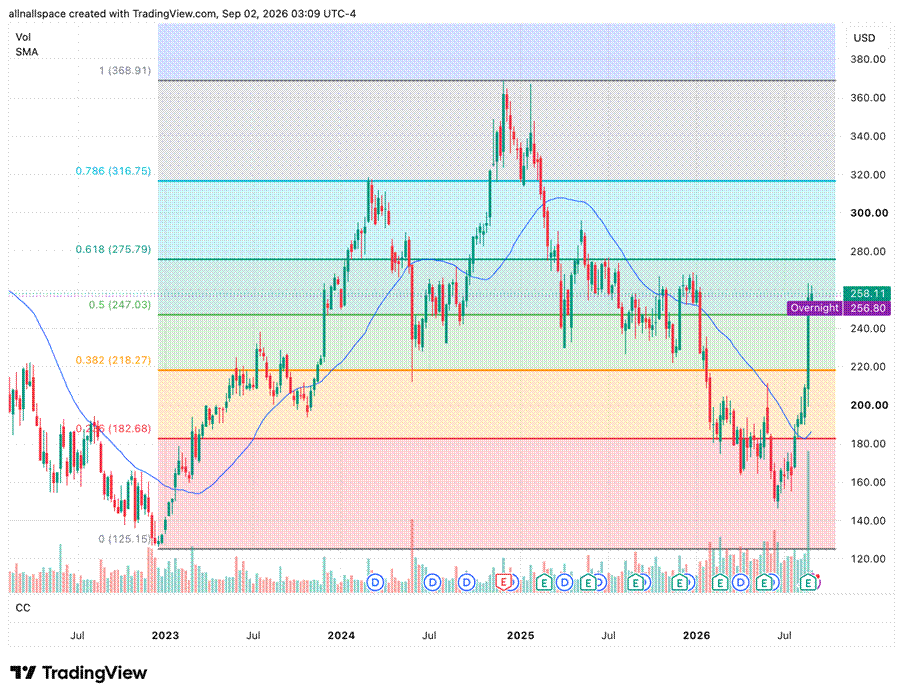
On the weekly chart, CRM has reclaimed the 0.5 Fibonacci retracement level near $247, drawn from the stock's 2025 high of $368.91 down to its 2022 low of $125.15, and is now trading just above it around $258. The stock is also back above its 30-week simple moving average, a sign the medium-term trend has turned constructive after months of being capped below it.
Looking ahead, if CRM can hold above the $247 level and keep climbing, the next resistance sits at the 0.618 retracement near $276, followed by the 0.786 level around $317, both above the stock's current 52-week high. A break above $317 would put the 2025 high near $369 back in play. On the downside, the $247 level (0.5) is the first support to watch; a close back below it would put the 0.382 retracement near $218 in focus, with the 0.236 level around $183 as a deeper line of defense if the recent rally fails to hold.
The Bottom Line
Salesforce didn't just beat a quarter; it directly attacked the reason its stock had been left for dead. Accelerating bookings, an AI product line growing at triple-digit rates, and a headline partnership with one of the most credible names in AI reasoning gave the market three separate reasons to reconsider the bear case in one day. The stock has already priced in a meaningful amount of that shift, trading close to its 52-week high with a Street consensus that sees only modest further upside from here. Whether CRM is "back" for good likely comes down to one thing: proving in the next two or three quarters that Agentforce and Data 360 keep compounding at anything close to this pace, rather than fading as the comparison base gets tougher.
This article is for informational purposes only and does not constitute investment advice. All figures are sourced from Salesforce's official Q2 FY2027 earnings release and subsequent company and analyst commentary as of early September 2026.
Recommended Articles







Comments (0)
Click the $ button, enter the symbol, and select to link a stock, ETF, or other ticker.