


Meta Stock Outlook: Named Top Pick by Morgan Stanley, Will the Stock Recover?



AI Podcast


Meta Platforms shares have declined significantly amid market concerns over the monetization of its heavy AI investments and ongoing losses from Reality Labs. Unlike cloud-based peers with direct enterprise revenue streams, Meta’s AI returns are reflected indirectly through advertising, pressuring short-term cash flow and profit margins. Despite soaring capital expenditures, Morgan Stanley named Meta a top pick, projecting 27% ad revenue growth in 2026. Technically, the stock remains in a downtrend below key moving averages, lacking reversal signals while hovering near support levels, though an oversold bounce remains possible if crucial thresholds are reclaimed.

TradingKey - Meta Platforms (META) shares have experienced a volatile decline since hitting a record high ($793) in August 2025. As of August 18 Eastern Time, based on a stock price of around $550, the drop during this period reached as much as roughly 30%.
By contrast, the Nasdaq 100 Index gained about 24% over the same period. Against the backdrop of the ongoing AI boom reshaping tech stock valuations, Meta bucked the trend with a notable decline, creating a stark divergence between its share price performance and the broader mega-cap tech sector. The main reason for this divergence is not that the market doubts Meta's AI capabilities, but rather that it questions the monetization ability of its AI business model.
Unlike Google (GOOGL), Amazon (AMZN), and Microsoft (MSFT), which can directly sell computing power to enterprise clients through cloud computing businesses, Meta's current AI investments primarily serve its own social platforms, advertising systems, AI assistants, and open-source models. The benefits brought by AI are mostly reflected in increased user engagement time, improved ad-matching efficiency, and potential new product opportunities, yet in the short term, it is difficult to break them out in financial reports as a clear, quantifiable revenue stream.
Whether Meta can gradually transform from a social media platform reliant on advertising monetization into a tech company boasting AI products, computing infrastructure, and diversified monetization channels will determine whether its stock price can reverse its weakness and regain market recognition.
Meta's AI Investments Have No Clear Path to Monetization
Behind the falling stock price lies market concern over whether Meta's AI investments can translate into quantifiable revenue and profits.
According to financial data released by Meta, the company continuously raised its capital expenditure guidance for 2026, with full-year capex expected to reach $130 billion to $145 billion, significantly higher than $72.2 billion in 2025. Meanwhile, second-quarter capital expenditure reached $31.1 billion, while free cash flow dropped from $8.55 billion in the same period last year to just $784 million, net profit fell about 14% year-over-year, and total costs and expenses rose 55% year-over-year.
This means that Meta's AI strategy is noticeably squeezing short-term cash flow and profit margins, while whether the advertising business can rapidly absorb these investments through more precise recommendations, ad ranking, and generative AI tools still lacks sufficient clear financial data support.
More importantly, Meta's AI monetization path remains at a stage where 'investment precedes return.' The company can use AI to increase user time spent, ad conversion rates, and platform engagement, but these benefits must ultimately be reflected indirectly through advertising revenue, rather than directly in the form of cloud computing revenue, customer orders, and contract backlogs like AWS, Google Cloud, or Microsoft Azure.
For investors, this return model offers lower visibility, making it harder to determine how much incremental revenue each dollar of AI infrastructure investment actually yields. As long as capital expenditures continue to rise without synchronized improvements in ad revenue growth, free cash flow, and profit margins, the market may continue to compress Meta's valuation multiples.
In addition, Reality Labs remains a long-term drag on Meta's valuation. The unit's cumulative operating losses have exceeded $80 billion since 2020, with Q2 2026 operating losses still surpassing $4.6 billion, yet the related hardware and metaverse businesses have not generated revenue matching the scale of investment. In other words, while Meta must absorb ongoing losses from Reality Labs, it is simultaneously pouring massive funds into AI infrastructure, data centers, chips, and talent, leading the market to question the efficiency of the company's capital utilization.
Simply put, the core reason behind the continued drop in Meta's stock price is that investors have shifted from solely focusing on user base size and ad growth to examining AI return on investment, free cash flow, and capital allocation efficiency. Until clear improvements emerge in these metrics, Meta will find it difficult to command the same AI valuation premium as cloud providers.
Morgan Stanley Names Meta a Top Pick, Sees 2026 Ad Revenue Growing About 27%
However, Morgan Stanley named Meta its Top Pick among hyperscalers in its latest research report, setting a price target of $775, which implies an upside of approximately 40% from current levels.
Morgan Stanley expects Meta's 2026 advertising revenue to grow by around 27%, believing that AI investments will continue to drive Reels engagement and ad monetization. Meanwhile, the company is also exploring how to further monetize its vast data center capacity. However, the risk that data center capital expenditures fail to generate sufficient returns is also listed as a major downside risk for Meta.
The firm believes that since computing power remains a scarce resource, cheaper models are expected to expand AI adoption and inference demand. Consequently, hyperscalers possessing GPUs, proprietary chips, and complete cloud service ecosystems may still achieve healthy returns on capital.
Morgan Stanley pointed out that lower-priced open-weight models have begun exerting pricing pressure across the entire model layer, with multiple U.S. model labs introducing cheaper products. In this environment, relying solely on leading model capabilities is no longer enough to ensure strong investment returns; model providers must simultaneously increase token throughput, expand user adoption, build ecosystems, and attract enterprise, developer, and SMB clients through differentiated features.
Morgan Stanley's core logic is that for a data center of the same scale, if each GPU can generate more tokens per second, the revenue generated per gigawatt of computing power can still remain at a high level even if the price per token decreases.
Morgan Stanley believes that a model price war will not necessarily hurt cloud giants. The firm stated that even as open-weight models gain widespread adoption, the unit economics of hyperscalers will remain attractive.
Meta Platforms Technical Analysis: No Trend Reversal Signal Yet
Meta's stock price continues to trade below its downtrend line, having currently broken below the 0.236 Fibonacci retracement level ($562.63) as well as the 5-day, 10-day, 20-day, 40-day, and 80-day moving averages, with short-term bears remaining in control. The current price is near the previous low area, presenting the possibility of an oversold bounce, though no clear trend reversal signal has emerged yet.
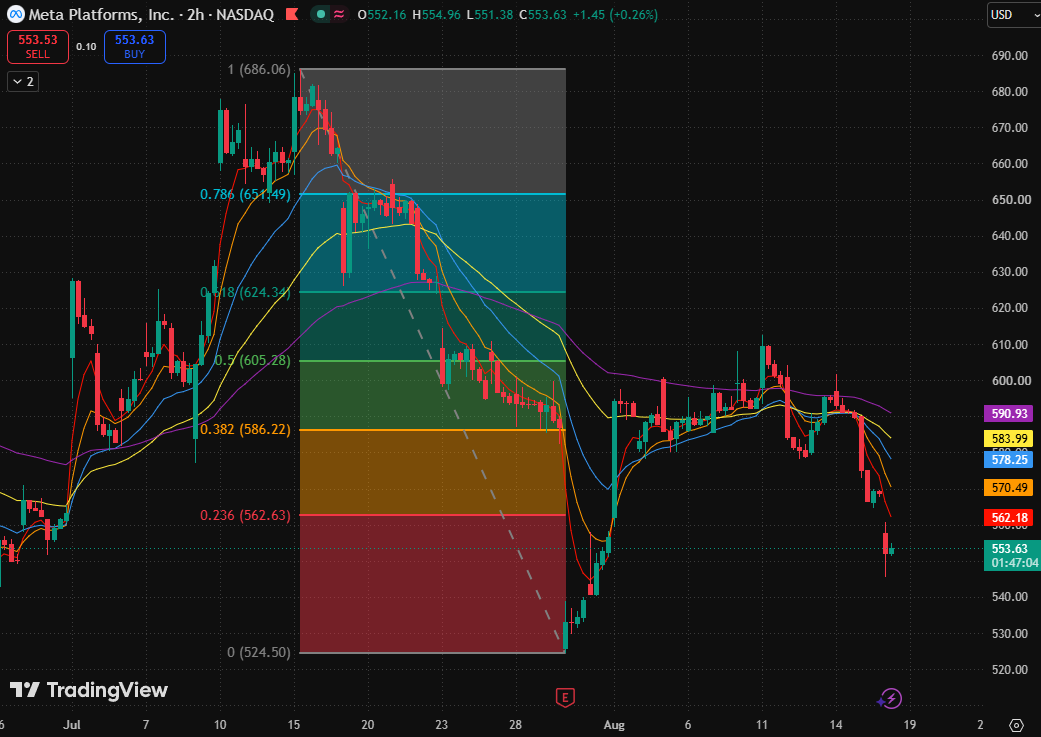
Meta 2-hour candlestick chart, Source: TradingView
Meta's stock price was previously repeatedly capped near the 0.5 Fibonacci retracement level ($605.28) before falling below the 0.382 Fibonacci retracement level ($586.22) and the 0.236 Fibonacci retracement level ($562.63), signaling that the rebound structure has weakened.
Only if the stock price reclaims $562.63 and further moves above the dense moving average cluster can a technical recovery be expected; otherwise, caution is needed regarding a potential retreat toward the previous low area.
To the downside, the primary support level to monitor is the $545 area near recent lows. If that level fails to hold, the next level to watch is the 0 Fibonacci retracement level ($524.50), which serves as critical bottom support for this retracement structure.
To the upside, a rebound would first require reclaiming the 0.236 Fibonacci retracement level ($562.63), with subsequent focus on the 0.382 Fibonacci retracement level ($586.22) and the 0.5 Fibonacci retracement level ($605.28). Before reclaiming the 0.382 Fibonacci retracement level ($586.22), the rebound is more likely to represent a weak consolidation rather than a trend reversal.
This content was translated using AI and reviewed for clarity. It is for informational purposes only.
Recommended Articles









Comments (0)
Click the $ button, enter the symbol, and select to link a stock, ETF, or other ticker.