


Moderna Surges Over 100% Pre-Market as Phase 3 Cancer Vaccine Trial With Merck Succeeds



AI Podcast


Moderna and Merck announced positive Phase 3 results for their jointly developed personalized mRNA cancer vaccine in high-risk melanoma patients, marking a historic milestone for mRNA technology in oncology. Combining the vaccine with Keytruda significantly delayed cancer recurrence compared to Keytruda alone, meeting the trial's primary objective. This success validates a crucial new growth driver for Moderna amid declining COVID-19 vaccine sales, boosting its stock and market expectations. The partners plan to present complete trial data at a future medical conference and discuss regulatory submissions globally, bringing personalized cancer immunotherapy closer to commercialization.

TradingKey - Moderna (MRNA) and Merck (MRK) announced on Wednesday that a personalized mRNA cancer vaccine jointly developed by the two companies achieved positive results in a large Phase 3 clinical trial. This marks the first time a personalized mRNA cancer vaccine has succeeded in a large Phase 3 clinical trial. Previously, the most widely known application of mRNA technology was COVID-19 vaccines, and the latest results mean that the technology has taken another major step closer to commercialization in cancer treatment. Driven by the news, Moderna shares surged over 100% in U.S. pre-market trading, while Merck shares also moved higher.
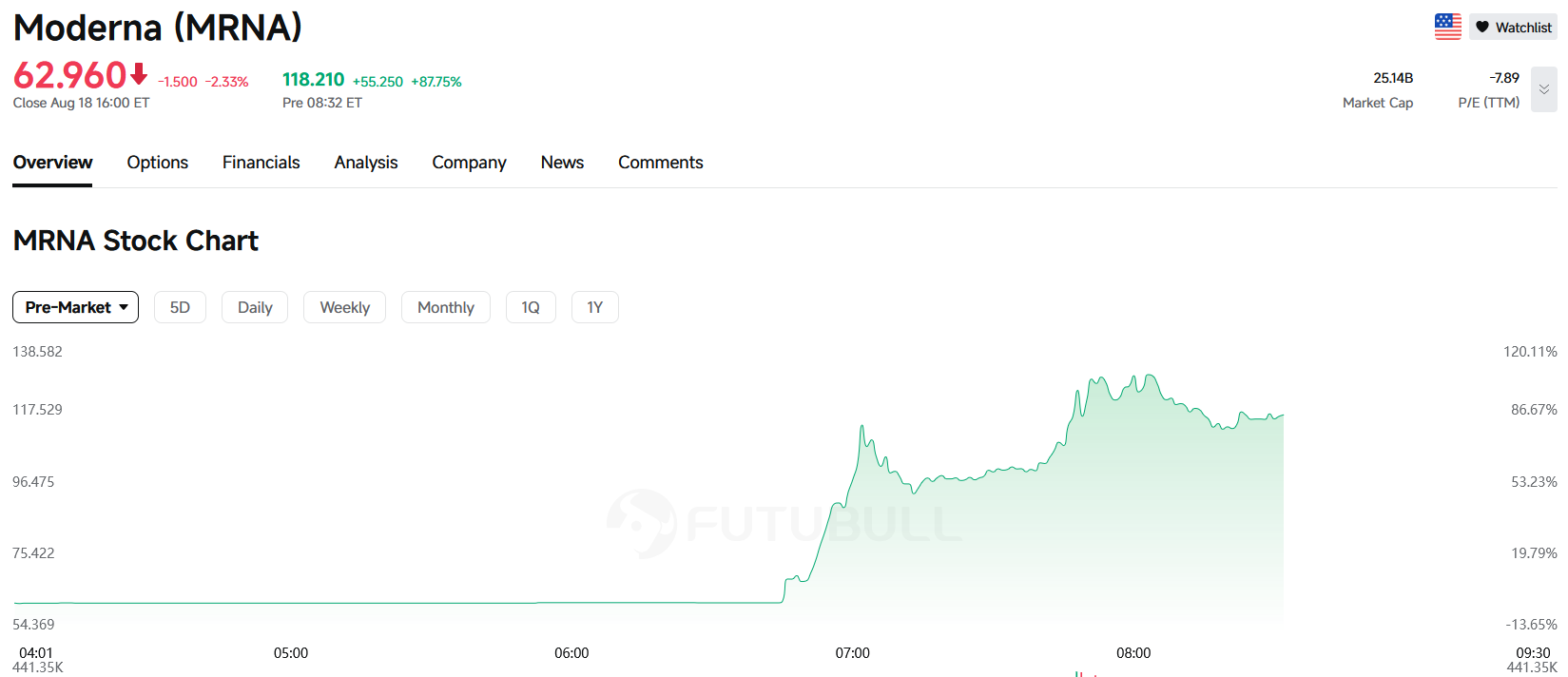
MRNA stock chart, Source: FUTUBULL
The trial targeted high-risk melanoma patients who had undergone surgery, with a total of 1,137 participants. Results showed that adding Moderna's personalized cancer vaccine significantly delayed cancer recurrence compared to using Merck's cancer drug Keytruda alone, meeting the trial's primary objective. The two companies have not yet released the full Phase 3 data, and detailed results will be disclosed at a future medical conference.
The key feature of this vaccine is that it can be "tailor-made" for individual patients. Doctors first analyze the characteristics of a patient's tumor and then use mRNA technology to create a vaccine targeted to that patient, helping the body's immune system recognize and attack cancer cells more accurately. Long-term follow-up results from the previous Phase 2 trial showed that combining the two therapies reduced the risk of cancer recurrence or death by approximately 49% compared with Keytruda alone.
For Moderna, as COVID-19 vaccine sales fell sharply, the company's revenue and stock price have been under sustained pressure in recent years, leading the market to look for its next blockbuster product to succeed the COVID-19 vaccine. The cancer vaccine is viewed as one of Moderna's most important new growth drivers, and the Phase 3 trial success markedly improved investor expectations for the company's future product pipeline, sending its stock soaring by over 100% in pre-market trading at one point.
Moving forward, Moderna and Merck plan to present complete trial results and discuss regulatory submissions with global regulatory authorities. If ultimately approved, the product could serve not only as a major new source of revenue for Moderna, but also as one of the world's first personalized mRNA cancer vaccines to enter large-scale clinical application.
This content was translated using AI and reviewed for clarity. It is for informational purposes only.
Recommended Articles









Comments (0)
Click the $ button, enter the symbol, and select to link a stock, ETF, or other ticker.