


Raytheon Secures $22.9 Billion US Navy 'Tomahawk' Missile Contract, Bolstering Long-Term Orders and Defense Business



AI Podcast


The U.S. Navy has awarded Raytheon, a subsidiary of RTX, a $22.9 billion Tomahawk missile contract to accelerate inventory replenishment and expand production capacity. This long-term agreement significantly boosts RTX's defense backlog—which reached $119 billion out of a total $289 billion—and reinforces its multi-year revenue visibility. Driven by robust global defense demand, RTX has raised its 2026 financial forecasts. While execution risks remain in converting massive orders into revenue, this contract underscores sustained high-level defense spending and strengthens the medium-term growth certainty of RTX's core missile business.
TradingKey - The U.S. Navy recently announced a procurement contract worth approximately $22.9 billion with Raytheon, a business of RTX (RTX), for Tomahawk cruise missiles, aimed at accelerating the replenishment of critical munitions and expanding missile production capacity. This large-scale, long-term contract will support Raytheon in adding staff, expanding production lines, and strengthening its supply chain to boost the future delivery speed of Tomahawk missiles.
This contract comes as the U.S. accelerates the replenishment of its missile inventories. In recent years, the Russia-Ukraine conflict and military operations in the Middle East have continuously depleted U.S. stocks of precision-guided weapons, prompting the U.S. government to demand that major defense contractors increase production. As one of the U.S. Navy's key long-range precision strike weapons, the expanding procurement scale for Tomahawks indicates that related production demand is likely to remain high for years to come.
For RTX, the most direct impact of this contract is further enhancing long-term revenue and backlog visibility. As of the end of the second quarter this year, RTX's total order backlog reached approximately $289 billion, up 22% year-over-year, with defense backlog accounting for about $119 billion. By comparison, $22.9 billion represents nearly one-fifth of its existing defense backlog. As the contract value is gradually converted into formal orders, it will further solidify Raytheon's revenue base for years to come.
Raytheon has already become one of RTX's faster-growing businesses. In the second quarter, Raytheon's sales grew 18% year-over-year to $8.27 billion, driven mainly by demand for missiles such as Patriot, Standard Missile, and AMRAAM. Strong defense demand also prompted RTX to raise its 2026 adjusted sales forecast from $92.5 billion–$93.5 billion to $95 billion–$96 billion, and its adjusted earnings per share forecast from $6.70–$6.90 to $7.10–$7.25.
More importantly, the contract further confirms that the U.S. military is shifting from short-term stockpile replenishment to long-term capacity expansion. RTX had previously been pushing forward with production expansion for key weapons including Tomahawk, AMRAAM, SM-3, and SM-6. Therefore, the $22.9 billion contract not only increases backlog scale, but also provides more certain demand support for the company to invest in new equipment, expand facilities, and stabilize its supply chain.
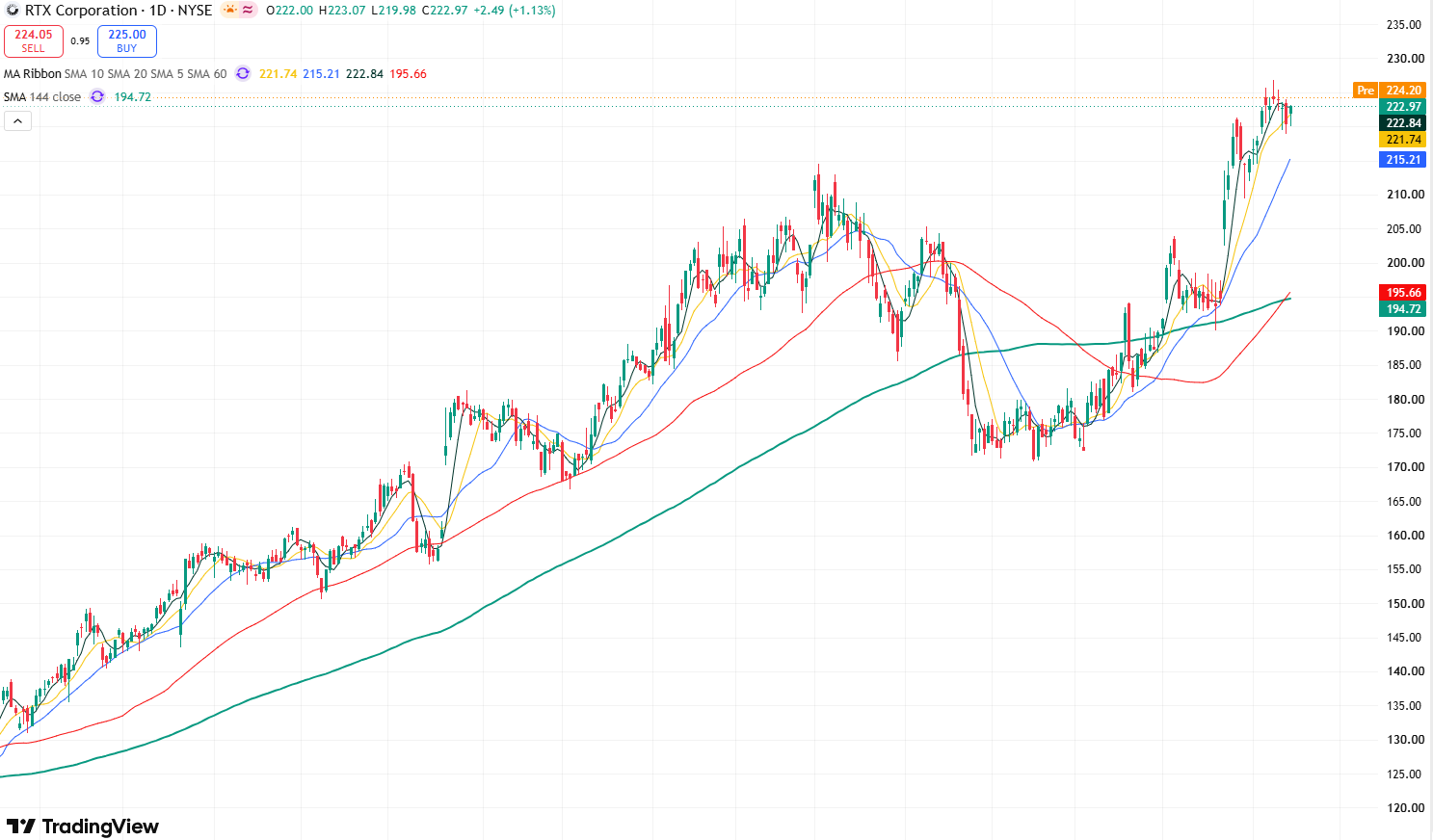
RTX daily stock price chart, Source: TradingView
For RTX's stock price, the market focus will center on whether the massive orders can be smoothly converted into revenue and profit. RTX is currently benefiting from both the commercial aviation recovery and global defense spending growth, while Raytheon's defense business is becoming a major source of upward earnings guidance revisions. JPMorgan previously estimated that about two-thirds of RTX's latest annual profit guidance increase came from the Raytheon business. If missile capacity expansion for Tomahawks and other systems proceeds smoothly, the growth certainty of RTX's defense business over the next few years is expected to strengthen further.
This content was translated using AI and reviewed for clarity. It is for informational purposes only.
Recommended Articles












Comments (0)
Click the $ button, enter the symbol, and select to link a stock, ETF, or other ticker.