


Amazon: From Everything Store to Global Infrastructure Platform



AI Podcast


In Q2 2026, Amazon reported robust financial growth, driven primarily by its high-margin services. AWS achieved accelerated revenue growth, supported by expanding enterprise AI demand and custom Trainium chips, though heavy AI infrastructure investments temporarily turned free cash flow negative. Simultaneously, Amazon’s retail profit structure improved through increased third-party Marketplace transactions and high-margin advertising revenue. Key risks include uncertain returns on AI capital expenditures, intensifying cloud competition, and potential margin ceilings in retail operations. Ultimately, Amazon is transitioning into a primary infrastructure rent collector across e-commerce, advertising, and cloud computing.
If you still primarily view Amazon through the lens of a leading global e-commerce company today, you may have missed the company's most important transformation.
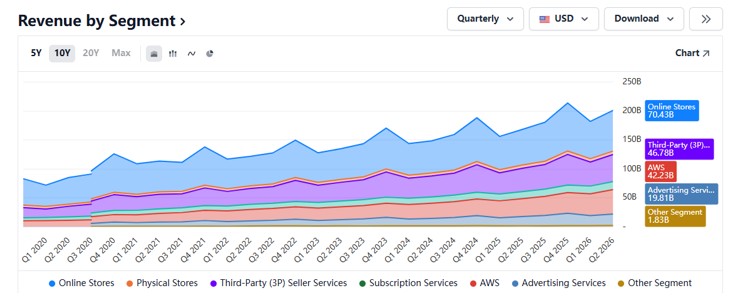
In Q2 2026, Amazon posted revenue of $200.6 billion, up 20% year-over-year, with operating income reaching $27.5 billion, up 43% year-over-year. But what truly deserves attention isn't the reacceleration of total revenue—it's where the profit comes from: AWS quarterly revenue hit $42.2 billion, up 37% year-over-year, its fastest growth rate in 18 quarters; operating income reached $16.6 billion, meaning AWS contributes only about one-fifth of the group's revenue yet accounts for roughly 60% of operating income.
Meanwhile, Amazon's advertising revenue grew 26% year-over-year, and third-party seller services grew 16%. In other words, while the outside world is still accustomed to discussing how much merchandise Amazon sold, the company's increasingly important economic sources have become cloud computing, advertising, commissions, logistics services, and subscriptions.
Understanding today's Amazon may require a different framing: retail is responsible for building scale, while high-margin services are responsible for monetizing that scale. And AI is pushing this system into its next phase—except this time, Amazon is becoming remarkably asset-heavy again.
What Kind of Business Is Amazon, Really?
Source: StockAnalysis
The easiest misunderstanding about Amazon stems from its revenue scale. In Q2 2026, Online Stores revenue reached $70.4 billion, up 15% year-over-year, still the largest single revenue category. But looking at this segment alone makes it easy to mistake Amazon for a more efficient Walmart.
In reality, the key to Amazon's business model was never just about selling things. What it has truly built is consumption infrastructure.
At the very bottom, of course, is first-party retail. Amazon procures merchandise itself, holds inventory, warehouses and delivers it, then sells to consumers. This segment is large in scale but also carries the strongest traditional retail characteristics: inventory ties up capital, logistics generates costs, and margins on the goods themselves are limited. But owned retail creates the most important thing—traffic, frequency, and infrastructure utilization.
Large numbers of users first come to Amazon because of product selection, price, and logistics; Prime further lowers the psychological cost of ordering on Amazon. The more orders, the denser the delivery network; the faster the delivery, the higher the shopping frequency.
So retail itself doesn't necessarily need spectacular margins. Its significance lies in keeping consumers on Amazon's turf. What happens next is where things get interesting.
Marketplace: From Selling Goods to Charging the Transaction Ecosystem
Third-party sellers can sell merchandise on Amazon's platform, and Amazon collects commissions while providing Fulfillment by Amazon, warehousing, delivery, and other services. Amazon's official accounting for third-party seller services itself includes commissions, fulfillment, and shipping fees. In Q2 2026, this segment generated $46.8 billion in revenue, up 16% year-over-year.
This differs fundamentally from Amazon's own merchandise in terms of economic model. A third-party seller selling $100 of merchandise doesn't mean Amazon needs to recognize $100 in revenue. Amazon is largely earning commissions and service fees within this ecosystem. Amazon doesn't necessarily bear the same degree of procurement cost and inventory risk, yet it still controls the transaction gateway, the logistics system, and the consumer relationship.
Amazon's original business was selling things itself; the better business is letting others sell on its infrastructure, then charging fees across the entire transaction chain.
Prime is the lock-in layer of this system. Membership fees certainly contribute revenue—Amazon's Q2 Subscription Services revenue was approximately $13.7 billion, up 12% year-over-year—but looking at membership fees alone underestimates Prime's value. Prime's more important role is increasing purchase frequency, reducing user churn, boosting logistics network utilization, and ultimately expanding the traffic pool that Marketplace and advertising businesses can monetize.
Therefore, the real flywheel of Amazon's consumer business isn't selling more goods, but rather:
More users → more orders → higher delivery density → more sellers → richer selection → more advertisers → higher per-unit traffic monetization.
This is why Amazon can continually grow high-margin businesses atop a seemingly low-margin retail empire. Beyond this consumer flywheel, it also has a business that could almost stand alone: AWS.
AWS + AI: Amazon's Most Important Profit Engine
If you imagine Amazon as a holding company, AWS is likely its single most valuable asset.
In Q2 2026, AWS revenue grew 36.7% year-over-year to $42.2 billion, corresponding to an annualized revenue run rate of roughly $169 billion—its fastest growth in 18 quarters. AWS operating income reached $16.6 billion, up 64% year-over-year, with quarterly operating margin further rising to 39.4%. Over the trailing twelve months, AWS has generated $148.4 billion in revenue and approximately $54.7 billion in operating income. These figures directly reshape Amazon's profit structure.
North America's Q2 revenue is nearly three times that of AWS, but its operating income is only $9.1 billion (Amazon's segment reporting is primarily divided into North America, International, and AWS, with North America mainly comprising retail and related services in the North American region); AWS, by contrast, reached $16.6 billion. International revenue was roughly $42.2 billion—almost identical to AWS—yet its operating income was only $1.7 billion. So where Amazon's group-wide margin heads in the future depends less on consumers shopping a few more times a year, and increasingly on how fast AWS can grow and how much its share of the group can rise.
The most important variable right now is clearly AI. Amazon doesn't have the hottest model, but it wants to sell shovels.
In the first phase of generative AI, AWS looked somewhat awkward at times. Microsoft has OpenAI, Google has Gemini; by comparison, Amazon lacks an equally famous proprietary frontier model. But Amazon's strategy was never about betting on a single model winner. What it's building is an entire AI infrastructure stack: AWS provides compute, storage, and networking; Bedrock provides a platform for calling and deploying different models for enterprises; Anthropic provides an important model ecosystem relationship; and Trainium and Inferentia attempt to push control further down into the chip layer.
As of Q2, Amazon said AWS's AI business has surpassed a $25 billion annualized revenue run rate and is still growing at triple-digit rates; its chip business likewise exceeds a $25 billion annualized run rate. Bedrock already has hundreds of thousands of customers, with new usage and customer spending continuing to accelerate rapidly in Q2.
The logic here is quintessentially Amazon: it doesn't necessarily need to know which single model will ultimately win—it just needs to believe that all the winners will need to buy compute. If models keep multiplying, parameters keep growing, and inference calls keep becoming more frequent, then compute, storage, networking, and data centers themselves become billable infrastructure.
This somewhat resembles early AWS. Back then, Amazon didn't try to become the world's largest software company—it noticed that all internet companies needed servers, and turned servers into a service. Today, it hopes to do something similar for AI.
Trainium: Why Must AWS Design Its Own Chips?
There's a second layer of logic here. If AI cloud remains heavily dependent on Nvidia GPUs long-term, Amazon is essentially using its own balance sheet to buy Nvidia's products and then rent out the compute to customers.
That can certainly be a good business, but AWS has limited control over cost, supply, and product differentiation. So Trainium's significance isn't simply about Amazon challenging Nvidia. More precisely, AWS wants to control its most expensive means of production.
Amazon said in Q2 that both Anthropic and OpenAI have made multi-year, multi-gigawatt-scale commitments to Trainium, and Trainium's customer base continues to expand. If in-house chips can lower unit training and inference costs, AWS can choose to pass the cost advantage to customers, or partially retain it in its own margins. But this is precisely where Amazon's biggest contradiction today emerges.
Over the trailing twelve months, Amazon's operating cash flow grew 33% to $161.4 billion. Over the same period, gross purchases of property and equipment were about $173.0 billion; after netting out roughly $4.0 billion in proceeds from asset sales and related incentives, net purchases used in the company's free cash flow calculation were approximately $169.0 billion. As a result, on Amazon's own non-GAAP basis, free cash flow swung from positive $18.2 billion in the prior-year period to negative $7.6 billion. The company said the decline in free cash flow primarily reflects continued investment in AI infrastructure.
So it's not simple to say AI is purely a positive for Amazon. The more accurate framing is that Amazon is trading today's already-strong cash generation capacity for greater AI infrastructure capacity tomorrow; what genuinely needs to be validated is how high a return that capital will ultimately produce. AWS is once again making Amazon a growth company—but AI is also once again making Amazon an asset-heavy one.
Retail, Marketplace, and Ads: The Other Half of the Profit Reconstruction
AWS easily grabs the attention, but another notable shift at Amazon in recent years has actually happened inside the retail business.
In Q2 2026, North America operating income reached $9.1 billion, with an operating margin of approximately 7.9%; over the trailing twelve months, operating income reached $33.7 billion, with a margin of about 7.4%. The International segment has also sustained profitability, with a Q2 operating margin of approximately 4.1%. Compared to a few years ago, when the logistics network was rapidly expanding and retail margins were under clear pressure, the profitability of Amazon's consumer business has improved noticeably.
However, based on the latest quarter, this margin improvement can't simply be attributed to logistics cost reductions. The company attributed the Q2 North America operating income growth mainly to higher sales volume and advertising revenue growth, while transportation, fulfillment, and technology-related costs partially offset the gains. This also shows that the profit reconstruction in Amazon's retail business isn't a single cost story: it comes partly from order volume growth, and partly from a rising share of higher-margin revenue like advertising.
From a longer-term operational efficiency perspective, the fulfillment network remains another important variable. Amazon has continued to regionalize inventory in recent years, pre-positioning more merchandise at nodes closer to consumers while expanding same-day and overnight delivery coverage. The company disclosed that in the first half of 2026, the number of items Prime members received via same-day or overnight delivery grew more than 40% year-over-year.
Faster delivery itself doesn't necessarily mean lower cost. In regions with insufficient order volume, shortening delivery windows can even reduce vehicle load rates and push up per-unit delivery costs. What Amazon truly relies on is scale and local order density: when a region already has enough orders, and popular inventory is pre-positioned near consumers, delivery routes can shorten and the distance between adjacent orders can shrink. Amazon's advantage isn't batching packages longer before consolidated delivery—it's that order volume is large enough that even with faster delivery, it can still maintain high delivery density and network utilization.
This is also where Amazon's years of massive logistics investment are gradually showing their value. In the past, this network was reflected more as warehouse, transportation, and fulfillment costs; as order volume, inventory positioning, and network utilization have improved, the same infrastructure can carry more transactions, and its strategic significance has gradually shifted from a cost center to a competitive moat.
The second shift comes from Marketplace. Third-party sellers bear more merchandise inventory risk, but still pay Amazon transaction, storage, and fulfillment fees. As the Marketplace ecosystem expands, the same GMV can correspond to more service revenue, without Amazon needing to proportionally expand its own inventory.
The third, and most easily overlooked, is advertising. Amazon's Q2 advertising revenue reached $19.8 billion, up 26% year-over-year—notably faster than the overall retail business. Amazon's advertising is especially valuable because it happens near the point of purchase. Google knows what someone is searching for, Meta excels at understanding what someone might be interested in, but Amazon holds an extremely scarce type of data: what this consumer might be about to buy right now.
As a result, the same shopping action can be monetized repeatedly. A third-party seller might first pay a platform commission, then pay for FBA and delivery fees, and then purchase Sponsored Ads to secure better search placement; on the other end, the consumer might still be a Prime member. Amazon doesn't even need consumers to suddenly spend twice as much to increase the economic value it extracts from the same transaction.
This may be the simplest way to understand Amazon's retail profit reconstruction: in the past, Amazon pursued GMV; today, what increasingly matters is how many layers of fees can be stacked on each dollar of GMV.
Advertising, Marketplace, and logistics efficiency are therefore not three independent stories. Together, they're transforming the profit density of Amazon Commerce.
Amazon Leo: Another Long-Term Project That Doesn't Look Like the Core Business
Amazon also has a business that often generates misunderstanding: satellite internet. It's now officially called Amazon Leo, formerly Project Kuiper.
It's worth distinguishing that Amazon itself doesn't operate a full rocket manufacturing and launch business the way SpaceX does. Leo is building a low-earth-orbit satellite communications network, and it procures launch capacity from companies including Arianespace, Blue Origin, SpaceX, and United Launch Alliance for its satellite launches. Amazon plans to deploy an initial low-earth-orbit constellation of more than 3,000 satellites; as of Q2 2026, nearly 400 satellites were already in orbit, and the company said it has the conditions in place to launch initial satellite internet service within the year.
In November 2025, Amazon officially renamed Project Kuiper to Amazon Leo, at which point it had already announced partner customers including JetBlue, L3Harris, DIRECTV Latin America, Sky Brasil, and Australia's NBN Co. But at this stage, it wouldn't be appropriate to frame Leo as Amazon's next AWS.
The two do share a certain cultural similarity: Amazon likes to first invest in massive internal infrastructure, then gradually turn it into a platform for external customers.
Leo may eventually create synergies with AWS, enterprise networking, remote-area connectivity, aviation communications, and government customers. But satellite internet is highly capital-intensive, the competitive landscape already has strong incumbents, and its economic model remains far less clear than AWS's. So a more reasonable research approach is to treat Leo as a long-term optionality with strategic synergy potential, but not yet suited to bearing core profit forecasts.
What's truly worth watching isn't how many billions of dollars to value it at, but whether it can cross the threshold of network coverage and user scale—from a project that continuously consumes capital to one with a sustainable unit economic model.
Valuation: Whether Amazon Is Expensive Depends on What You Think It Is
Amazon is a company particularly prone to being misled by a single valuation metric. As of August 13, 2026, Amazon's stock price was around $267, with a market capitalization of approximately $2.91 trillion. Its trailing-twelve-month P/E is only about 21.5x.
The problem is, this figure isn't as cheap as it looks right now. Amazon's reported Q2 net income reached $62.6 billion, but this included $53.4 billion in pre-tax non-operating gains, primarily from the change in valuation of its Anthropic investment.
So if you calculate P/E directly using GAAP net income, it's easy to mistake the fair-value appreciation of an investment asset for recurring profit generated by Amazon's core business. This is also why operating income tends to be more worth watching than current-period EPS when researching Amazon.
Over the trailing twelve months, Amazon's operating income was approximately $93.7 billion, up 23% year-over-year. Using the current equity market cap of nearly $2.9 trillion as a rough gauge, that's roughly 31x market cap-to-TTM operating income. Adjusting for enterprise value by factoring in cash, securities, and debt, the multiple still sits at roughly the same order of magnitude, around 30x EV/operating income.
This multiple alone can't answer whether it's expensive or cheap, because the question ultimately depends on what happens after that $93.7 billion in operating income.
A relatively conservative scenario: AWS's growth rate gradually normalizes after the AI infrastructure buildout cycle, retail margins approach a phase-specific ceiling, and capital expenditure remains persistently elevated. In that case, the current valuation would need a long period of profit growth to be digested.
A neutral scenario: AWS maintains growth clearly faster than the group overall, advertising and Marketplace continue gaining share, and North America efficiency keeps improving. Even without extreme revenue growth for the group, Amazon's profit growth could still outpace revenue growth, because the revenue mix itself is improving.
A more optimistic scenario requires today's remarkably large AI investment to actually generate high returns: Trainium achieves broader adoption, AI inference becomes sustained cloud demand, and AWS maintains high margins while continuing to grow.
The debate over Amazon's valuation really isn't "is 31x expensive or not?" It should instead be: how much AWS growth, how much retail margin improvement, and how much AI capital return is the market implicitly paying for today?
This is also why sum-of-the-parts (SOTP) thinking suits Amazon better than a simple P/E. AWS can be understood as a high-growth cloud infrastructure asset; Commerce encompasses traditional retail, Marketplace, and advertising simultaneously, with improving earnings quality; and projects like Leo, Zoox, and Healthcare are better treated as long-term options that haven't yet been fully validated. For a company like this, the point of valuation isn't to compute a precisely correct share price down to the dollar—it's to judge what operating assumptions the current price requires to hold up, and which variables would change the valuation logic if they diverge.
Risks: The Four Things Most Worth Watching for Amazon Going Forward
Amazon's biggest risk today may no longer be whether e-commerce growth slows.
First is the return on AI capital expenditure. Over the trailing twelve months, Amazon's free cash flow has already turned negative due to massive infrastructure investment. If AI demand growth fails to keep pace with data center, chip, and network investment, strong near-term AWS revenue growth may not translate into equally strong capital returns.
Second is AWS's competitive position. Microsoft Azure, Google Cloud, and AI infrastructure built by enterprise customers themselves are all competing for the same incremental budget. In-house chips can help AWS control costs, but they also bring technology and utilization risk.
Third is whether retail margins are gradually approaching a ceiling. North America's current profitability is already far better than a few years ago. There's certainly room for further efficiency gains, but the operational improvements needed to raise margins further will only get harder over time.
Fourth is whether long-term projects ultimately shift from optionality to capital drain. Leo, Zoox, healthcare, and other new ventures fit Amazon's traditional pattern of long-term bets. AWS proves such bets can create enormous value, but AWS's success doesn't mean every new project will become the next AWS.
Conclusion: Amazon Is Once Again at the "Spend First, Prove Later" Stage
For more than two decades, Amazon has repeatedly done one particularly characteristic thing.
It first builds infrastructure that looks extremely costly and low-margin, then scales up utilization, and then finds new ways to monetize it. The retail network gave rise to Marketplace and advertising. Computing infrastructure built for itself eventually became AWS. The logistics network is gradually opening up to third-party supply chain services.
Now, Amazon is again building AI data centers, in-house chips, and a low-earth-orbit satellite network.
The difference is that today's Amazon is no longer a small company with a few billion dollars in revenue that investors can patiently wait on. It has a market cap of nearly $3 trillion and has already generated close to $100 billion in annual operating income. The market's demands for capital efficiency are naturally higher. So the focus of researching Amazon over the next few years probably isn't predicting whether Prime membership rises a few percentage points, or whether Online Stores grows a bit faster.
What's truly worth continuously tracking are three figures: AWS's growth and margins, Commerce's margins, and the returns that capital expenditure ultimately converts into.
If the first two continue to improve, and AI investment gradually converts into new revenue and cash flow, then what's happening at Amazon right now is yet another profit structure upgrade. Conversely, if capital expenditure keeps growing sharply without generating corresponding incremental profit, then today's seemingly strong operating cash flow could also be steadily consumed by a new infrastructure cycle.
This is exactly what makes Amazon so interesting. It's no longer just the company that sells everything. It increasingly resembles a company that collects infrastructure rent from the internet economy—providing logistics to consumers, marketplace and fulfillment to merchants, purchase intent to advertisers, and compute capacity to enterprises for rent.
The real question posed by AI isn't whether Amazon is participating in this wave—it's already invested deeply enough. The real question is: twenty years ago, Amazon turned its server cost center into AWS; today, it's trying to do something similar again with a new round of infrastructure investment worth hundreds of billions of dollars. This time, how much rent it can ultimately collect is the most important variable for understanding Amazon's future value.
Disclaimer: This article is based solely on publicly available information for research on company fundamentals and business models. It does not constitute investment advice, a recommendation to buy or sell securities, or any promise of returns. The valuation and scenario assumptions discussed are intended only for discussing market pricing and operating variables.
Recommended Articles









Comments (0)
Click the $ button, enter the symbol, and select to link a stock, ETF, or other ticker.