


AMD Acquires Chip Startup Taalas; Can It Challenge Nvidia’s AI Dominance?



On August 6, Eastern Time, AMD acquired AI inference chip startup Taalas to advance its strategy in heterogeneous computing. Taalas specializes in model-specific integrated circuits that significantly enhance inference speed, addressing the high latency and energy inefficiency of general-purpose GPUs. While this acquisition strengthens AMD’s Helios rack-scale systems and optimizes inference costs, it faces significant hurdles: Taalas’s rigid, model-specific design lacks the flexibility of Nvidia’s CUDA-backed GPUs. Although unlikely to immediately challenge Nvidia’s market dominance, the move provides AMD a strategic foothold in the rapidly growing inference market, targeting critical efficiency gains for cloud-scale customers.

TradingKey - On August 6, Eastern Time, AMD ( AMD) announced the acquisition of Taalas, an AI inference chip startup headquartered in Toronto, Canada. AMD's stock closed at $489.28 that day, up 1.5%.
This comes only just over seven months after Nvidia ( NVDA) acquired Groq-related assets for approximately $20 billion through technology licensing and talent hiring. Both transactions point to the same signal: the focus of AI chip competition is shifting from model training to the inference side.
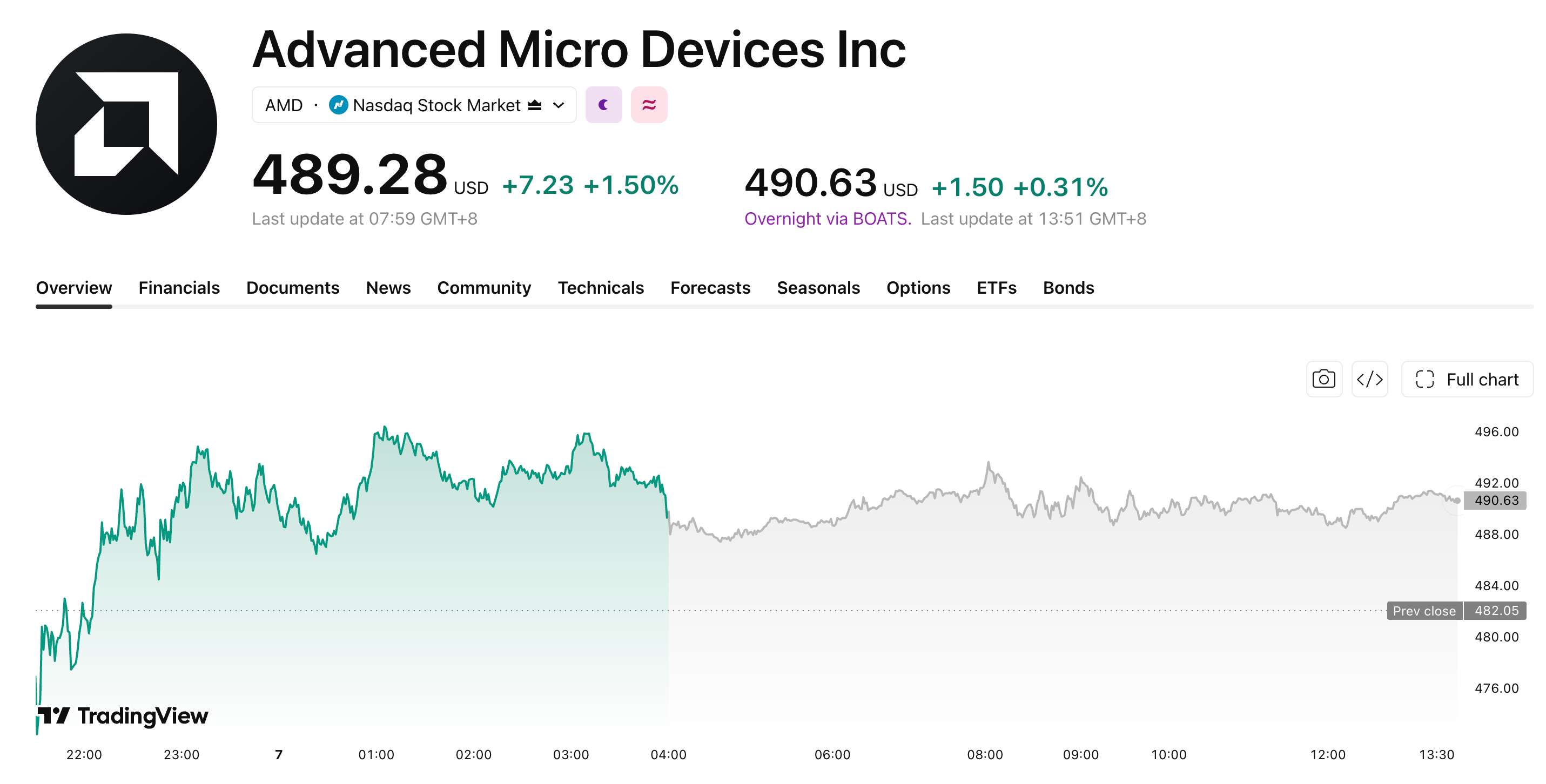 [Source: TradingView]
What Kind of Company Is Taalas?
Founded in 2023, Taalas's technological path is completely different from the vast majority of AI chips on the market today. Instead of making general-purpose GPUs, the company directly etches the weights of specific AI models onto silicon, creating model-specific integrated circuits.
In February this year, Taalas released its first test chip, the HC1, using TSMC's ( TSM) 6-nanometer process. Benchmarks at the time showed that when running the Llama 3.1 8B model, the chip achieved a speed of nearly 17,000 tokens per second, which is about 48 times that of Nvidia's H200 and B200.
The trade-off of this approach is the sacrifice of flexibility; once the chip is taped out, the model is hardwired onto the silicon, and any substantial update means a new tape-out. However, Taalas claims that it takes only about two months from receiving a new model to completing the hardware implementation. This means customers need to make a trade-off between specialized performance and update frequency.
Why Is AMD Acquiring Taalas?
AMD CEO Lisa Su previously stated that there is no one-size-fits-all solution in the chip sector. The AI market is evolving toward heterogeneous computing and custom chips, and the acquisition of Taalas is a concrete response to this trend, as well as part of AMD's rack-scale strategy.
Since 2024, AMD has successively spent $665 million to acquire AI model developer Silo AI, and another $4.9 billion to acquire server manufacturer ZT Systems, paving the way for its Helios rack-scale systems.
In July this year, Lisa Su announced at the Advancing AI 2026 conference that Helios has entered the mass production stage, with deliveries expected to roll out in the second half of the year and go online in the fourth quarter, and customers including Microsoft ( MSFT ), OpenAI, and Anthropic already confirming deployment.
AMD plans to deploy Taalas chips alongside its Instinct GPUs. According to people familiar with the matter, under a disaggregated architecture, prompt processing is handled by the GPU, while token generation tasks are offloaded to the Taalas accelerator, establishing a deployment path of verification first, followed by acceleration.
Can AMD’s Taalas Acquisition Shake Nvidia?
First, let's look at the cards AMD holds.
Lisa Su revealed at a July conference that about 60% of AI computing power would be used for inference by 2026. Inference costs are becoming a core concern for cloud providers and enterprises, while Nvidia's GPUs have low energy efficiency and high latency in inference tasks, and Taalas's dedicated chips target precisely this demand.
In terms of performance, the 48x gap in inference performance, even if degraded in actual deployment, is still enough to make cloud providers reconsider their cost calculations. Microsoft, Meta ( META) and other leading customers have already started developing their own inference chips, so AMD's entry at this moment is not too late.
On the system level, Helios is equipped with 72 MI455X GPUs, with computing power and memory capacity that are 15% and 50% higher, respectively, than Nvidia's Vera Rubin NVL72. From chips to servers and then to the software stack, the acquisition of Taalas addresses the biggest weakness on the inference side.
But the challenges AMD faces are also impossible to ignore.
First is the cost of flexibility. Taalas's chips hardwire the models onto the silicon, while AI models are updated weekly. Customers choosing Taalas must accept an update cadence of once every two months. Nvidia's GPUs, by contrast, can adapt to any new model at any time, and this versatility is the foundation of Nvidia's irreplaceability.
Second is the developer ecosystem. Nvidia's advantage lies in the millions of developers who have long built AI applications on the CUDA platform, making switching costs extremely high. Although AMD's ROCm software stack is catching up, the gap remains significant.
Finally, there is the scale gap. Nvidia's fiscal year 2026 revenue is projected to exceed $200 billion, compared with about $30 billion for AMD. Whether in R&D spending, control of top-tier supply chain capacity, or customer relationships, the two are still not in the same league.
Reasonably speaking, this acquisition alone is unlikely to shake Nvidia's lead in the short term, but it opens a breakthrough for AMD in cost reduction and efficiency improvement.
The inference market has just begun to explode, and Lisa Su expects the AI accelerator market to reach $1.4 trillion by 2030. If Taalas's technology is successfully implemented as planned, the Helios system is validated, and the ROCm ecosystem continues to catch up, AMD is poised to capture a substantial incremental share in the inference space. In this sense, the acquisition of Taalas is a critical step.
This content was translated using AI and reviewed for clarity. It is for informational purposes only.
Recommended Articles






Comments (0)
Click the $ button, enter the symbol, and select to link a stock, ETF, or other ticker.