


AI Bubble or AI Boom? How Europe's Markets Read Alphabet Down 15%, Meta Down 10%, Microsoft Up 8%



AI Podcast


The week of July 28, 2026, saw significant volatility in US tech stocks, driven by hyperscale capex concerns and earnings mixed performance. While major firms like Alphabet and Meta faced sharp sell-offs, the underlying data confirms robust AI-driven demand, evidenced by surging cloud revenue and massive infrastructure investment. European markets showed notable resilience, maintaining stability as investors prioritized long-term cycles over quarterly fluctuations. Ultimately, the market transitioned from fearing a bubble to recognizing that capital spending is supported by measurable demand. Global sentiment stabilized as memory shortages and positive sector earnings reinforced the ongoing AI expansion.

TradingKey - Markets will analyze the week of July 28, 2026, for a long time to come. Alphabet saw 82% Cloud growth and posted a record $9.11 EPS — and fell 15%. Meta surpassed estimates by 1% and saw 28% growth — and fell 10% in after hours on EPS and free cash flow of $784 million. After reaching $1,255, Micron fell 41% to $707 before bouncing 18% on Thursday, after Samsung announced a chip shortage. Microsoft rose 8% after reporting 43% growth in Azure. Qualcomm fell 7% after a miss in Q4 guidance. NVIDIA lost 17% from peak after Circular Financing fears. Meanwhile, the STOXX 600 in Europe ended the week essentially where it started. It shows where serious money thinks the AI Infrastructure debate is and what the earnings calls really mean.
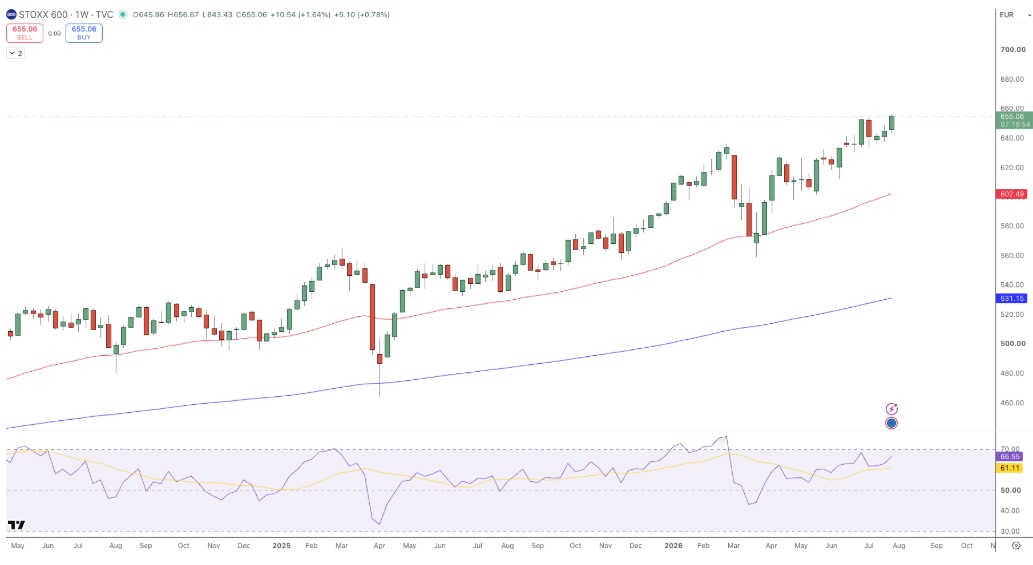
STOXX 600 Price Chart - Source: Tradingview
What Europe Saw That US Markets Didn't
The week of July 28, 2026, was a unique one for US markets. European markets opened before them and partially absorbed US after-hours and overnight moves. On July 28, the Asian chip sell-off, with the KOSPI down 10.8% and a 14.7% drop of SK Hynix, prompted a cautious European opening.
The STOXX 600 was up 0.2% with most tech stocks remaining flat, indicating that the Asian semiconductor sell-off had not yet made its way to Europe. Mid-week, ASML fell by 8.4% following news of Chinese progress in Lithography Equipment, dragging the AEX down by 0.82%. ASM International fell 7.1% and BE Semiconductor fell 9.7%.
However, altogether, the STOXX 600 appeared completely unchanged at 644.52, through the most tempestuous week of US technology in years, while European institutional investors, were not being apathetic or ignorant, and had the same earnings reports in front of them as everyone else. Analysts stated, “this is less about weakening AI demand and more about a repricing of expectations after an exceptionally strong rally,” this week. How you constitute AI, and technology names, and adjacent US, and European, sentiments change greatly, when the repositioning is attributed to a repricing of expectations instead of a demand pullback.
The Three Things That Actually Happened This Week
The moves of this week averaged three unique interpretations, when the daily moves were removed.
First, US hyper-scale capex spending was confirmed to actually be increasing and not retreating. This week, Alphabet confirmed $205 billion in annual capex, Microsoft confirmed $260 billion for FY2027, and Meta confirmed annual spending of $145 billion. This leads to $610 billion of capex for one year to build out the AI infrastructure from only three companies, and is actually a sign of not a bubble.
Bubbles are demonstrated by no customer demand and spending. Spending in AI is a bubble because Azure grew 43%, Google Cloud grew 82% and had a backlog of $514 Billion, and Meta's advertising business grew 28% with 3.6 billion daily active users. Spending has visible and measurable demand and therefore customers. Replace this or build upon this.
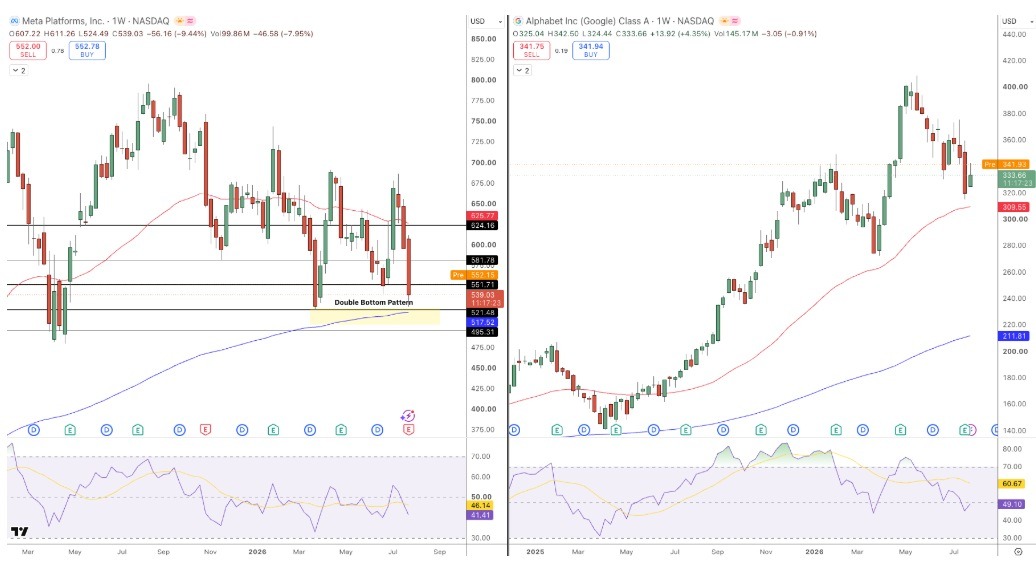
Meta & GOOGL Price Chart - Source Tradingview
Second: Spending communication is under a new market discipline. Microsoft rose 8%, while Alphabet fell 15%. Microsoft and Alphabet spent the same amount relative to company size. Microsoft attributed supply exceeding demand for Azure, as well as an increase of 30 million paid Copilot seats, a $678 billion commercial backlog, and steady capex guidance. In comparison, Alphabet reported $44.9 billion in quarterly capex with an earnings per share (EPS) figure buoyed by $6 to $7 in unrealized gains from Anthropic and SpaceX, and provided limited demand-side investment scale comments. The market did not turn down AI infrastructure spending this week; it turned down AI infrastructure spending without justification.
Third: Samsung's Q2 earnings confirmed the underlying memory supply constraint story is correct, as SK Hynix attained 550% profit growth. Parallel to this, Micron's quarterly revenue of $41 billion at 85% gross margin demonstrated the same.
The CXMT IPO in Shanghai, which rose 531%, also provided evidence of China placing a huge bet on memory demand, not peaking, while a market in bubble territory would indicate this. A market which has been exceptional for 18 months and is now behaving a little repressed should demonstrate the same.
What the ASML Move Reveals
The most telling European data point this week was not in a headline, but rather ASML’s 8.4% single stock drop when news hit of China’s progress on domestic lithography. ASML is the world’s sole supplier of extreme ultraviolet lithography machines, which is the necessary tool for fabricating the most advanced chips. ASML’s lithography machines are currently export restricted to China.
The market sold ASML because if China is able to develop deep ultraviolet lithography to the scale of CXMT, ASML’s EUV machines could face long term competition from a customer base that theoretically would be able to bypass the need for EUV machines. It appears ASML’s stock is being priced for the 2028 to 2030 time horizon which shows that European professional investors are considering AI in technology cycles rather than in quarterly metrics.
ASML’s Q2 results on July 15, which had a high degree of order and operational momentum and confirmed Intel as its first High-NA EUV customer, were positively received. The sell off that followed was the market interpreting the developments and positioning the stock in response to the geopolitical and competitive framework, not ASML’s business performance.
The same trend is seen across the STOXX 600 moves this week. The business results were relatively positive and the sell off was related to the narrative that was constructed around those results, China’s ambitions on chips, circular financing in the US, and the nature of AI capex, is it demand driven or is it speculation?
Where This Leaves European AI Names
Most European AI opportunities come from industrial automation firms like Siemens and ABB, semiconductor equipment manufacturers like ASML, and defense firms like Rheinmetall. Rheinmetall’s AI-integrated systems deserve special mention. None of the above names partook in the earnings drama in the United States this week. By the week’s end, most of the above names finished in the green. The DAX was flat to barely negative.
The FTSE 100 was mostly in the green. The STOXX 600 construction index advanced by 1.55%. Mining stocks advanced by 1.21%. These stocks are the infrastructure build beneficiaries of AI with crashing equities in the United States.
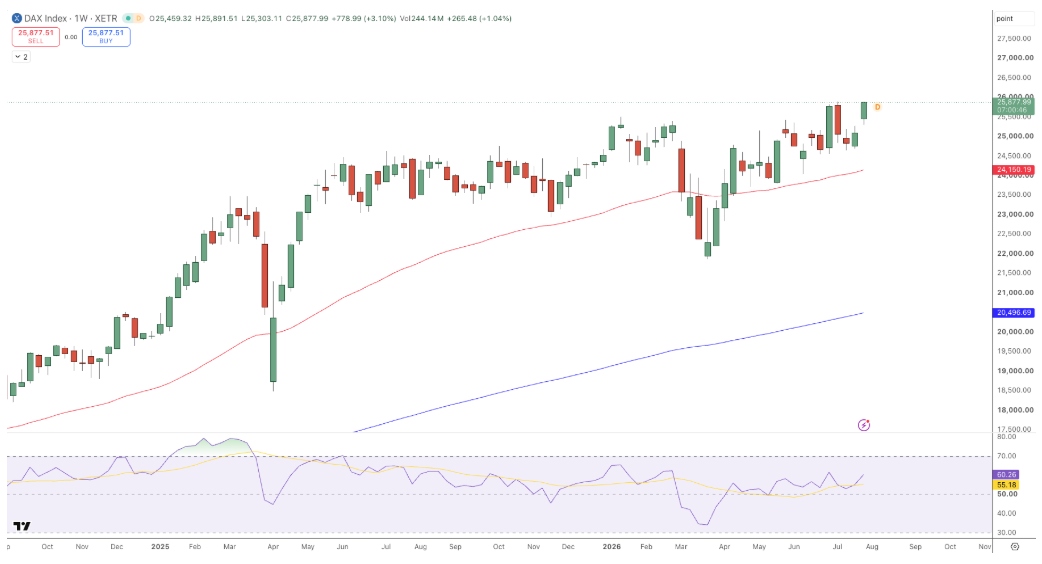 DAX Price Chart - Source: Tradingview
The clear message from Europe during this time is about divergence: all the elements of physical infrastructure for the AI boom (power, cooling, buildings, copper, steel, etc.) are already (or soon to be) in place. The equity premium for companies that build a software layer on this infrastructure is being adjusted, and European markets are being given a premium in the absence of the ROI curve. European markets remained calm during the most turbulent U.S. tech markets week of 2026 (which could be interpreted as either wisdom, or complacency).
Given that the STOXX 600 reached a two-week peak immediately before earnings season and the DAX reached two-week peak earlier in July, the most generous assumption may be that European investors saw Alphabet's $44.9 billion quarterly capex, Microsoft's $255 to $260 billion FY 2027 planning capex, and Meta's $31.9 billion operational cash flow and $784 million of free cash flow, and decided to wait one quarter to see if it is a bubble or boom.
Bottom Line
The most unpredictable tech week of 2026 closed with a bang on July 31. South Korea's KOSPI rose 15% led by a jump in Samsung and SK Hynix shares due to a memory shortage. After the close on Thursday, Amazon released its positive 2nd quarter earnings, adding another reason for an 8% increase in Microsoft’s shares, following a positive earnings trend by hyperscalers, after Amazon.
By mid-morning Friday the STOXX 600 was +0.94% and DAX and CAC 40 up 1% each, pushing the index back to 52 week high of 654.44. Micron jumped 18%. Nvidia and AMD also showed positive gains. The dominant narrative Monday to Wednesday of circular financing worries, capital expenditures, and free cash flow disappearing was replaced by the data that was captured in vertical financing, where the free cash flow supports the construction of deferred revenue facilities to fulfill contracts.
Samsung's breakthrough in Chip shortages and Amazon's advances in Cloud computing supported Microsoft's argument against the $255 billion in annual capital outlays. Europe's markets didn't panic or dismiss the intermittent volatility that spanned the week. The AI boom remains in place and the changes in the pricing of the boom and justifications are consistent.
Recommended Articles






Comments (0)
Click the $ button, enter the symbol, and select to link a stock, ETF, or other ticker.