


US Stocks Close: Dow Rises 500 Points, Philadelphia Semiconductor Index Falls Over 4%; Memory, Optical Communication Stocks Extend Losses, Software Stocks Rebound; Apple Hits $5 Trillion Market Cap, SanDisk Falls Below $1,100 Mark



AI Podcast


The Dow Jones rose 1.03% on strong earnings, while the Philadelphia Semiconductor Index plummeted 4.49% as technical support faltered. Markets now await the Federal Reserve’s interest rate decision. Sector-specific developments include Apple’s planned expansion into the smart home market via a Siri-based hub, and Amazon’s strategic pivot toward "Frontier Model Research." Meanwhile, Visa announced a 7% workforce reduction, and reports suggest Koch is weighing a $15 billion sale of its data center arm. HSBC maintains an overweight equity stance, citing robust earnings and reasonable valuations as buffers against geopolitical risks and inflationary pressures.
TradingKey - Boosted by strong corporate earnings, falling oil prices, and a rotation of capital from the semiconductor industry to other sectors, the Dow Jones Industrial Average rose by more than 500 points. Memory and chip stocks extended yesterday's losses, while software stocks rebounded. The market is focusing on the Federal Reserve's interest rate decision tomorrow, as well as tech earnings reports scheduled for release this week.
At the close, the Dow Jones Industrial Average rose 1.03% to 52,747.32; the Nasdaq Composite Index fell 0.22% to 24,876.91; and the S&P 500 Index rose 0.21% to 7,428.78.
Tech Stock Performance
Apple (AAPL) rose 0.94% to $340.08, bringing its latest market capitalization to $4.99 trillion.
Apple reporter Mark Gurman stated that Apple is preparing to make a major push into the global smart home market, centered around Siri AI. This indicates that Apple is gearing up to aggressively enter the smart home market with new on-device hardware and an AI software ecosystem. Citing sources familiar with the matter, Gurman wrote that the company plans to launch this smart home product offensive soon with a smart home hub device built around the new Siri AI assistant. The sources added that Apple is also preparing to release a new TV set-top box and an upgraded version of the HomePod mini smart speaker. The sources asked not to be identified as the plans are not yet public.
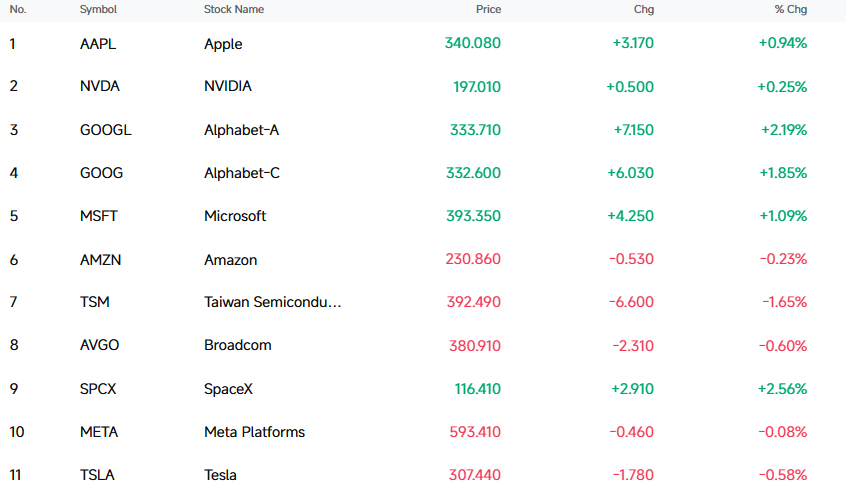
Among mega-cap tech stocks, SpaceX (SPCX) rose 2.56%, Google (GOOGL) climbed 2.19%, Microsoft (MSFT) edged up 1.09%, Apple (AAPL) gained 0.94%, and Nvidia (NVDA) ticked up 0.25%. On the downside, Broadcom (AVGO) fell 0.60%, Tesla (TSLA) dropped 0.58%, Amazon (AMZN) slipped 0.23%, and Meta Platforms (META) dipped 0.08%.
[Source: FutuBull]
The Philadelphia Semiconductor Index fell 4.49% to close at 11,035.68 points, officially breaking below key near-term support around 11,200 points, as technicals continued to deteriorate. According to analysis by The Market Ear, if this support level fails, the index will face a vast vacuum zone down to its 200-day moving average, which happens to coincide with a longer-term uptrend line.
Optical communications stocks plummeted, with Corning (GLW) down 12.06%, Coherent (COHR) down 10.39%, Astera Labs (ALAB) down 7.89%, GlobalFoundries (GFS) down 7.82%, and Marvell Technology (MRVL) down 7.77%.
Corning reported second-quarter GAAP sales of $4.51 billion, up 17% year-over-year. Core sales were $4.74 billion, up 17% year-over-year, beating analyst expectations of $4.62 billion. GAAP net income was $559 million, or $0.64 per share. For the third quarter, guidance projects core sales between $4.9 billion and $5.0 billion, up approximately 16% year-over-year, with core EPS expected between $0.85 and $0.89, up approximately 28% year-over-year. Market analysis suggests that the company's third-quarter revenue guidance fell short of investor expectations, which had been elevated by the AI boom.
Memory stocks extended their losses, with SanDisk (SNDK) falling 14.25%, SK Hynix (SKHY) dropping 8.98%, Micron Technology (MU) sliding 8.85%, Seagate Technology (STX) declining 8.53%, and Western Digital (WDC) losing 6.91%.
Company News
Amazon Overhauls AI Strategy to Focus on Frontier Model Research (FMR)
According to media reports, Amazon is comprehensively overhauling its artificial intelligence strategy, phasing out many of its in-house models, reorganizing teams, and concentrating engineers on a new strategy to compete in the frontier space. This reorganization indicates that Amazon is refocusing its AI strategy. Instead of spreading resources across a variety of text, image, and video models, the company is consolidating engineering talent and limited computing resources to focus on its highest-priority projects. According to people familiar with the matter, Amazon is phasing out most of its flagship models, including the high-end Premier and Omni models, the Reel video generation model, and the Canvas image generation model. Some Amazon employees describe these models as currently being in a "KTLO (Keep the Lights On)" state. According to people familiar with the matter, resources are shifting away from the existing Nova model toward a new frontier model project led by researcher Pieter Abbeel. The project, known internally as "Frontier Model Research" (FMR), has become the company's top priority this year. Under this initiative, Amazon is developing a brand-new flagship foundation model, which is expected to be unveiled at its annual re:Invent conference this fall.
Apple Plans to Push into Global Smart Home Market
Apple tracker Mark Gurman stated that Apple is preparing to make a major push into the global smart home market, with Siri AI at its core. This indicates that Apple is gearing up to enter the smart home market in a big way, leveraging new hardware devices and an AI software ecosystem. Gurman, citing people familiar with the matter, wrote that the company plans to launch its smart home offensive soon with a smart home hub built around its new Siri AI assistant. The people said Apple is also preparing to release a new TV set-top box and an upgraded HomePod mini smart speaker. The people asked not to be identified because the plans are not yet public.
Koch Weighs Sale of Data Center Developer Edged in Deal That Could Exceed $15 Billion
Koch Inc. is considering a sale of its data center developer Edged, according to people familiar with the matter. The company, co-founded by Koch, focuses on building data center projects for the world's leading hyperscale cloud providers. The people said Koch Real Estate Investments, a subsidiary of Koch, is working with Goldman Sachs Group Inc. and Newmark Group Inc. to gauge buyer interest in the asset. One of the people, who asked not to be identified because the information is private, said Edged has already received multiple offers, and the transaction valuation could exceed $15 billion.
Visa to Cut About 2,600 Jobs, Representing 7% of Global Workforce
Visa (V) plans to cut about 2,600 jobs. CEO Ryan McInerney announced to employees in an internal memo on Tuesday that the layoffs represent about 7% of the company's global workforce, primarily affecting technology and product teams. "I am confident that we are making the right decisions for Visa, our clients, and our partners," he wrote in the memo. "We will continue to drive company-wide efficiencies so that we can reinvest resources in our areas of greatest growth potential."
Industry & Macro News
TD Securities: If Fed holds rates steady at this meeting, it will lead to a weaker US dollar
TD Securities stated that if interest rates are kept unchanged at this meeting, it will directly trigger a weakening of the US dollar; the fewer dissenting votes internally, the stronger the policy consensus, which means the previously priced-in hawkish premium will fade more thoroughly, leading to a larger correction in the dollar. Although rising oil prices are pushing up inflationary pressures and strengthening the case for a rate hike, the bank believes that current evidence is not yet sufficient to build a consensus among the majority of committee members for a rate hike. Overall, this decision is more likely to be a phase-by-phase realization of hawkish expectations, and crowded long positions face pressure for a correction due to profit-taking.
Iranian Deputy Foreign Minister: Proposal made to Oman for talks on a temporary shipping route in the Strait of Hormuz
According to Iran's Tasnim News Agency, the Iranian Deputy Foreign Minister stated that a proposal has been made to Oman to negotiate a temporary shipping route in the Strait of Hormuz. If an agreement is reached, this route would replace the current north-south shipping lanes. The Deputy Foreign Minister said Oman suggested designing a channel that is 50% controlled by Iran and 50% controlled by Oman. 'We stated that this would not resolve Iran's concerns,' he said. 'We said the inbound channel must be fully controlled by Iran, and part of the outbound channel should also be under Iranian control. If they accept this arrangement, we will proceed to the next stage. We will never recognize the southern channel of the Strait of Hormuz, not even for an hour. If Oman does not accept Iran's proposal regarding the Strait of Hormuz, the strait will remain closed, and we are prepared to resume war. Under no circumstances do we recognize the southern channel of the strait. Our proposal is that one channel of the strait must be fully controlled by Iran, and part of the other channel should be as well. This plan is clear, and Iran will not accept any other option.'
HSBC: This sentiment- and positioning-driven correction has fully released short-term risks
HSBC's latest research report pointed out that strong corporate earnings growth and reasonable valuation levels are the core reasons why risk assets have remained resilient against the backdrop of a deteriorating inflation environment. Despite the renewed escalation of tensions in the Middle East, surging oil prices, and a collective sell-off in global momentum stocks, major stock indices have experienced very limited corrections from their historical highs. The S&P 500 Index has fallen less than 3% from its historical high set in June, and has consistently oscillated within a relatively narrow range over the past two months. HSBC's strategy team maintains its maximum overweight rating on equity assets, believing that this sentiment- and positioning-driven correction has fully released short-term risks.
Jensen Huang Reiterates Support for Open-Weight AI Models
Nvidia CEO Jensen Huang stated that open-weight artificial intelligence models are crucial for driving the AI industry, which is still in its early stages of development. After meeting with US lawmakers in Washington on Tuesday, Huang said that open-weight models are very important for ensuring that artificial intelligence is safely and reliably applied across the economy. In brief remarks to reporters, Huang said: 'For American industries, we need open weights for security, and we need open weights for safety. At the same time, this is also very important for the entire industry to stay vibrant.'
This content was translated using AI and reviewed for clarity. It is for informational purposes only.
Recommended Articles










Comments (3)
Click the $ button, enter the symbol, and select to link a stock, ETF, or other ticker.