


US Stocks Close: Three Major Indices Tumble, Nasdaq Falls Over 2%, Market Worries Over Google and Tesla’s Massive Capital Expenditures, Tech Stocks Lead Declines, Memory Stocks Find Support Against the Trend



AI Podcast


Rising geopolitical tensions and elevated oil prices—with Brent crude surpassing $100—have pushed 10-year US Treasury yields to 18-month highs, triggering a sharp decline in major US stock indexes. Technology shares led the downturn, fueled by investor anxiety over Google’s aggressive capital expenditure hikes and Tesla’s disappointing margins. While memory stocks displayed resilience, broader market sentiment remains pressured by inflation concerns and intensifying conflicts in the Middle East. Meanwhile, the Federal Reserve faces growing market expectations for potential rate hikes, as policymakers monitor fiscal impacts from escalating geopolitical risks and infrastructure spending.
TradingKey - Investor panic over increased capital expenditures at Google and Tesla, combined with Brent crude rising to $100, pushed the 10-year US Treasury yield to its highest level in nearly a year and a half, dampening market trading sentiment. The three major US stock indexes fell sharply, with technology stocks leading the decline, while memory stocks bucked the trend to find support.
At the close, the Dow Jones Industrial Average fell 0.97% to 51,711.65 points; the Nasdaq Composite Index dropped 2.15% to 25,137.69 points; and the S&P 500 Index slid 1.21% to 7,408.12 points.
Tech Stock Performance
Tesla (TSLA) fell 14.52% to $319.69.
Tesla's Q2 revenue reached $28.236 billion, beating market expectations, primarily driven by vehicle deliveries hitting a record high for the same period in the company's history. However, its Q2 adjusted earnings per share (EPS) fell 18% year-on-year to $0.33, missing analysts' estimates by over 35%, while its gross margin for the quarter stood at 16.8%, below the expected 19.4%. Operating profit plunged 57% year-on-year to just $398 million, representing less than 30% of market expectations.
Google (GOOGL) fell 7.13% to $317.69.
Google's parent company Alphabet reported Q2 revenue of $119.8 billion, up 24% year-on-year; operating profit was $40.8 billion, up 30% year-on-year; driven by a surge in equity gains from investments like Anthropic, net income jumped 298% year-on-year to 112.1 billion yuan. However, Google raised its full-year capital expenditure guidance to between $195 billion and $205 billion, up from the previous forecast of $180 billion to $190 billion, sparking market concerns over whether such massive capital spending can yield corresponding returns.
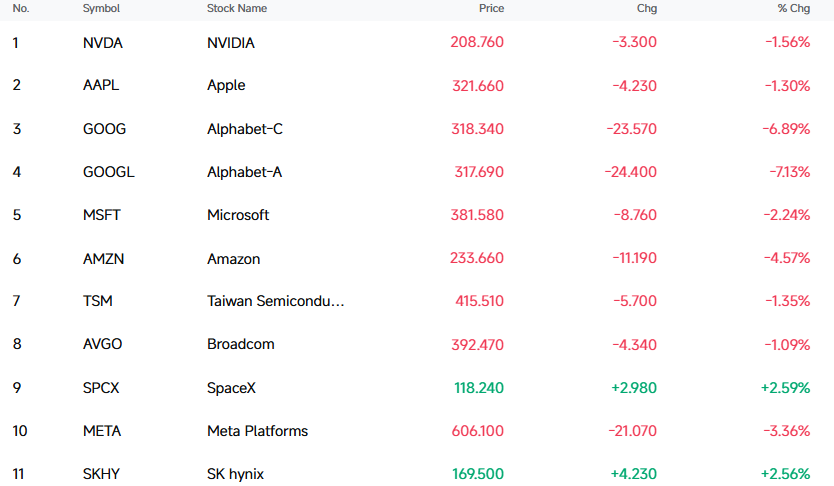
Among large-cap tech stocks, SpaceX (SPCX) rose 2.59% and SK Hynix (SKHY) gained 2.56%. On the downside, Google (GOOGL) fell 7.13%, Amazon (AMZN) dropped 4.57%, Meta Platforms (META) slid 3.56%, Microsoft (MSFT) lost 2.24%, Nvidia (NVDA) declined 1.56%, Apple (AAPL) slipped 1.30%, and Broadcom (AVGO) shed 1.09%.
[Source: FutuBull]
The Philadelphia Semiconductor Index fell 0.54% to 12,343.84 points. Of its 30 constituents, 10 rose and 20 fell.
Among memory stocks, Micron Technology (MU) rose 3.20%, SK Hynix (SKHY) gained 2.56%, SanDisk (SNDK) rose 0.69%, Seagate Technology (STX) climbed 0.58%, and Western Digital (WDC) ticked up 0.29%.
Company News
AMD Raises AI Accelerator Market Size Forecast to $1.4 Trillion, Officially Launches Rack-Scale AI System Helios
The AMD Advancing AI conference was held on July 22-23 in San Francisco. AMD CEO Lisa Su stated that the artificial intelligence accelerator market is expected to reach $1.4 trillion by 2030, the global data center CPU market size will reach $220 billion, and the global computing market size will reach $2 trillion. In addition, AMD officially launched its first rack-scale AI system, Helios. Su stated that Helios has fully entered production and will begin shipping soon. A CNBC analysis pointed out that a year ago, Su's forecast for the AI accelerator market size in 2028 was $500 billion. According to the latest forecast, by the end of this decade, this size will be roughly equivalent to the volume of today's "entire semiconductor market." Su stated that GPUs will account for the majority of the share.
Google's Future Spending Commitments Rise to $811 Billion
Google revealed in a quarterly filing that, as of the end of June, its future contractual spending commitments reached $811 billion, an increase of nearly $500 billion from three months prior. These amounts are disclosed separately from Google's capital expenditure budget and represent purchases the company has committed to under supply agreements and outstanding purchase orders. Of this, about $200.7 billion is for short-term purchases. These commitments cover various areas, including chips, data centers, electricity, inventory, and content licensing. This massive increase highlights how quickly Google is locking in resources as it expands the infrastructure supporting its artificial intelligence business. The disclosure further illustrates the staggering scale of AI infrastructure buildout. Google's parent company, Alphabet, said on Wednesday that it expects to spend approximately $195 billion to $205 billion on capital expenditures alone this year to compete with Microsoft, Meta, and Amazon to expand its AI computing power.
SpaceX Short Sellers Generate $15.5 Billion in Paper Profits and Continue to Increase Short Positions
According to data as of Tuesday from data analytics firm Ortex Technologies, investors shorting SpaceX stock have realized about $15.5 billion in paper profits since SpaceX's IPO in mid-June, as its stock price has fallen below the IPO offering price. Short sellers make money by borrowing shares to sell and then buying them back at a lower price. As SpaceX's stock price fell from its post-IPO high of $225.64 to below the offering price of $135, they increased their bearish bets on the company. "There is currently no sign that short sellers are taking profits on their SpaceX positions," Ortex co-founder Peter Hillerberg said. "If anything, they are actually doubling down on their shorts," Hillerberg added. Ortex's data as of Tuesday showed that about 360 million SpaceX shares had been borrowed, representing approximately 56% of the free float. Musk said last Friday, "Companies that hold large short positions in SpaceX for the long term have a very low probability of survival."
Industry & Macro News
US House Passes Resolution Again, Demanding Trump End War Against Iran
With bipartisan support from a handful of Republicans, the US House of Representatives passed a War Powers Resolution regarding Iran for the second time, demanding Trump stop the war against Iran. The House's roll-call vote that day was 214 in favor and 208 against. Four Republican representatives joined Democrats in voting for the resolution. In June of this year, the House passed a similar resolution, with four Republican representatives also voting in favor at the time. This action is largely symbolic, but it highlights the unpopularity of the war against Iran and the growing concerns among a handful of Republican lawmakers that they could face a strong backlash in the congressional midterm elections just a few months away.
Market Expects Fed to Raise Rates as Early as Next Week
As the threat of an escalating war in Iran pushed up oil prices, US Treasury yields rose to their highest levels of the year, fueling market expectations that the Federal Reserve could raise interest rates as early as next week. The two-year Treasury yield, which is highly sensitive to Fed policy expectations, rose about 4 basis points on Thursday to around 4.34%, reaching its highest level since early 2025. The 10-year Treasury yield touched a new high for the year, and the 30-year yield rose to 5.19%, just below its highest level since 2007. Brent crude prices are slowly climbing back toward $100 a barrel as Houthi militants claimed to have attacked commercial vessels for the first time in months.
Trump: Close to Decision on 'Massive Strikes' Against Iran
According to media reports, US President Donald Trump stated that he is seriously considering relaunching massive military operations in Iran, including strikes more severe than those during 'Operation Epic Fury'. Trump acknowledged that this decision would bring consequences and emphasized that he has not yet made a final decision. Trump did not provide a deadline for the decision. Two other US officials confirmed that no orders have been received yet and no new directives have been issued to the military. Trump said: 'I am looking at a massive attack, of an unprecedented scale. I am close to making a decision, and we are ready for this.' Trump stated that if he requested, Israel 'would join the war in two minutes,' but he also emphasized that 'we don't need anyone' to launch new military actions against Iran.
Brent Crude Futures Break Above $100/Barrel for First Time Since May
Brent crude futures broke above $100 for the first time in nearly two months. This came after Yemen's Houthi rebels claimed to have attacked two Saudi tankers sailing in the Red Sea, intensifying the Middle East conflict and threatening further oil supply disruptions. The Houthi attacks have opened a new front in the regional conflict; prior to this, traffic through the Strait of Hormuz had already been snarled due to the US-Iran conflict. Since the outbreak of the conflict, the Bab-el-Mandeb Strait in the Red Sea has become a lifeline for oil exports. Recently, both the US and Iran have downplayed the possibility of peace talks, raising the prospect of a prolonged standoff.
This content was translated using AI and reviewed for clarity. It is for informational purposes only.
Recommended Articles









Comments (0)
Click the $ button, enter the symbol, and select to link a stock, ETF, or other ticker.