


Tesla Q2 Revenue Hits Record High, Why Is the Market Focusing on Negative Cash Flow?



AI Podcast


Tesla’s Q2 2026 results reflect a divergence between record revenue growth and weakening profitability. Revenue rose 26% to $28.24 billion, yet adjusted EPS of $0.33 missed estimates, and gross margins fell to 16.8%. Aggressive price cuts to drive delivery volume pressured automotive profits, while record capital expenditures of $5.79 billion in AI and robotics caused free cash flow to turn negative for the first time in two years. With management signaling sustained high investment, market sentiment is shifting focus toward when these long-term AI and autonomous driving initiatives will yield sustainable cash flow.
TradingKey - While Musk continuously emphasizes that Tesla's future is as an artificial intelligence and robotics company, the reality remains that it cannot do without the cash flow support provided by its automotive business.
And this latest quarterly scorecard also reveals an increasingly obvious contradiction: new businesses require continuous cash burn, while the ability of the traditional automotive business to generate profits is weakening.
Tesla ( TSLA )'s released Q2 2026 financial results show that the company's revenue continued to maintain strong growth, with vehicle deliveries hitting a record high for the same period, but its profitability weakened significantly. Declining margins, earnings per share missing expectations, coupled with negative free cash flow for the first time in over two years, have prompted the market to begin re-evaluating the quality of the company's growth.
Following the release of the earnings report, Tesla's shares fell over 4% at one point in after-hours trading.
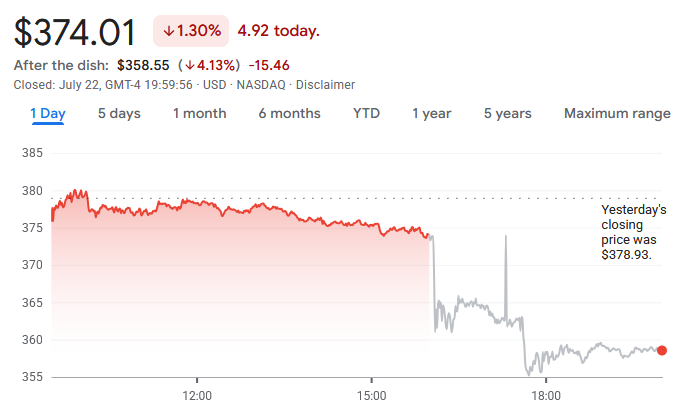
Source: Google Finance
Revenue Hits Fastest Growth in Three Years, but Profit Performance Clearly Lacks Luster
From a revenue perspective, Tesla delivered a solid performance this quarter.
In the second quarter, the company generated $28.24 billion in revenue, up 26% year-over-year. This not only beat market expectations but also marked its fastest quarterly growth rate in nearly three years.
Previously released data showed that vehicle deliveries for the quarter exceeded 480,000 units, also setting a record for the period and providing critical support for revenue growth. Second-quarter automotive revenue reached $20.5 billion, up 23% year-over-year.

Source: Tesla
Although sales volume returned to growth, the automotive business itself has begun to face new challenges. Tesla's deliveries this quarter rose about 25% year-over-year, significantly beating prior market expectations. However, to sustain sales volume, the company continued to implement price cuts, promotions, and launch lower-priced models, which kept overall vehicle profitability under pressure.
While the automotive business still accounts for over 70% of revenue, it is increasingly struggling to serve as the stable source of profit it once was.
However, in contrast to the stellar revenue, profitability emerged as the weakest link in the entire earnings report.
Adjusted earnings per share for the quarter came in at just $0.33, significantly below the market estimate of $0.51. The overall gross margin fell to 16.8%, also missing analysts' previous projection of 19.4%. Furthermore, operating profit plummeted 57% year-over-year, leaving the operating margin at a mere 1.4%. In other words, although Tesla sold more cars and generated higher revenue, these gains did not effectively translate into profits.
Free Cash Flow Turns Negative for First Time in Two Years
Behind the pressure on profits is the fact that Tesla is entering its most investment-intensive phase in recent years.
In the second quarter, the company's capital expenditures reached $5.79 billion, surging more than 140% year-on-year to nearly double the figure from the same period last year. These funds flowed primarily into several areas, including artificial intelligence infrastructure, Robotaxi autonomous driving taxis, Optimus humanoid robots, chip R&D, and manufacturing capacity expansion.
The heavy investment directly weighed on cash flow performance.
Free cash flow for the quarter fell to negative $1.09 billion, marking Tesla's first quarterly negative cash flow in two years. Although the actual outflow was better than the market's more pessimistic forecasts, free cash flow turning negative again remains one of the market's deepest concerns for a growth company that has long enjoyed a high valuation premium.
Management gave no signal of scaling back investment. During the earnings call, Elon Musk reiterated that capital expenditures are expected to exceed $25 billion in 2026 and will continue to grow over the next two to three years.
He stated that the company is currently in the largest investment cycle in its history, aiming to accelerate infrastructure construction as much as possible to lay the groundwork for the future AI era.
FSD Continues to Grow but AI Commercialization Still Needs Time for Validation
This quarter, Tesla's FSD (Full Self-Driving (Supervised)) subscribers continued to grow to approximately 1.48 million, up 56% year-on-year, exceeding market expectations. This means an increasing number of vehicle owners are beginning to pay recurringly for the software, while also indicating that FSD remains highly attractive.
Meanwhile, Tesla has expanded its unsupervised Robotaxi service to multiple U.S. cities and revealed that its cumulative unsupervised mileage has surpassed 380,000 miles. However, compared with Waymo's already established large-scale commercial operations, Tesla is still in the early stages of expansion, and the business has yet to generate significant revenue.
Another closely watched project, the Optimus robot, has also entered a new phase, with the company stating that its first Optimus production line is currently under construction and mass production is expected to begin in 2026.
However, Musk admitted that this is the most difficult product to mass-produce in Tesla's history, and since almost all components need to be redeveloped, it will still experience a long capacity ramp-up period in the future.
Together, these projects form an important foundation for Tesla's future valuation, but at least for now, they remain primarily in the investment phase rather than serving as sources of profit.
In the past, investors were willing to grant high valuations because they believed that autonomous driving, robotics, and artificial intelligence would yield profit margins far exceeding those of automotive manufacturing. Today, however, as capital expenditures continue to rise and profitability remains under pressure, the market is focusing more closely on when these investments will finally translate into stable revenue and cash flow.
This content was translated using AI and reviewed for clarity. It is for informational purposes only.
Recommended Articles






Comments (0)
Click the $ button, enter the symbol, and select to link a stock, ETF, or other ticker.