


Samsung Electronics Falls Over 10%: Tesla AI5 Chip Tape-Out Fails to Stop Sector Stampede



AI Podcast


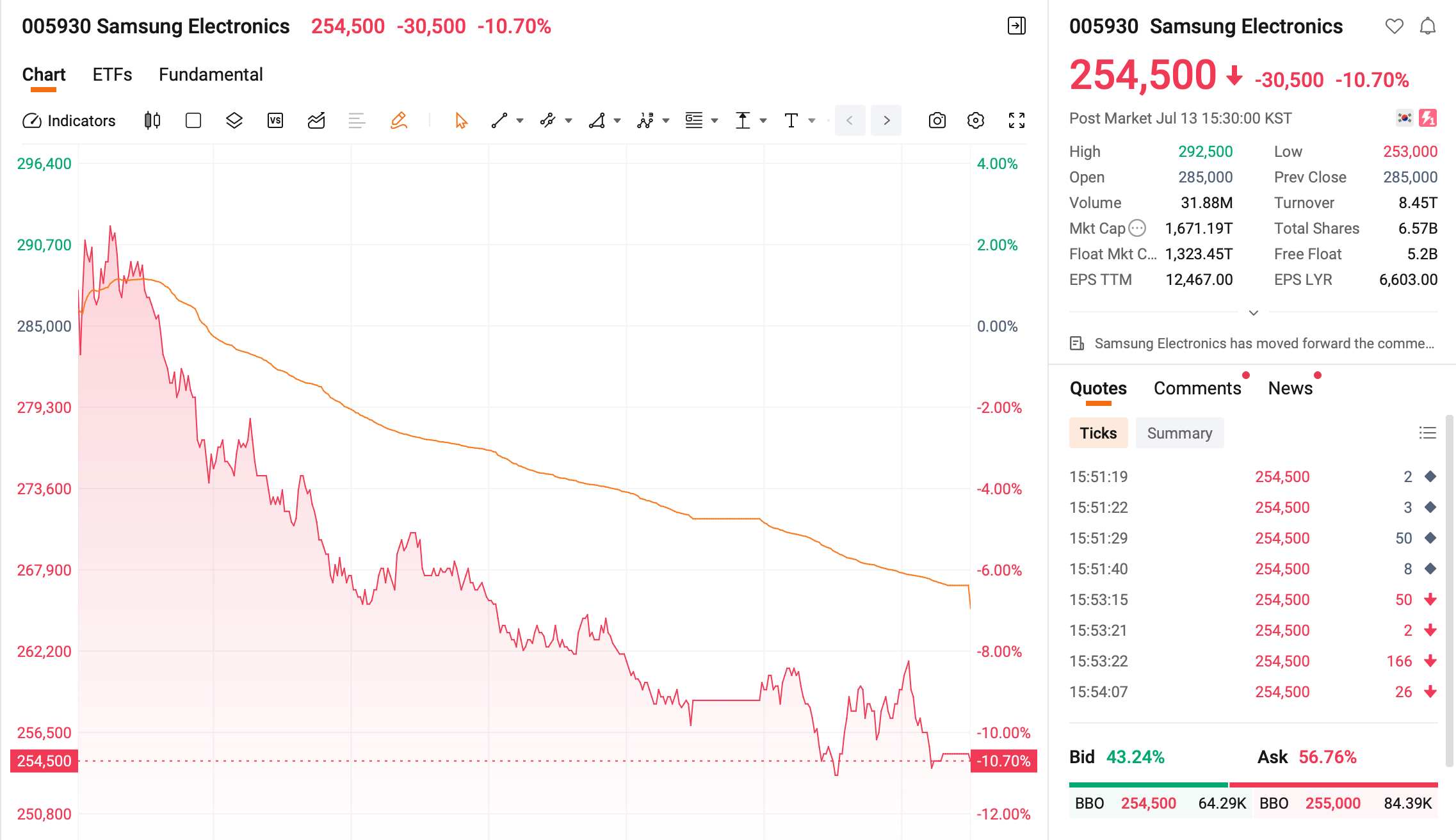
South Korean equities plummeted on July 13 as the KOSPI index fell nearly 9%. Despite news of Samsung Electronics securing a Tesla AI5 chip contract, shares dropped 10.7%. The market downturn was primarily triggered by SK Hynix, which plunged 15.37% after reporting second-quarter operating profits that missed consensus estimates by 8%. Investors reacted to concerns over HBM average selling prices and valuation multiples, viewing the earnings miss as a signal of a cooling semiconductor cycle. Neither central bank assurances nor government pledges for infrastructure support could offset investor panic, resulting in significant sector-wide sell-offs.
TradingKey - During the Asian trading session on July 13, South Korean equities suffered a 'Black Monday.' Despite reports that Samsung Electronics has completed the tape-out of Tesla's AI5 chip and is preparing for production, the company's shares still closed down over 10%, leading losses in the KOSPI Index. The Korea Exchange triggered the 'SIDECAR' intraday circuit breaker to temporarily halt program selling.
[Source: Futu]
On the news front, according to South Korean media reports, James Kim, a chief engineer at Samsung Foundry, confirmed in a LinkedIn post that the Tesla AI5 chip has completed its tape-out and will be manufactured using Samsung's 2-nanometer process at its Taylor, Texas plant, with integration into Tesla's latest products expected soon. Industry analysts noted that this confirms market expectations that Samsung's 2-nanometer yield rate has surpassed 60%. However, Samsung responded by stating that it does not comment on customer-related matters. According to Tesla's roadmap, mass production of the AI5 is expected to kick off in 2027, initially targeting the Optimus humanoid robot and AI supercomputers.
However, the positive foundry news for Samsung Electronics failed to stabilize market sentiment. Today's panic was triggered by an earnings warning from rival SK Hynix, which dragged down the entire South Korean semiconductor sector. On the same day, Korea Investment & Securities (KIS) released a report projecting SK Hynix's second-quarter operating profit to be 60.4 trillion won. Although this represents a massive 556% surge year-on-year, it is about 8% lower than the market consensus estimate of 65 trillion won.
KIS explained in its report that the primary reason for the miss was that HBM accounted for too high a share of SK Hynix's revenue, while its average selling price (ASP) growth lagged the market average. Nevertheless, the report maintained an optimistic outlook, projecting that ASP will return to the market average once HBM4 enters mass production in the third quarter, while reiterating its 'Buy' rating and target price of 3.8 million won. Impacted by this, SK Hynix shares plunged over 15% by the close.
Although Samsung Electronics was not the direct target of the downgrade, it suffered 'collateral damage.' Analysts pointed out that Samsung is already facing intense pressure from TSMC in the advanced node foundry sector. Now that the high-pricing logic of HBM is being questioned and optimistic expectations for the memory chip cycle are wavering, Samsung not only lacks near-term earnings catalysts but must also bear the pressure of a downward shift in the industry's overall valuation multiple.
The Bank of Korea urgently released a report that day, dismissing market concerns that the 'chip cycle has peaked.' However, this only temporarily soothed market sentiment, and the index subsequently accelerated its decline.
Policy support also failed to boost confidence. On the 13th, President Lee Jae-myung chaired a national fiscal strategy meeting to focus on investment directions for 'three major super projects' (semiconductors, physical AI, and AI data centers), with the ruling party promising support through legislation and budget allocations. However, under the dual blow of near-term earnings downgrades and profit-taking, long-term policy tailwinds were clearly unable to offset the immediate market panic.
By the close, South Korea's KOSPI Index fell nearly 9%, slipping below the 6,900-point mark. Samsung Electronics dropped 10.7%, while SK Hynix plunged 15.37%, with both chip giants hitting fresh recent lows.
This content was translated using AI and reviewed for clarity. It is for informational purposes only.
Recommended Articles








Comments (0)
Click the $ button, enter the symbol, and select to link a stock, ETF, or other ticker.