


US Stocks Close: Nasdaq Rises 1.3%, Philly Semiconductor Index Up Over 3%; Meta Denies Excess Computing Power, Tech Stocks Extend Rally, Chip and Optical Communications Shares Lead Gains



AI Podcast


US markets rose as easing oil prices and potential Middle East diplomacy improved sentiment. Tech sector gains were led by chip and memory stocks, with Micron’s $250 billion U.S. expansion highlighting strong AI infrastructure demand. Meta’s shift toward AI commercialization and OpenAI’s efficiency gains underline a focus on deployment ROI. However, macroeconomic risks persist; the Fed signaled potential rate hikes if AI-driven demand fuels inflation, while analysts warn that slower-than-expected AI profitability could trigger systemic market risks. Additionally, June existing-home prices reached record highs amid tight inventory, further complicating the economic landscape.

TradingKey - Trump stated that Iran took the initiative to contact the US to seek a deal, and falling oil prices boosted overall market sentiment. The three major US stock indexes all rose, with tech stocks extending their gains, while chip, memory, and optical communication stocks led the advances.
As of the close, the Dow Jones Industrial Average rose 0.27% to 52,487.41 points; the Nasdaq Composite Index gained 1.30% to 26,206.89 points; and the S&P 500 Index climbed 0.81% to 7,543.64 points.
Performance of technology stocks
Micron (MU) rose 4.52% to close at $991.64. Micron announced today that it will increase its previously announced domestic expansion plan in the U.S. to $250 billion, an increase of $50 billion from its original commitment, proving the explosive growth in demand for memory chips amid the AI infrastructure boom. The related projects cover multiple plant construction plans in New York, Idaho, and Virginia, with overall spending expected to continue through 2035. In addition, Micron stated it will set aside another $3 billion to strengthen the domestic semiconductor supply chain, which includes providing $500 million in strategic financing to Taiwan-based silicon wafer supplier GlobalWafers Co., with both parties signing a ten-year raw materials supply agreement.
Among large-cap tech stocks, Meta Platforms (META) rose 4.70%, Broadcom (AVGO) rose 3.20%, Tesla (TSLA) rose 3.17%, SpaceX (SPCX) rose 2.60%, Amazon (AMZN) rose 1.40%, Apple (AAPL) rose 0.88%, and Microsoft (MSFT) rose 0.27%.
In terms of decliners, Google (GOOGL) fell 0.84% and Nvidia (NVDA) fell 0.66%.
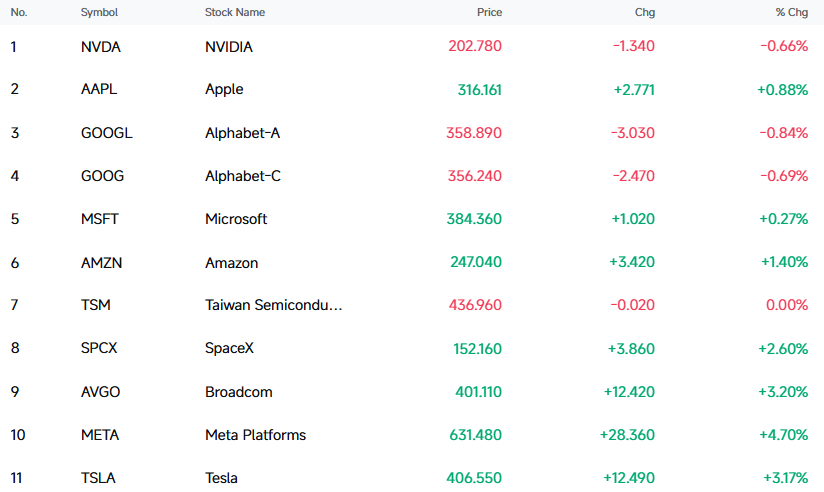
[Source: FutuBull]
The Philadelphia Semiconductor Index rose 3.06% to close at 12,960 points. Among its 30 constituents, 28 rose and 2 fell.
Among chip stocks, Arm Holdings (ARM) rose 9.20%, Advanced Micro Devices (AMD) rose 5.67%, Qualcomm (QCOM) rose 2.44%, and Intel (INTC) rose 2.09%.
Among optical communications stocks, Lumentum (LITE) rose 11.13%, Nokia (NOK) rose 8.08%, Applied Optoelectronics (AAOI) rose 6.79%, Marvell Technology (MRVL) rose 4.99%, and Corning (GLW) rose 4.60%.
Among memory stocks, SanDisk (SNDK) rose 7.59%, Western Digital (WDC) rose 5.04%, Micron Technology (MU) rose 4.52%, and Seagate Technology (STX) rose 3.50%.
Among US-listed Chinese concepts, Alibaba (BABA) rose 1.98%, TAL Education (TAL) rose 1.67%, Futu Holdings (FUTU) rose 1.45%, Pinduoduo (PDD) rose 1.35%, and Zai Lab (ZLAB) rose 1.16%.
Company News
SK Hynix Targets US IPO Pricing of $149
SK Hynix plans to issue ADRs at $149 per share, corresponding to a total fundraising scale of approximately $26.5 billion. If listed at this price, it is poised to break the record held by Alibaba for many years, becoming the largest-ever foreign enterprise IPO in US stock market history. This pricing represents a slight premium of about 3% over its latest closing price on the Korean stock exchange.
TeraWulf Plans $3.5 Billion Debt Issuance to Fund Kentucky Justified Data Center Construction
TeraWulf plans to raise $3.5 billion through a combination of "loans + bonds" to fund the construction of its Justified Data center campus in Kentucky. This marks the company's debut in the leveraged loan market, with the financing led by Morgan Stanley and expected to officially launch within the year.
The core underlying logic supporting this large-scale financing is its long-term, deep partnership with leading AI developer Anthropic. The two parties recently signed a 20-year data center lease with two five-year renewal options, expected to contribute approximately $19 billion in revenue over the full cycle. Combined with two other previously agreed data center chip leasing partnerships, TeraWulf has deeply embedded itself into Anthropic's computing power expansion chain. These stable cash flow expectations provide ample credit support for the debt financing.
Meta Launches Muse Spark 1.1 Model, Doubling Down on Agents and Coding Tracks
Meta has launched its most advanced artificial intelligence model, Muse Spark 1.1, which includes a brand-new paid tier for developers. This marks the first time Meta is charging enterprises for model access, opening up a new revenue stream. In an interview prior to the release, Mark Zuckerberg stated that this will become one of the most cost-effective choices on the market.
Meta's AI business is shifting from technology R&D to large-scale commercialization. Alexandr Wang, head of the AI business, drove rapid product iteration in just three months, launching the Muse Spark 1.1 large language model and the Muse Image generation model in quick succession this week to round out the multimodal product matrix. This officially mounts a direct challenge against the high-end model market dominated by OpenAI and Anthropic.
Meta's Self-Developed AI Chip 'Iris' set for Mass Production as Early as September
According to an internal memo seen by Reuters, Meta plans to start mass production of its self-developed AI chip, code-named "Iris," as early as this September, and aims to maintain an iteration pace of launching a new generation of chips roughly every six months through 2027. The company's goal is to double its total data center computing capacity to 14 gigawatts (GW) by 2027. This indicates that Meta is accelerating its push to reduce its heavy reliance on Nvidia GPUs, lowering AI infrastructure costs and enhancing computing power autonomy through proprietary chips.
Meta Denies Computing Power Overcapacity
Meta Platforms CEO Mark Zuckerberg stated that the company needs to acquire as much computing power as possible. However, in a market where resources needed to run and develop AI products are in short supply, he is also considering whether leasing a portion of Meta's AI infrastructure to external enterprises would yield higher value. Zuckerberg remarked that under certain circumstances, leasing computing power resources or considering such transactions might make more sense than internal utilization.
OpenAI Launches New GPT-5.6 Sol Series Models, Boosting Agentic Coding Efficiency by 54%
OpenAI CEO Sam Altman stated that the company's latest artificial intelligence model, GPT-5.6 Sol, has improved token efficiency in agentic coding tasks by 54%, with overall performance rivaling top industry competitors. This essentially reduces unit computing costs through technical optimization, aligning with enterprises' core focus on AI ROI, and signaling that industry competition is shifting from a pure comparison of parameter scale to commercial cost-effectiveness and deployment efficiency.
Industry & Macroeconomic News
New York Fed President Williams: AI Demand is Core Inflation Concern; Rate Hikes Forced If Inflation Keeps Rising
The demand expansion driven by AI has officially entered the Federal Reserve's core inflation decision-making framework. The latest statement from New York Fed President John Williams made it clear: the sustained demand shock brought by AI is currently the variable most worthy of attention regarding inflation. If it continues to drive supply-demand imbalances and exacerbate inflation stickiness, the Fed will initiate interest rate hikes to counter it, thoroughly shattering the market's previous perception that tech investment does not affect monetary policy.
CFTC Suspends Approval of CME's Around-the-Clock Crude Oil Futures Listing
The U.S. Commodity Futures Trading Commission (CFTC) has blocked CME Group's application to launch around-the-clock crude oil futures trading. It is understood that this product could have been listed for trading as early as this Friday, but now it can only be transferred to the regular, long-cycle approval process, bringing the regulatory disagreements over rules between the exchange and regulators officially to the surface.
The core dispute between the two parties lies in the listing standards for the new contracts. According to industry practice, small-denomination contracts derived from mature underlying assets can typically be quickly listed within 24 hours through a self-certification channel. However, the CFTC believes that 24-hour uninterrupted trading represents a major mechanism adjustment affecting market operations and cannot simply apply existing rules. As early as June, when CME officially announced the August launch of around-the-clock crude oil futures, regulators had already made it clear that they would initiate a systematic review of all categories of 24/7 futures and energy perpetual contracts, opposing the exchange's rushed implementation without a comprehensive analysis.
U.S. Home Prices Hit Record High in June as Sales Fall 2.4% MoM
Data from the National Association of Realtors (NAR) showed that existing home sales in June fell 2.4% month-on-month to 4.09 million units, while increasing 2.8% year-on-year, whereas housing market analysts had generally expected a slight MoM increase in sales. At the end of June, total housing inventory nationwide stood at 1.56 million units, down 0.6% from May but up 1.3% from June 2025. Based on the current sales pace, this inventory represents a 4.6-month supply, whereas the industry typically views a 6-month supply as a balanced market for buyers and sellers. Persistently tight inventory supported further home price increases. Notably, the median existing-home sales price in June was $440,600, up 1.8% year-on-year, marking a record high.
Economist: If AI Profit Materialization is Slower Than Market Expectations, It Will Spread from Tech to Become a Systemic Risk for the Entire Market
Apollo's chief economist warned that if AI profit materialization is slower than market expectations, it will spread from the tech sector to become a systemic risk for the entire market. Wall Street currently widely expects hyper-scale cloud providers' free cash flow to double by 2030. However, this consensus faces the dual challenges of falling token prices and Chinese AI models surpassing the US in market share and usage, posing a significant downward revision risk for leading tech earnings. As the core heavyweights of US stocks, any price adjustment of the Magnificent Seven will transmit along the entire industry chain, dragging down the S&P 500 and potentially even spreading to the real economy to trigger a recession.
This content was translated using AI and reviewed for clarity. It is for informational purposes only.
Recommended Articles









Comments (0)
Click the $ button, enter the symbol, and select to link a stock, ETF, or other ticker.