


Tesla’s Q2 Deliveries of 480,000 Far Exceeded Expectations, Why Did the Stock Price Plunge 7.49% to Record the Biggest Drop in a Year?



AI Podcast


On July 2, local time, Tesla reported Q2 2026 deliveries of 480,126 vehicles, significantly exceeding analyst expectations. While growth in China and Europe helped inventory digestion, shares dropped 7.49% as markets had already priced in these results. Investors remain focused on Tesla’s AI and FSD narrative, as its 204x forward P/E ratio discounts traditional auto metrics. Despite record EV shipments, BYD reclaimed the global lead, and competitive pressures, alongside reliance on price incentives, pressure profit margins. Future performance hinges on AI development and navigating macroeconomic risks, as core vehicle sales face intensified industry competition.

TradingKey - On July 2, local time, Tesla ( TSLA) released its production and delivery data for the second quarter of 2026, delivering results that far exceeded market expectations.
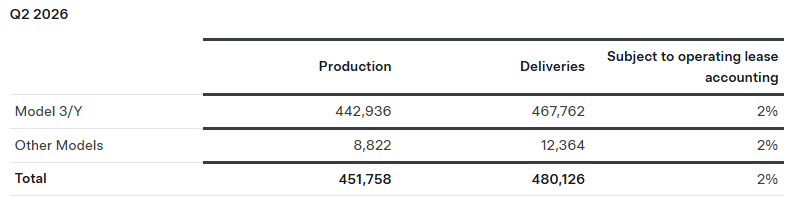
During the quarter, the company produced 451,758 vehicles and delivered 480,126, representing a 25% year-on-year increase and a 34% quarter-on-quarter increase. This not only significantly exceeded Bloomberg's consensus estimate of 406,000 vehicles, but also surpassed Goldman Sachs' most optimistic forecast of 420,000 vehicles.
Source: Tesla
Munster, Managing Partner at Deepwater Asset Management, noted: "Tesla's delivery data is the first sign that we are emerging from the 'EV winter' that began in March 2024."
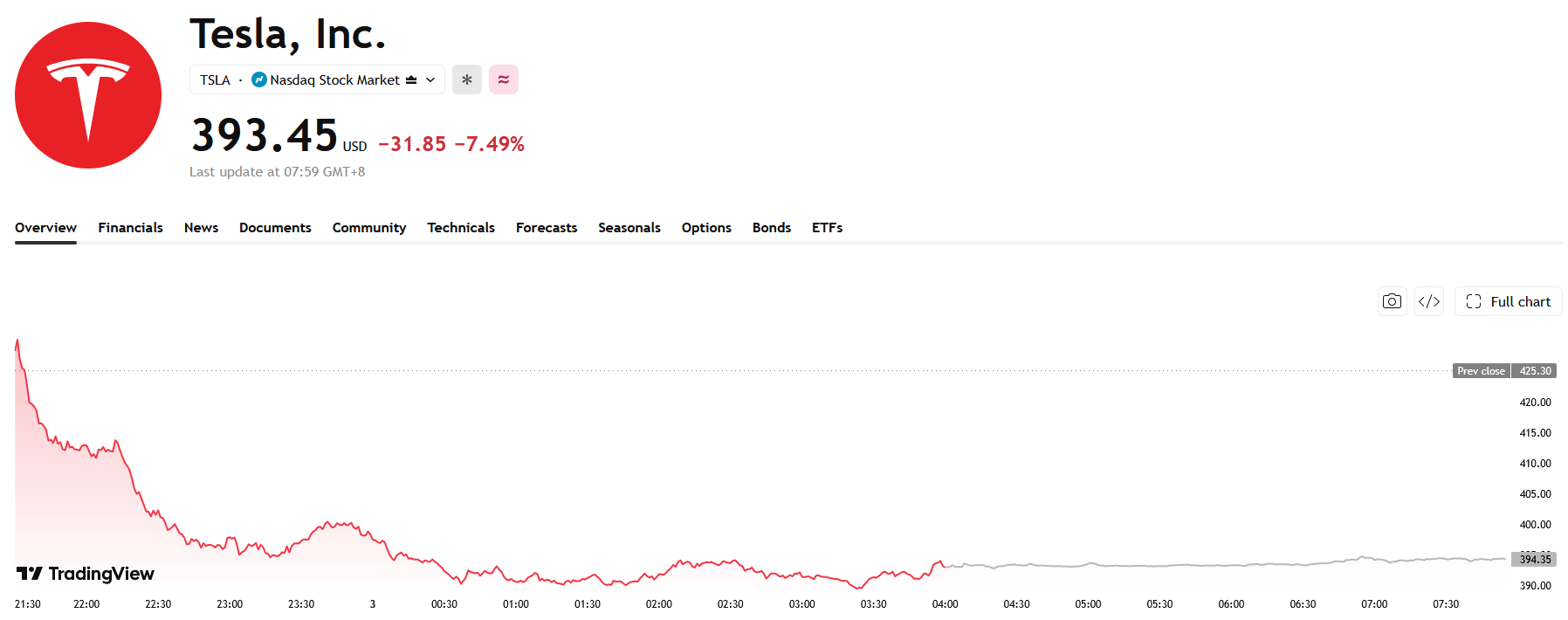
However, the stellar data failed to boost the stock price, as Tesla closed down 7.49% on the day at $393.45, marking its largest single-day drop in nearly a year.
Source: TradingView
Tesla's Q2 Deliveries Significantly Beat Expectations
Tesla's deliveries this time significantly exceeded expectations, primarily driven by strong performance in the Chinese and European markets. CFRA Research analyst Garrett Nelson pointed out that after the elimination of the $7,500 U.S. vehicle purchase subsidy, demand recovered faster than expected, while in the European market, consumer enthusiasm for electric vehicles rose significantly, fueled by rising oil prices driven by the conflict in Iran.
Furthermore, Tesla's second-quarter deliveries exceeded production by approximately 28,000 vehicles, indicating that the company successfully absorbed about 50,000 vehicles of leftover inventory from the first quarter, reversing the previous trend where capacity growth outpaced demand absorption.
In terms of vehicle models, Model 3 and Model Y remain the absolute mainstays, with deliveries reaching 467,762 vehicles, accounting for approximately 97.4% of total deliveries. Meanwhile, demand for the Cybertruck continues to be weak; were it not for bulk purchases by SpaceX, the overall delivery figures would have been even less impressive.
It is worth noting that this quarter may be the last one in which Model S and Model X benefit from the "last chance sale" effect, as Tesla ceased production of these two luxury models in May to shift capacity toward the Optimus humanoid robot.
Why did the stock price fall instead of rise?
The primary reason for the sharp decline in Tesla's stock price is that the rally over the previous four consecutive trading days had already fully priced in the positive news of better-than-expected deliveries.
Munster believes that investors had already bet on strong delivery data, leaving the market with little reason to remain excited when the news was officially announced.
Furthermore, Tesla's current forward P/E ratio of 204 times has long detached from the valuation logic of traditional automakers; investors are more focused on the grand narrative of integrating Musk's aerospace, electric vehicle, and artificial intelligence businesses, rather than simple growth in car sales.
Although Tesla's energy storage product deployment reached 13.5 GWh in the second quarter, representing a 53% increase from the first quarter, it fell slightly short of the market expectation of 13.8 GWh, failing to deliver an extra surprise to investors.
Truist analyst William Stein emphasized that compared to vehicle deliveries, the progress of AI projects—especially FSD (Full Self-Driving)—is far more critical to Tesla's long-term cash flow and stock performance.
Intensifying industry competition leaves Tesla facing multiple challenges
Ford ( F) saw its total sales decline by 10% in the second quarter, with electric vehicle sales dropping 40.7%. General Motors ( GM) experienced a 4.2% drop in quarterly sales and noted that the electric vehicle market remains small. Lucid ( LCID) reported lower-than-expected deliveries and announced a series of organizational restructurings. In contrast, Rivian ( RIVN) delivered a stellar performance, with last quarter's deliveries exceeding expectations and the company raising its full-year delivery target.
Notably, BYD delivered 557,090 all-electric vehicles in the second quarter, outperforming Tesla by 77,000 units to reclaim its position as the global leader.
To remain competitive, Tesla not only needs to continuously boost sales but also must ensure healthy profit margins. To meet its delivery targets, Tesla has relied on price cuts and promotional incentives, which inevitably squeeze its profit margins.
In addition, factors such as U.S. inflation, changes in trade policies, and rising chip costs could present further challenges for Tesla in the future.
This content was translated using AI and reviewed for clarity. It is for informational purposes only.
Recommended Articles










Comments (0)
Click the $ button, enter the symbol, and select to link a stock, ETF, or other ticker.