


Countdown to US-Iran Ceasefire Begins: Will US Stocks See an Accelerated Short-Covering Rally?



AI Podcast


A potential U.S.-Iran deal, finalized May 23 Eastern Time, suggests a ceasefire and gradual lifting of shipping restrictions. This news prompted a decline in WTI crude to $90 and Brent crude below $100. Markets previously pressured by high interest rates and sticky inflation due to Middle East tensions saw short positions in U.S. macro products surge. As ceasefire expectations rise, oil prices retreat, and Fed rate hike expectations ease, these short positions are being covered, triggering a potential short-squeeze rally, particularly in tech stocks. Despite this, underlying geopolitical divisions and the risk of negotiation collapse remain.

TradingKey - On May 23, Eastern Time, Donald Trump announced on social media that a U.S.-Iran deal is "essentially finalized" and the Strait of Hormuz will reopen accordingly. Although Iran quickly responded that Trump's claims were "incomplete"—emphasizing that the strait would remain under Iran's full control even if a deal is reached—it also acknowledged that both sides are in the final stages of finalizing a memorandum.
According to sources, the ceasefire could be extended by 60 days, and Iran's shipping restrictions in the strait, along with the U.S. naval blockade, are expected to be gradually lifted during negotiations. Secretary of State Marco Rubio confirmed the same day that negotiations "are making progress."
Oil prices moved first. During the Asian trading session on May 25, WTI crude fell to the $90 level, while Brent crude broke below the $100 mark to $97. Crude oil prices are highly sensitive to improvements in supply, and crowded long positions quickly cleared out once the news was clarified.
For the past several months, the market has faced two-way pressure: expectations that the Federal Reserve will maintain high interest rates or even hike them, and sticky inflation caused by high oil prices due to ongoing Middle East tensions. Shorting U.S. macro products (indices and ETFs) became a consensus trade to hedge these two risks.
Goldman Sachs prime brokerage data shows that short positions in U.S. macro products have surged to a 10-year high, even exceeding levels seen before the Iran situation intensified.
Now, as expectations for a U.S.-Iran ceasefire rise and oil prices retreat quickly, coupled with a marginal loosening of Fed rate hike expectations, positions previously forced into shorts to hedge macro risks find themselves on the wrong side of the trade. The Goldman Sachs trading desk warned that short positions have accumulated to a tipping point: "either they don't rise, or they trigger a stampede if they do."
Notably, the pace of short covering is accelerating. A Goldman Sachs report shows that short positions in U.S.-listed ETFs fell by 4% for the first time in three weeks, driven primarily by short covering in large-cap and tech ETFs. The tech sector saw its fastest net buying since mid-March, as the shift between bulls and bears creates an irreversible migration of positions.
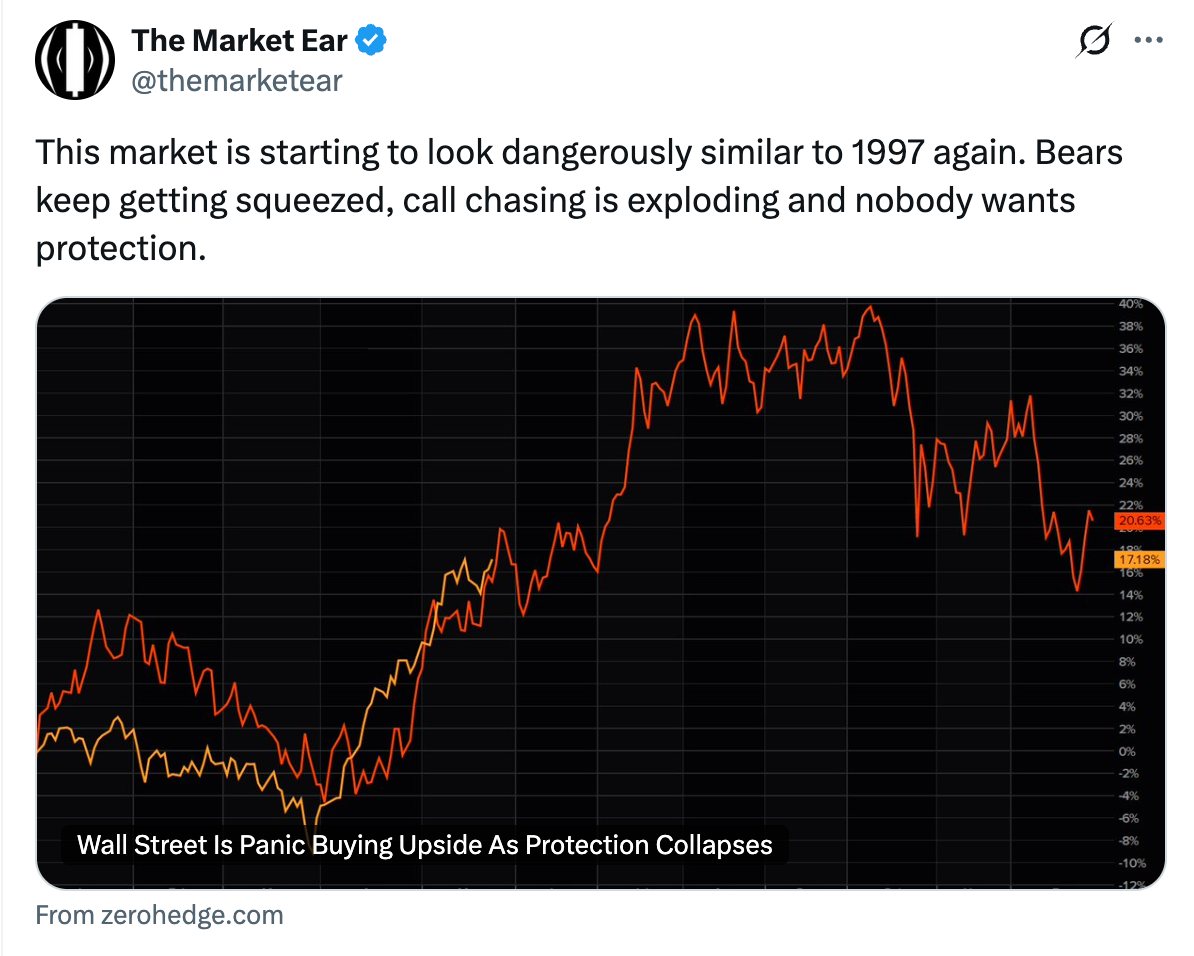
Explosive growth in call option buying has reinforced this trend, with nearly 25% of S&P 100 components showing an inverted call skew—a mirroring of the option structure seen during the 2021 meme stock mania.
The Goldman Sachs trading desk explicitly noted that the core conflict is not fundamentals, but rather that excessive short positioning, once triggered for covering, will create a self-reinforcing spiral: "rising prices force shorts to cover, which drives prices higher, leading to even more short covering."
Previous data showed that NVIDIA held the largest net short exposure in the S&P 500 at approximately $62.5 billion, far exceeding Apple's $38.5 billion and Microsoft's $33.7 billion. Once the external environment eases, the short-squeeze chain for these high-exposure stocks will be the first to ignite.
How will markets react if a ceasefire officially takes effect?
Under an optimistic scenario, once a ceasefire is implemented, the combination of short positioning at ten-year highs suggests U.S. stocks will face a systemic short-covering rally. The synchronized decline in oil prices and Treasury yields will remove the two primary constraints suppressing tech valuations, and the resulting chain reaction of short covering could drive gains beyond what fundamentals alone can explain.
In a neutral scenario, even if only a temporary ceasefire is reached rather than a permanent settlement—with Iran merely restoring pre-war transit volumes while the Strait remains under its "management"—as long as geopolitics shifts from a chaotic shock to a managed standoff, capital previously forced to hedge macro risks through short positions will still view this as a signal to de-risk.
Judging by Iran's hardline stance on sovereignty and the opposing positions on the nuclear issue, deep-seated divisions remain. Should the final stage of negotiations collapse again, oil prices could rebound swiftly, and the short-covering rally would likely reverse.
This content was translated using AI and reviewed for clarity. It is for informational purposes only.
Recommended Articles








Comments (0)
Click the $ button, enter the symbol, and select to link a stock, ETF, or other ticker.