


Kospi Slumps Over 3%, Nikkei 225 Falls Below 60,000 as SK Hynix and Kioxia Tumble Over 7%



AI Podcast


During the Asian session on November 16, Japanese and South Korean equity markets suffered sharp declines amid regional selling pressure and spillover volatility from U.S. tech stocks. The KOSPI tumbled 3.59% to close at 5,100.25 points, weighed down by heavyweights like SK Hynix and Samsung Electronics, and faces a critical test of the 5,000 level. The Nikkei 225 dropped 2.42% to 59,661.80 points, breaching the key 60,000 threshold with support eyed near 58,500. Investor sentiment remains cautious ahead of Nvidia’s upcoming earnings and AI capital expenditure guidance, which will dictate near-term stabilization for the global semiconductor sector.
TradingKey - Japanese and South Korean stocks plummeted, with the KOSPI tumbling 3.59% to near 5,000 points and the Nikkei surrendering the key 60,000-point level.
During the Asian session on November 16, Japanese and South Korean equity markets opened slightly higher before quickly facing heavy cross-market selling pressure across the Asia-Pacific region and spillover volatility from U.S. tech stocks, trending lower throughout the day to finish sharply down.
The benchmark KOSPI tumbled 3.59% to close at 5,100.25 points. Heavyweight stocks led the broad market decline, with SK Hynix sinking 7.89% to 1,120,000 won and Samsung Electronics dropping 4.95% to end at 196,000 won.
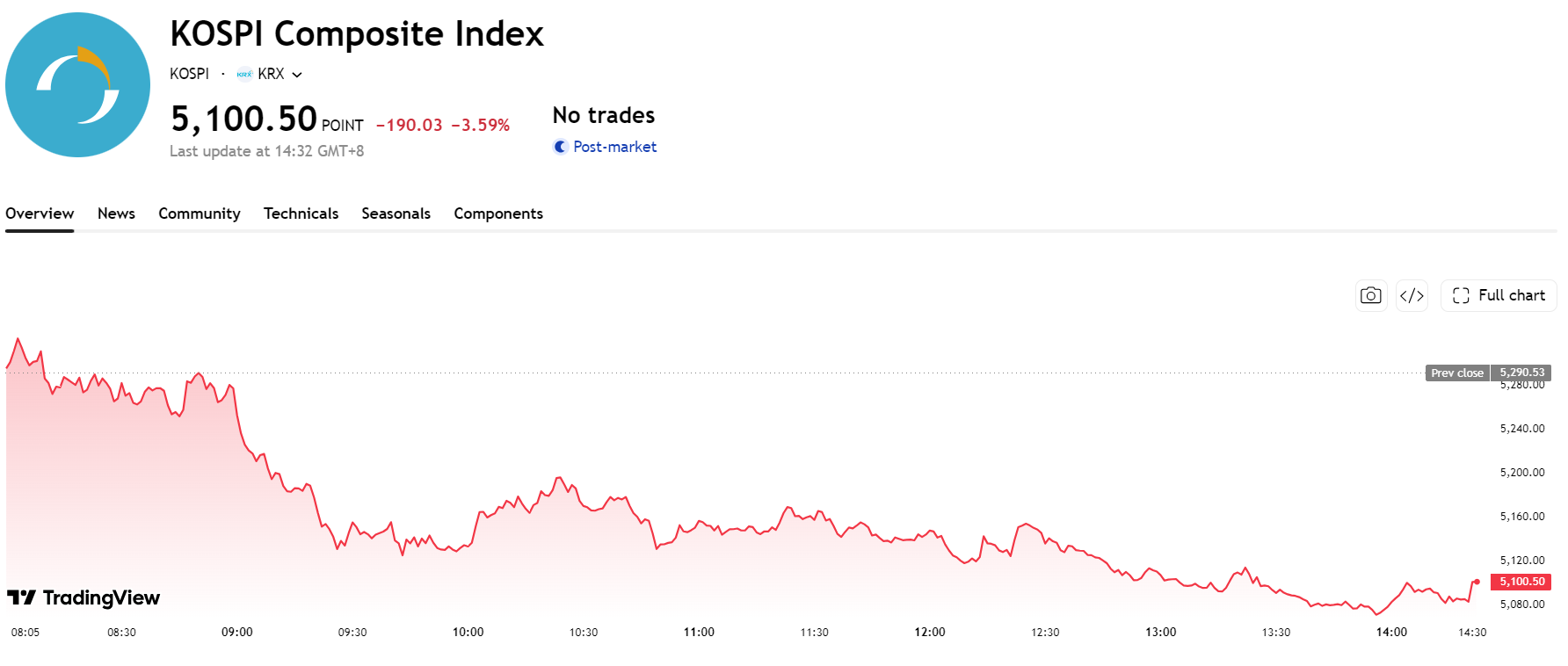 KOSPI Index Chart, Source: TradingView
The Nikkei 225 hit an intraday high of 61,389 points before collapsing under selling pressure, ultimately breaking below the key 60,000-point mark to slide 2.42% and close at 59,661.80 points; Kioxia plunged 7.69% to close at 8,392 yen, and SoftBank dropped 3.69% to 3,416 yen.
After falling below 60,000 points, the Nikkei 225 will seek strong short-term support in the 58,500–59,500 range, while South Korea's KOSPI faces a critical battle to defend the key 5,000-point mark. This Tuesday, Nvidia (NVDA) will report earnings and provide AI capex guidance, which will directly determine whether the global semiconductor sector can stabilize and recover.
This content was translated using AI and reviewed for clarity. It is for informational purposes only.
Recommended Articles









Comments (0)
Click the $ button, enter the symbol, and select to link a stock, ETF, or other ticker.