


Japan, South Korea Stocks Stage V-Shaped Rebound; Kospi Holds 7,000 Level as Samsung, SK Hynix and Kioxia Defy Decline



AI Podcast


During Asian trading on September 10, Japanese and South Korean stock markets initially declined due to crude oil surpassing $100 per barrel and Wall Street's overnight losses. However, afternoon bargain-hunting and recovering tech shares sparked a V-shaped rebound. The Nikkei 225 closed 0.2% higher at 65,270.95, while the KOSPI Index dipped 0.25% to 7,033.92, maintaining the 7,000 threshold. Major tech heavyweights narrowed earlier losses. Overall trading enthusiasm remained subdued as investors awaited upcoming U.S. PPI and CPI data to assess the Federal Reserve’s future monetary policy trajectory amid ongoing macroeconomic uncertainty.

TradingKey - Nikkei 225 rallied late in the session to close 0.2% higher, Korean stocks held firmly above the 7,000 mark, and Kioxia, Samsung, and SK Hynix narrowed losses.
During Asian trading on September 10, Japanese and South Korean stock markets both opened under downward pressure, weighed down by inflation anxieties as crude oil prices breached $100 per barrel and overnight losses on Wall Street. In the afternoon, driven by bargain-hunting capital and narrowing losses in the tech sector, performance diverged, displaying a V-shaped pattern of a choppy dip followed by a modest rebound.
Among them, the KOSPI Index closed down 0.25% at 7,033.92 points, holding above the 7,000 mark. The two major heavyweights both fell sharply in morning trading before gradually rebounding in the afternoon to narrow their losses, with Samsung Electronics slipping 0.19% to close at 269,000 won and SK Hynix dropping 0.16% to 1,853,000 won.
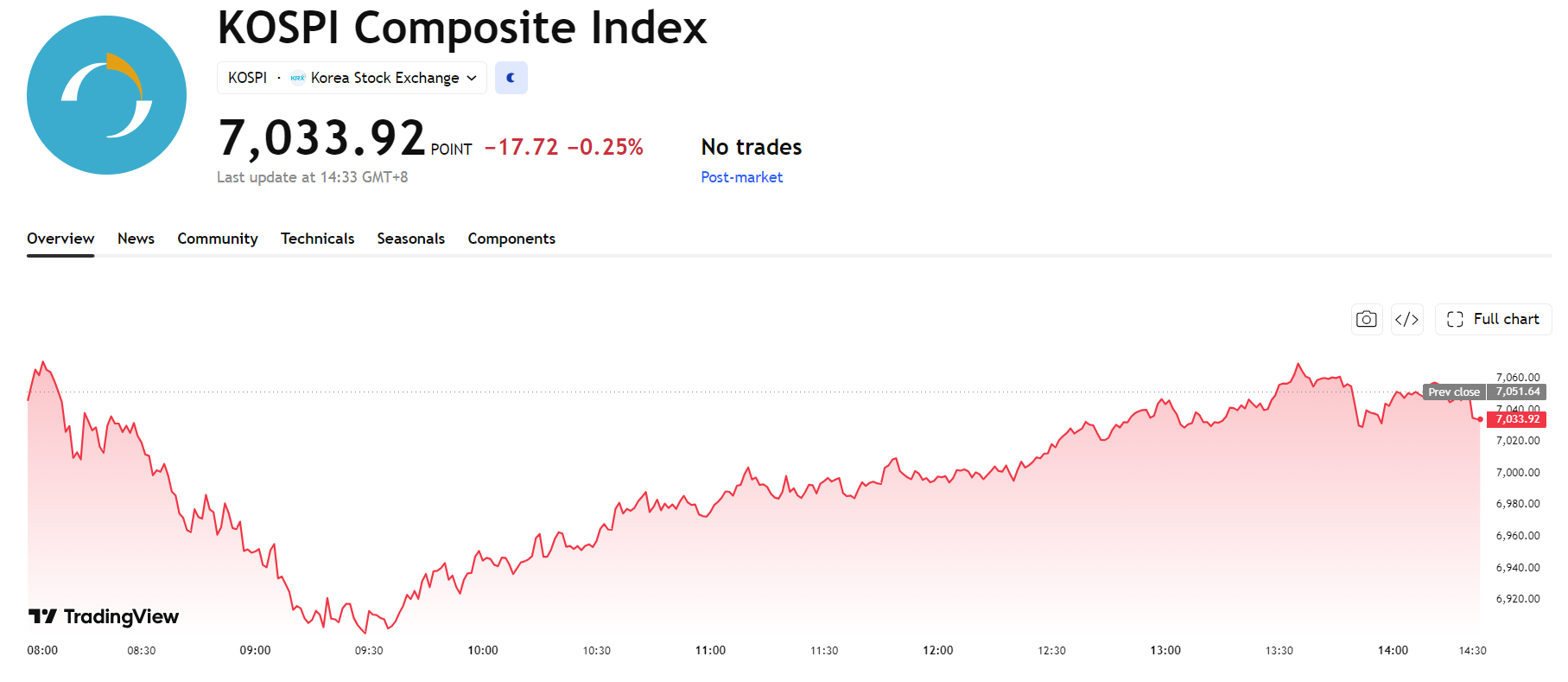 KOSPI Index Chart, Source: TradingView
The Nikkei 225 Index saw a notable late-session rally, ultimately closing up 0.2% at 65,270.95 points. Performance among the two major heavyweights diverged: Kioxia surged 1.91% to close at 58,090 yen, while SoftBank erased its morning losses to finish flat at 6,810 yen.
Markets are closely monitoring upcoming U.S. economic and inflation data, including the PPI and CPI, to gauge the Federal Reserve's (Fed) future interest rate path. Macroeconomic policy uncertainty has dampened overall trading enthusiasm across Asian markets, keeping bulls and bears fluctuating near breakeven levels.
This content was translated using AI and reviewed for clarity. It is for informational purposes only.
Recommended Articles









Comments (0)
Click the $ button, enter the symbol, and select to link a stock, ETF, or other ticker.