


Kioxia Falls Over 60% From High: What Is the Market Worried About Amid Stock Volatility?



AI Podcast


Kioxia shares experienced volatility on July 30, retreating after an early 16% surge to close up 2.92%. Despite a historic 48-fold gain since its late 2024 listing, the stock has plummeted over 60% from its peak. Markets remain concerned about looming NAND flash oversupply by 2027, driven by capacity expansion among global competitors and emerging Chinese players. Additionally, Bain Capital’s recent total stake liquidation has dampened investor sentiment. While Q1 earnings are anticipated on July 31, the stock requires significant positive guidance on capital expenditures and production to stabilize amidst persistent selling pressure and bearish industry outlooks.
TradingKey - During the Asia-Pacific session on July 30, Kioxia's share price surged over 16% in early trading but subsequently pared gains, closing up just 2.92% at 39,500 yen (approximately $241).
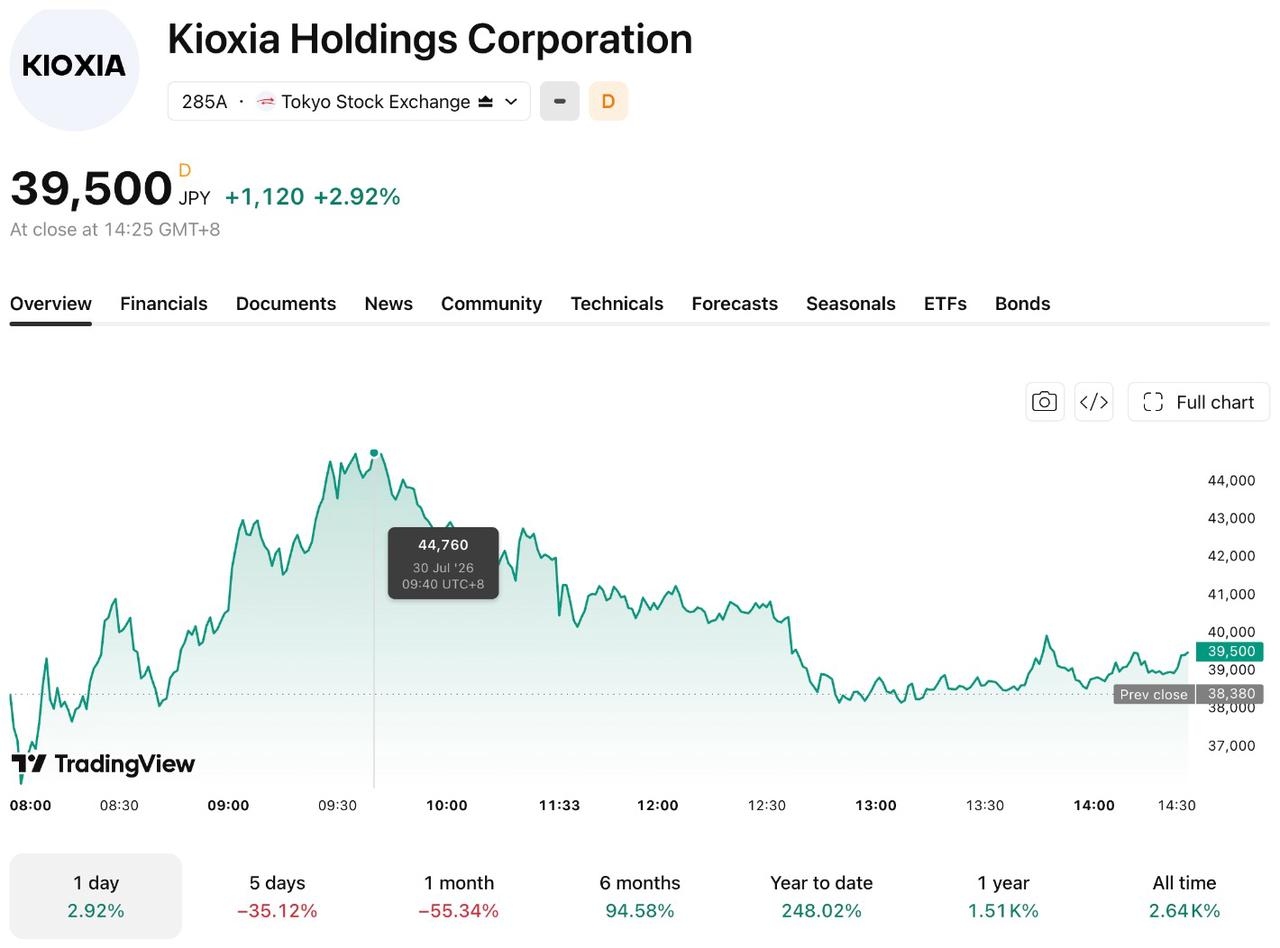
[Source: TradingView]
In mid-June, Kioxia's market capitalization reached 56 trillion yen (approximately $345 billion), briefly overtaking Toyota Motor to become Japan's most valuable company. Driven by an explosion in structural demand for NAND flash memory fueled by AI, the stock had surged up to 48-fold at its peak since its listing in late 2024.
However, the situation has taken a sharp downturn over the past month. As of Thursday's close, Kioxia has plummeted more than 60% from its peak, with an 18% drop on Tuesday, July 28 alone. Today's attempted rebound was interpreted by the market as a technical correction following an oversold condition, rather than a reversal driven by improving fundamentals. The intraday rise and subsequent fallback indicates that selling pressure remains strong at this level.
What is the market worried about? In the short term, the biggest concern is the shift on the supply side. On one hand, Samsung, SK Hynix ( SKHY) and Kioxia itself have been significantly expanding capacity over the past two years, with high-end NAND capacity gradually coming online. On the other hand, the rapid rise and aggressive capacity expansion of China's ChangXin Memory Technologies and Yangtze Memory Technologies are accelerating an industry-wide shakeout, directly forcing Japanese and South Korean giants into a more brutal competition in the flash memory sector.
The simultaneous surge in both internal and external supply has prompted many investors to worry ahead of time about a potential oversupply from late 2026 to 2027, and the brutal price war that could follow.
Another widely discussed factor is the exit of Bain Capital. The private equity firm, which had held Kioxia for nearly a decade, liquidated its entire stake in early July, yielding total proceeds of approximately $17 billion. Some institutions believe that the fact that such a large block of shares found buyers indicates that purchasing demand still exists. However, Bain's complete exit has indeed prompted some investors to reconsider the stock's medium-to-long-term value.
For now, the market's main focus is on the upcoming earnings report to be released on Friday, July 31. Kioxia's guidance in May projected first-quarter operating profit of 1.3 trillion yen, a sequential increase of 117%. However, amid the current bearish sentiment, an earnings report that merely 'meets expectations' may not be enough to reverse the decline. Investors are more keen to see management's concrete plans for subsequent capital expenditures, production capacity pacing, and shareholder returns. Only information that significantly beats expectations is likely to truly stabilize the stock price at this level.
This content was translated using AI and reviewed for clarity. It is for informational purposes only.
Recommended Articles





Comments (0)
Click the $ button, enter the symbol, and select to link a stock, ETF, or other ticker.