


SoftBank CEO Masayoshi Son Says AI Needs $5 Trillion Annual Investment by 2040, Dismisses AI Bubble Theory as ‘Absurd’



AI Podcast


SoftBank Group CEO Masayoshi Son projects the AI sector will require $5 trillion in annual investment by 2040, dismissing concerns of an asset bubble. He envisions a society dominated by 100 trillion AI agents, supported by a transition from natural gas to nuclear fusion for power. Despite this bullish outlook, SoftBank faces significant volatility as delays in OpenAI’s IPO extend monetization timelines and weigh on stock performance. While the company aggressively expands its AI footprint, market skepticism regarding valuations and high-growth delivery remains a primary risk factor impacting investor confidence and share price stability.
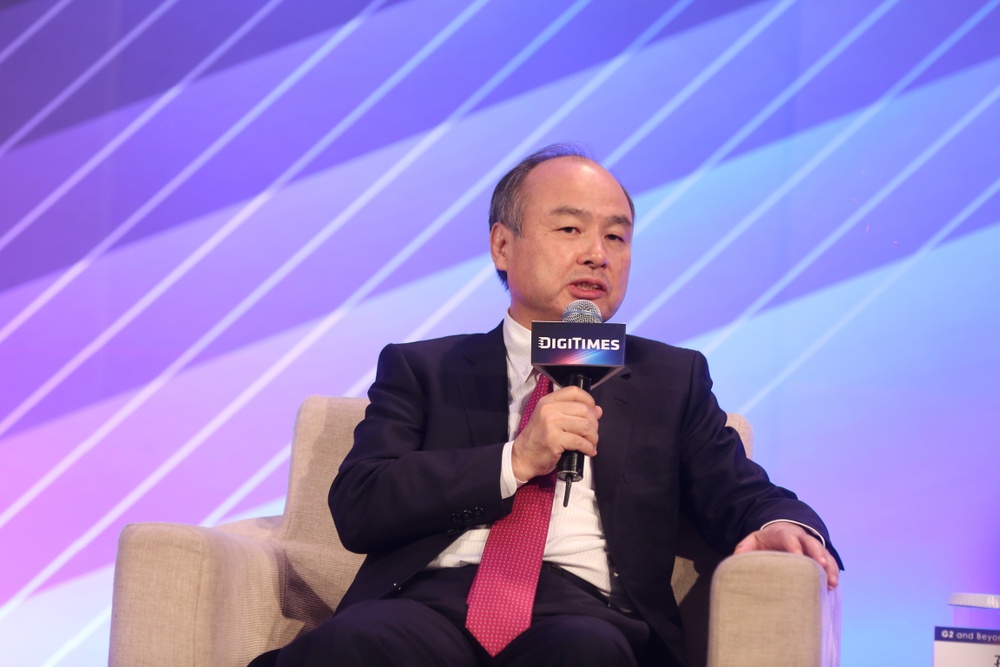
TradingKey - During Asian trading hours on July 14, SoftBank Group CEO Masayoshi Son predicted at the company's annual corporate meeting in Tokyo that by 2040, the AI sector would require an annual investment of $5 trillion (approximately 800 trillion yen). He flatly dismissed market concerns about an AI bubble, calling the question itself "absurd."
Son is known for his bold bets on transformative technologies. 'Five trillion dollars a year, you might think that is unbelievable, but I firmly believe this is the cost required,' he said at the meeting. He further argued the feasibility of his business model: 'By 2040, if AI revenue accounts for 20% of global GDP, then an annual expenditure of 800 trillion yen is just a rounding error.' However, he did not elaborate on the specific calculation basis for the $5 trillion forecast.
Son explicitly refuted market doubts regarding an AI valuation bubble. He believes that those who ask such questions 'don't understand what AI is at all.' This aligns with his consistent previous position that 'calling AI a bubble is a blasphemy against AI.' In his view, the revolutionary impact of AI is still in the early stages of being unleashed.
Regarding the energy support required for computing power, Son also made an assessment. He expects that by 2040, the electricity demand of AI data centers will reach 3 terawatts, equivalent to 1.8 times the current global power consumption. On the supply side, it will initially rely mainly on natural gas power generation, but with technological evolution, nuclear fusion is expected to replace natural gas as the primary energy source in about 15 years.
Over the past two years, SoftBank has executed a large-scale investment layout, pouring tens of billions of dollars into OpenAI and providing substantial funding for data centers and robotics companies. Currently, SoftBank's cumulative investment in OpenAI is expected to exceed $60 billion by the end of 2026, a direction that has become SoftBank's most confident investment focus.
Son also painted a picture of society in 2040: by then, there will be 100 trillion AI agents capable of autonomous decision-making, action, and communication, and the world will shift from human-centric to agent-centric. 'The era of the highest life form on Earth will end,' he said. 'For better or worse, this will happen and cannot be stopped.'
However, SoftBank's massive AI gamble is currently facing multiple real-world tests.
On June 26, rumors of OpenAI delaying its IPO hit SoftBank's stock price hard. According to media reports, OpenAI has confidentially filed for a listing, but management leans toward delaying the IPO until 2027.
The delay is primarily based on two considerations: first, the recent sharp fluctuations in AI concept stocks have led investors to question whether the relevant companies can deliver on their high-growth expectations; second, SpaceX's post-listing stock performance fell short of expectations, casting a shadow over OpenAI's goal of hitting a trillion-dollar valuation. With SoftBank's cumulative investment in OpenAI exceeding $60 billion, the delayed IPO means the monetization cycle for this investment will be prolonged.
On June 26, SoftBank's stock price plunged over 13% in a single day, wiping out 5.6 trillion yen in market value. Over the subsequent trading sessions, SoftBank continued its decline, falling over 5% on June 29 and slipping below the 6,000 yen mark.
Entering July, after briefly stabilizing around 6,200 yen, SoftBank's stock price fell to as low as 5,567 yen on July 8. On July 14, SoftBank's stock price slumped over 5% in early trading. However, on the same day, Son made optimistic AI predictions at the annual meeting, and SoftBank received buying support intraday, subsequently rebounding to close up 3.3% at 6,574 yen.
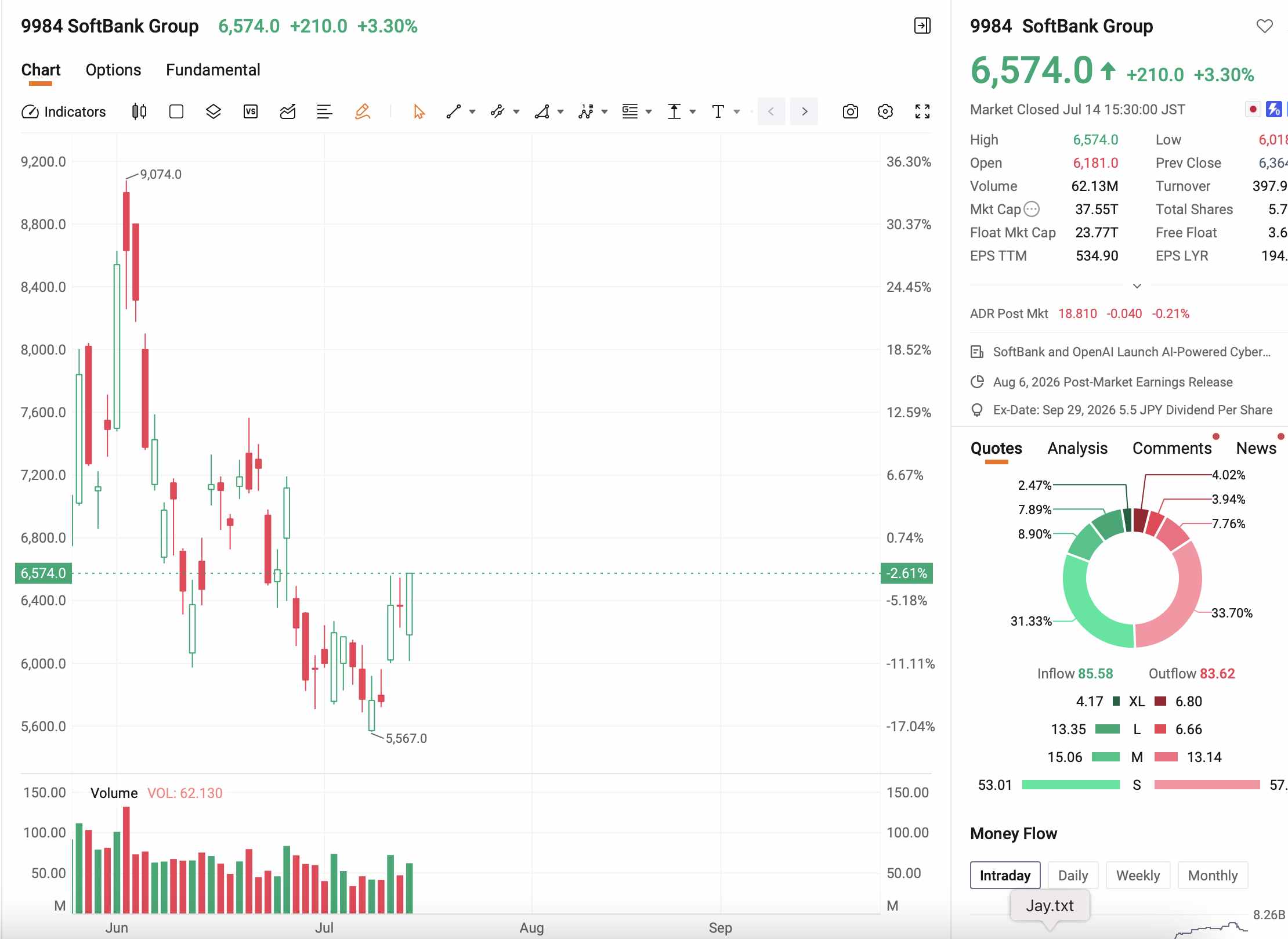
[Source: Futu]
This content was translated using AI and reviewed for clarity. It is for informational purposes only.
Recommended Articles







Comments (0)
Click the $ button, enter the symbol, and select to link a stock, ETF, or other ticker.