


Ripple’s Bell-Ringing Countdown? CEO Talks Up IPO: Will XRP Holders Get a Piece of the Pie or Be Marginalized?



AI Podcast


Ripple CEO Brad Garlinghouse’s suggestion of potential "special arrangements" for XRP holders during a future IPO has generated market interest, yet failed to catalyze price growth. While a public listing could enhance institutional credibility and adoption, it remains a double-edged sword. Investors fear that Ripple stock might divert institutional capital away from the token, causing a liquidity drain. Furthermore, the necessity to meet Wall Street’s quarterly financial expectations could lead to more systematic, long-term monetization of Ripple’s XRP escrow holdings, creating persistent selling pressure that offsets potential benefits of increased corporate transparency.
TradingKey - Ripple CEO Brad Garlinghouse says an IPO could offer special arrangements for XRP holders, but why hasn't the XRP price risen significantly?
Recently, Ripple ( XRP) CEO Brad Garlinghouse has once again addressed the issues of an IPO and XRP holders' rights, bringing a spark of enthusiasm to the sluggish crypto market while drawing widespread attention from the XRP community. However, the price of XRP has not shown any significant gains, remaining volatile around $1.10. This is likely because the impact of a Ripple IPO on XRP is a double-edged sword, accompanied by high uncertainty.
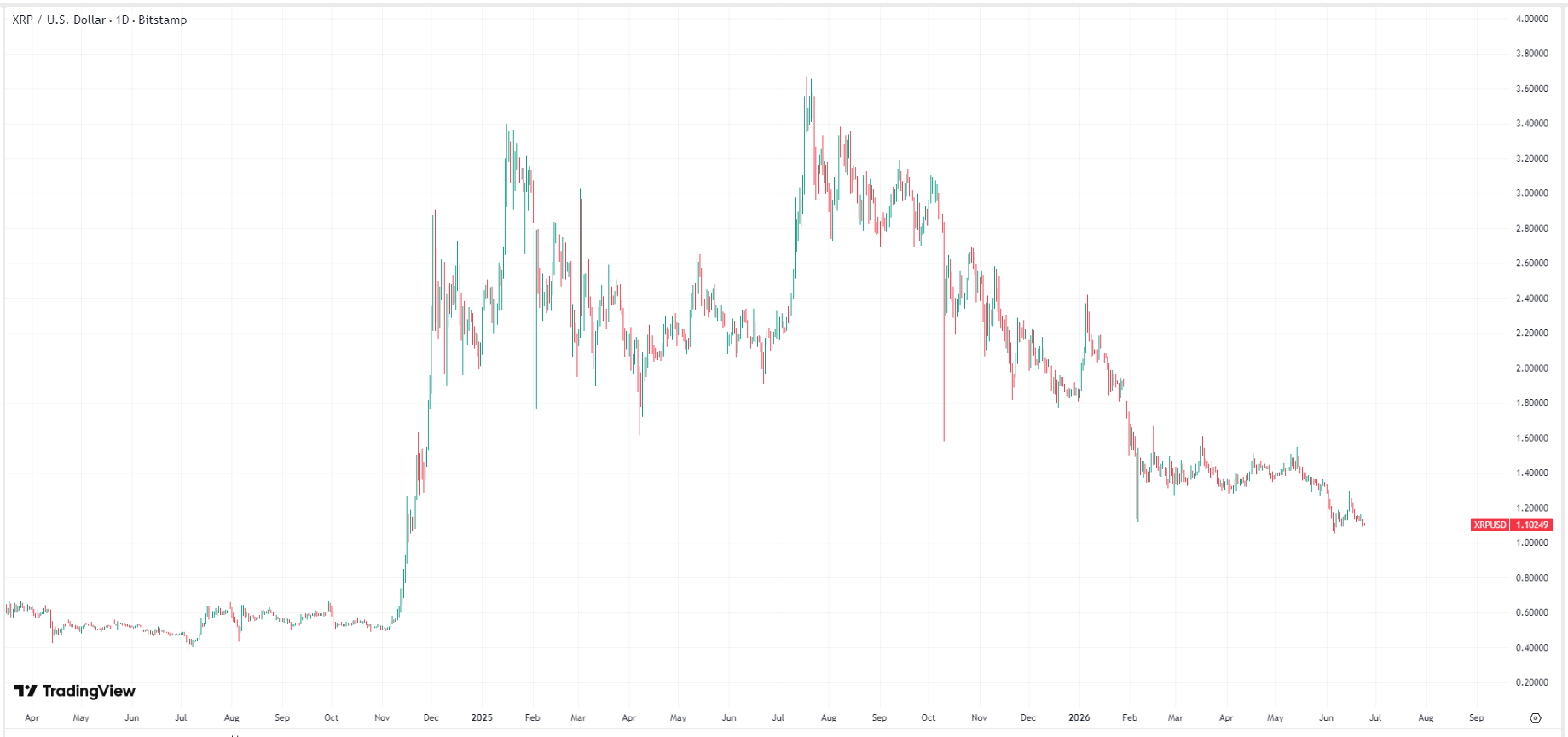 XRP Price Chart, Source: TradingView
In a June 2026 interview on the "Crypto In America" podcast, when asked whether XRP holders could gain equity from a Ripple IPO, Brad Garlinghouse nodded and said, "Perhaps there will be a special arrangement." As early as late May this year, Garlinghouse had already mentioned Ripple's IPO prospects, though his attitude was relatively conservative. At the CoinDesk Consensus conference, he revealed, "Currently, many listed crypto companies have not performed well in the public market, and remaining private actually gives Ripple more operational flexibility."
Although Ripple will not go public in the short term—its CEO previously emphasized that "this (an IPO) is definitely not something that will happen very soon"—he has also hinted at the possibility of a listing. In reality, what XRP investors are focused on is not the timing of the IPO, but rather what they stand to gain or lose from it.
After Garlinghouse signaled that "there might be a special arrangement," the market began to form various expectations. The most common speculation is that long-term XRP holders or users staking on the XRPL chain would be granted priority subscription rights for IPO shares, or that some form of "equity-token bound" proof of entitlement would be issued. In short, this would allow XRP token holders to transition into company shareholders. From a feasibility standpoint, this is indeed a possibility.
Furthermore, although XRP has already achieved legal clarity, many multinational banks and central banks remain on the sidelines regarding large-scale adoption because Ripple is a private company. Once Ripple becomes a publicly traded company that releases quarterly financial reports and is strictly regulated by the SEC, institutional trust in XRP will surge, thereby driving substantial adoption.
However, in the short term, a Ripple IPO could also turn into a severe "liquidity and attention drain" for XRP. Once Ripple rings the bell on the US stock market, institutional investors may pivot toward Ripple stock—which offers dividends, financial transparency, ownership of company assets, and compliance guarantees. This would directly siphon off the institutional incremental capital that would have otherwise flowed into the XRP token.
Most concerningly, Ripple could face selling pressure driven by monetization to meet post-IPO financial reporting demands. As a private company, Ripple has often been criticized for selling its tokens. However, after going public, to satisfy Wall Street's stringent quarterly demands for cash flow and profitability, Ripple's board of directors is highly likely to monetize tens of billions of XRP from escrow accounts in a more "precise and rational" manner to bolster the company's financial reports. This would create an invisible, long-term selling pressure on the price of XRP.
This content was translated using AI and reviewed for clarity. It is for informational purposes only.
Recommended Articles




Comments (0)
Click the $ button, enter the symbol, and select to link a stock, ETF, or other ticker.