


Why 80% of Altcoins Never Reclaim Their Highs — and How to Spot the Ones That Do



AI Podcast


Historical data indicates that over 80% of altcoins fail to reclaim previous all-time highs, often suffering from extreme supply inflation, narrative rotation, and lack of real utility. Successful projects typically exhibit sustained developer activity, genuine protocol revenue, balanced tokenomics, and deep network effects. Investors should avoid assets with low circulating supply ratios and speculative models. To identify long-term survivors, evaluate protocols based on a high market-cap-to-FDV ratio, on-chain income generation, and consistent engineering growth. Prioritizing infrastructure-focused projects with established economic moats is essential for navigating volatile crypto market cycles and mitigating significant drawdown risks.
Thousands of new tokens are released into every crypto bull market. In the hype of pumping prices, they come with huge promises and paradigm-shifting technology. They get a lot of investors and prices skyrocket along with other cryptos, and market euphoria peaks.
Then the bear market comes. Prices crash 80% to 95%. The majority of investors endure the agony and they will wait for the next cycle to find even greater all-time highs (ATHs). History, however, shows a harsh fact: more than 80% of altcoins fail to reach their peak values.
These altcoins spend their entire lifespan trading below their launch price. The crypto landscape is a graveyard of forgotten blue-chip projects. Understanding why this happens is the single most critical skill for surviving multiple market cycles.
The Brutal Data Behind Altcoin Decay
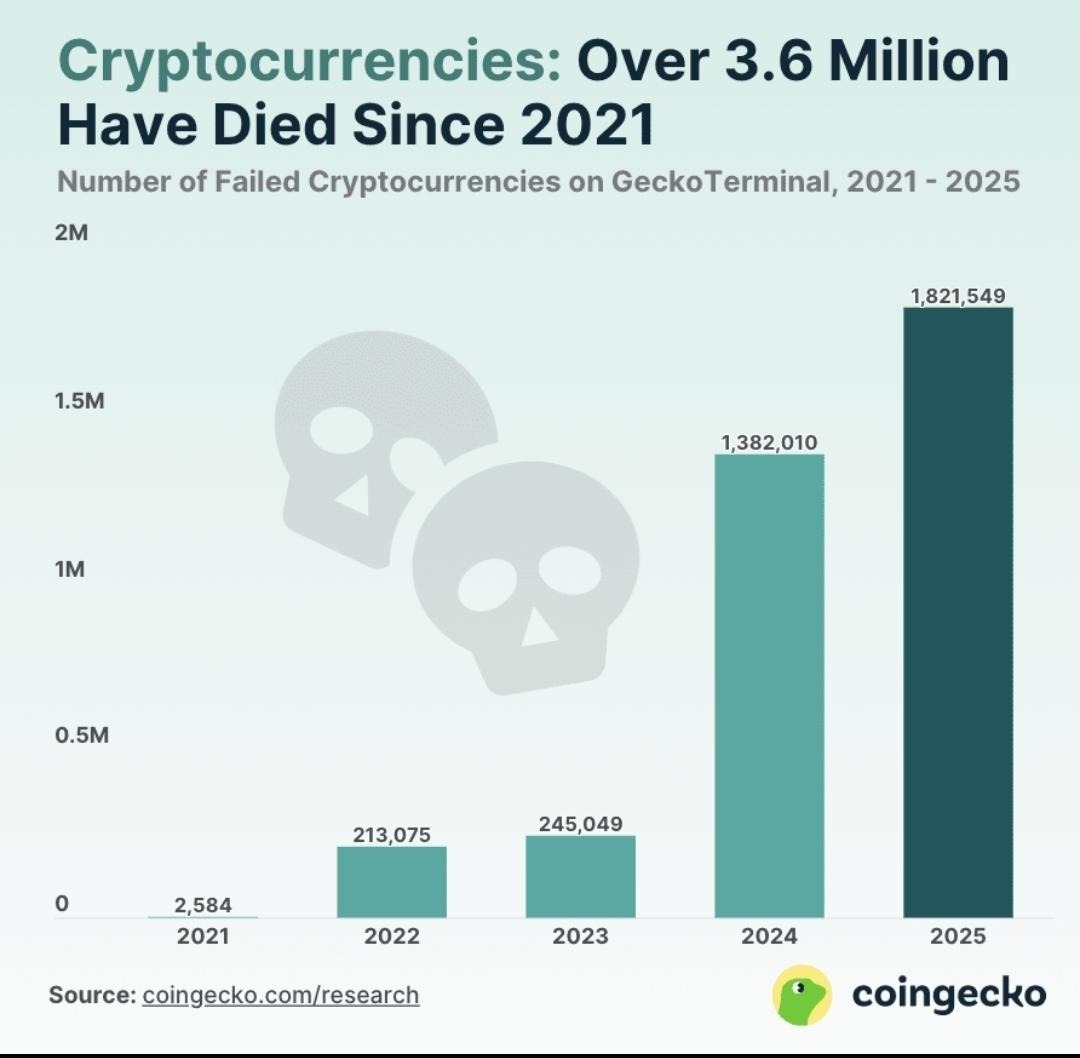
Thousands of cryptocurrencies launch every week in the crypto space, especially during the bull market. As a result, most of them quickly jump to new all-time highs. But as bear seasons come, they quickly decay, losing more than 99% of their value.
Look back at the top 20 cryptocurrencies from January 2018. Former market darlings reached staggering peaks:
- EOS peaked at $22.89, but now trades at $0.06545.
- NEO touched $196. It now trades under $2 as of August 2026.
- Dash hit $1,642. The altcoin now languishes at around $31.20.
Fast-forward through subsequent bull runs. None of these tokens came close to matching those historical peaks. The 2021 cohort suffered a similar fate:
- Internet Computer (ICP) hit a high of $700 before sinking over 98%.
- Filecoin (FIL) reached $237 during the storage narrative peak, but now only trades at $0.71.
- Algorand (ALGO) peaked above $3.20 and struggled to regain $0.100.
Data analyzing token survivorship across major cycles shows that fewer than 15% to 20% of altcoins ever surpass their previous ATH in a subsequent cycle. So why does billions of dollars in market cap vanish forever?
The Structural Traps Killing Altcoin Prices
Low Float, High FDV Tokenomics
This is the biggest structural trap in crypto. Venture capital firms fund projects at cheap valuations. The token launches with only 5% to 10% of its total supply in circulation (a low float).
This artificial scarcity drives the price up quickly. However, the Fully Diluted Valuation (FDV), which is the total value if all tokens were circulating, becomes astronomically high.
Over time, team and investor token unlocks trigger massive inflation. Millions of dollars in new tokens flood the market every week. Even if project usage increases, relentless token supply growth pushes the price down.
Mercenary Capital and Narrative Rot
Crypto moves fast. A narrative dominates one cycle, like ICOs in 2017, DeFi in 2020, or NFTs and GameFi in 2021, and then cools off. Capital in crypto is mercenary.
When a trend fades, liquidity migrates to newer, shinier tokens. Older tokens lose active traders and market makers. Without fresh buying pressure, token prices perpetually bleed out against Bitcoin.
Zero Real Value Accrual
Many altcoins are only speculative tokens. Holders receive governance voting rights, but no share of platform revenue or real utility. If there is no market speculation, the price can have no economic bottom.
If there are no mechanisms such as fee burn or staking yields to support a real protocol income, then the tokens are gradually losing value with time.
The Rare 20%: What ATH Reclaimers Look Like
But a small number of altcoins manage to defy the trend.
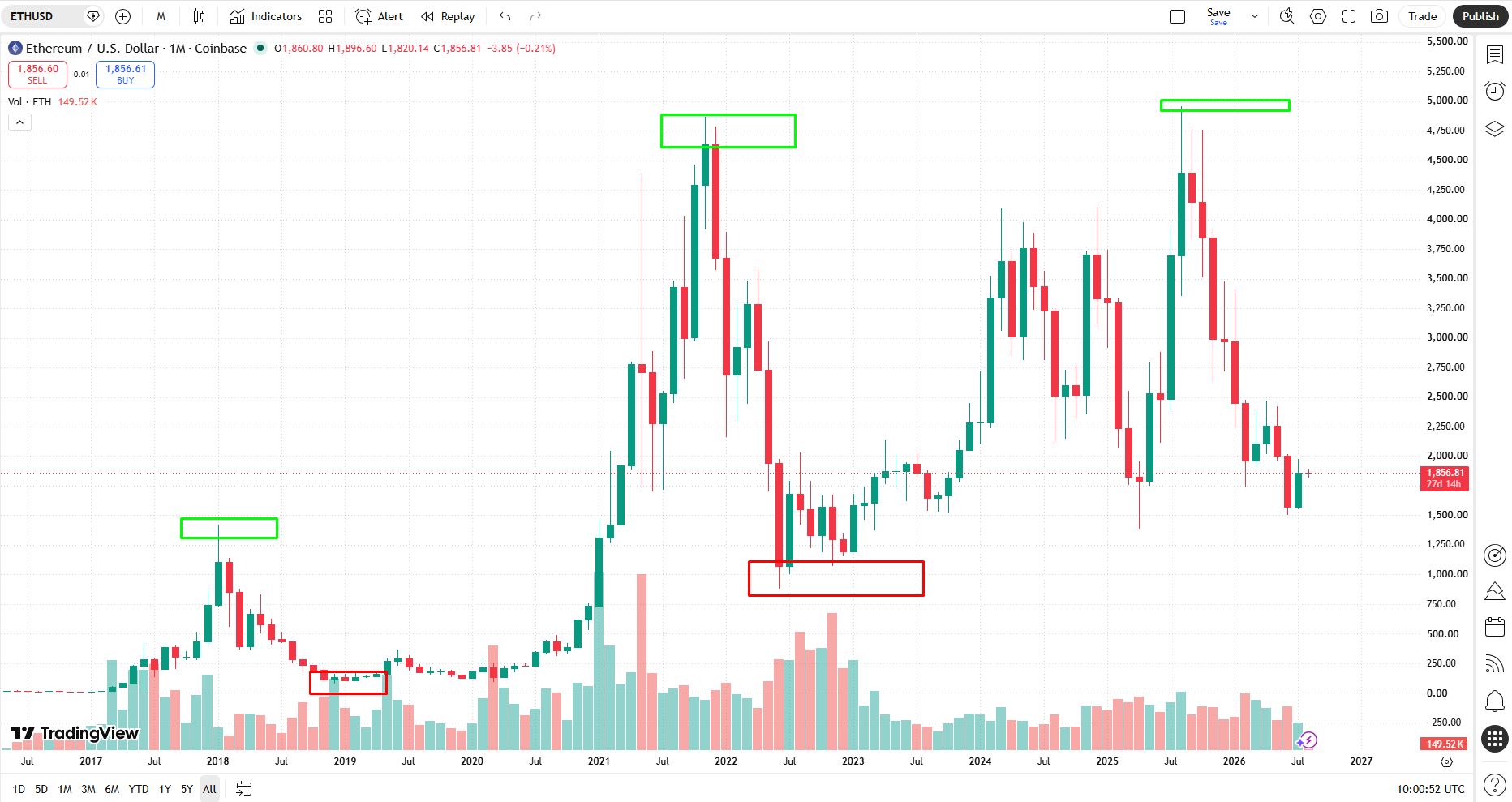
Ethereum (ETH) fell from $1,400 in 2018 down to $80, only to rally past $4,800 in 2021.
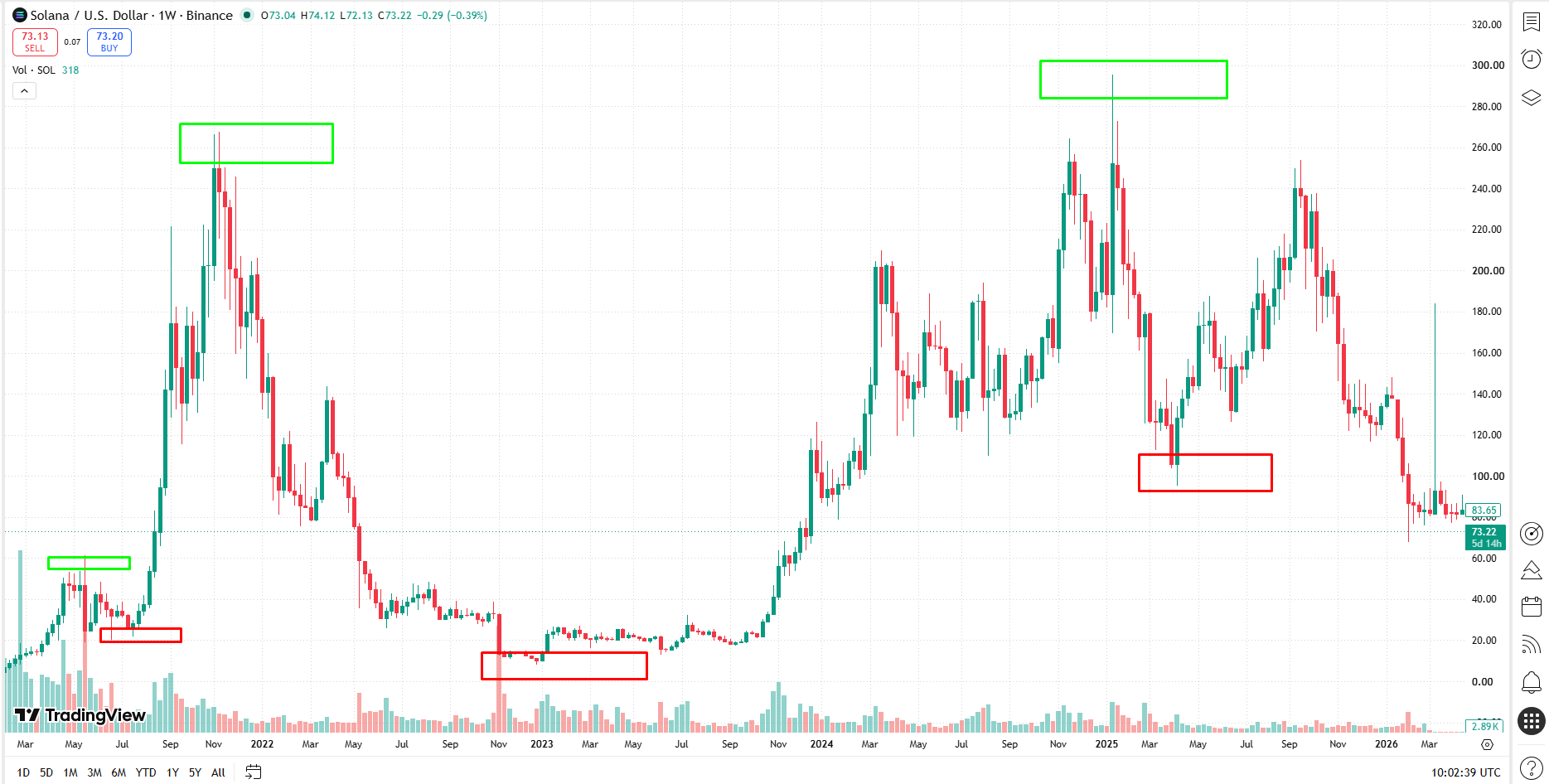
Solana (SOL) collapsed to $8 in late 2022 after the FTX crash. SOL rebounded above $200 in the 2025 bull market.
Cardano (ADA), Binance Coin (BNB) and Chainlink (LINK) had multi-cycle resurgences to create new ATHs.
What sets these survivors apart?
- Real Revenue Generation: Winners collect actual protocol fees from real users. Ethereum burns base transaction fees. Solana generates heavy network usage revenues. Real cash flow creates a hard economic floor during bear markets.
- Developer Mindshare: Code drives long-term value. Developer activity reports consistently show that top-performing chains retain active builders through brutal bear markets. Applications keep getting built even when prices crash.
- Balanced Supply Schedules: Multi-cycle winners avoid extreme supply inflation. Their circulating-to-FDV ratios are high, meaning the worst token unlocks are already in the past.
- Deep Network Effects: Core infrastructure protocols build deep liquidity moats that new competitors struggle to displace.
How to Spot Future ATH Reclaimers: A Checklist
Before holding an altcoin through a market downturn, run it through this four-step checklist:
- Calculate the FDV (Fully Diluted Valuation) Ratio: Divide market capitalization by fully diluted valuation. If the ratio is below 0.30, heavy dilution lies ahead. Identify tokens that have ratios greater than 0.60. New ATHs are possible with high FDV ratio altcoins, due to the fact that they require less capital inflow to achieve large price surges.
- Check On-Chain Revenue: Ensure that the protocol indeed brings real income using tools such as DeFiLlama. Do not offer tokens that just depend on token emissions for yield-farmers.
- Track Active Developers: Check GitHub commit frequency and active contributor numbers. Abandoned code repositories mean the project is dying behind the scenes.
- Test Longevity: Ask the following questions: Will the heart of the problem be relevant to you in 5 years? Every time there's a short-lived hype cycle, infrastructure and core financial primitives occur again.
The majority of altcoins are not meant for holding, but are meant for short-term trading. Instead of focusing on 80%, make sure you're looking at tokens with a healthy supply and genuine protocol revenue, and you'll be better equipped to distinguish the few tokens that will have the potential to soar to new heights.
Recommended Articles




Comments (0)
Click the $ button, enter the symbol, and select to link a stock, ETF, or other ticker.