


Ethereum Replaying Amazon Playbook? ETH Falls Below 2,000 Mark, Standard Chartered Maintains $40,000 for 2030 Unchanged



AI Podcast


Ethereum has fallen 60% from its peak, exceeding Bitcoin's decline, amid community concerns. These include the Ethereum Foundation's large OTC sales and unstaking of ETH, fueling selling pressure fears and accusations of opaque operations. Core team departures have further heightened worry. However, Standard Chartered maintains a bullish outlook, comparing Ethereum to early Amazon. They argue that Ethereum's on-chain metrics, like transaction volume and TVL, remain strong, suggesting undervaluation similar to Amazon's post-dot-com bubble recovery. The bank predicts ETH will reach $4,000 by year-end and $40,000 by 2030, driven by stablecoins and tokenization.

TradingKey - Ethereum's development is highly similar to the early years of Amazon and Solana; it is currently in a trough, but is expected to break out again as the environment improves.
On May 29, impacted by the U.S. April PCE data, cryptocurrencies plunged collectively this morning, and Ethereum ( ETH) also briefly fell below the $2,000 mark, dropping to $1,974 and returning to its low from two months ago. Compared to the peak of around $5,000 set last October, the price of Ether has fallen by a cumulative 60% to date, far exceeding the decline of Bitcoin ( BTC )'s 40% drop, further heightening concerns within the Ethereum community.
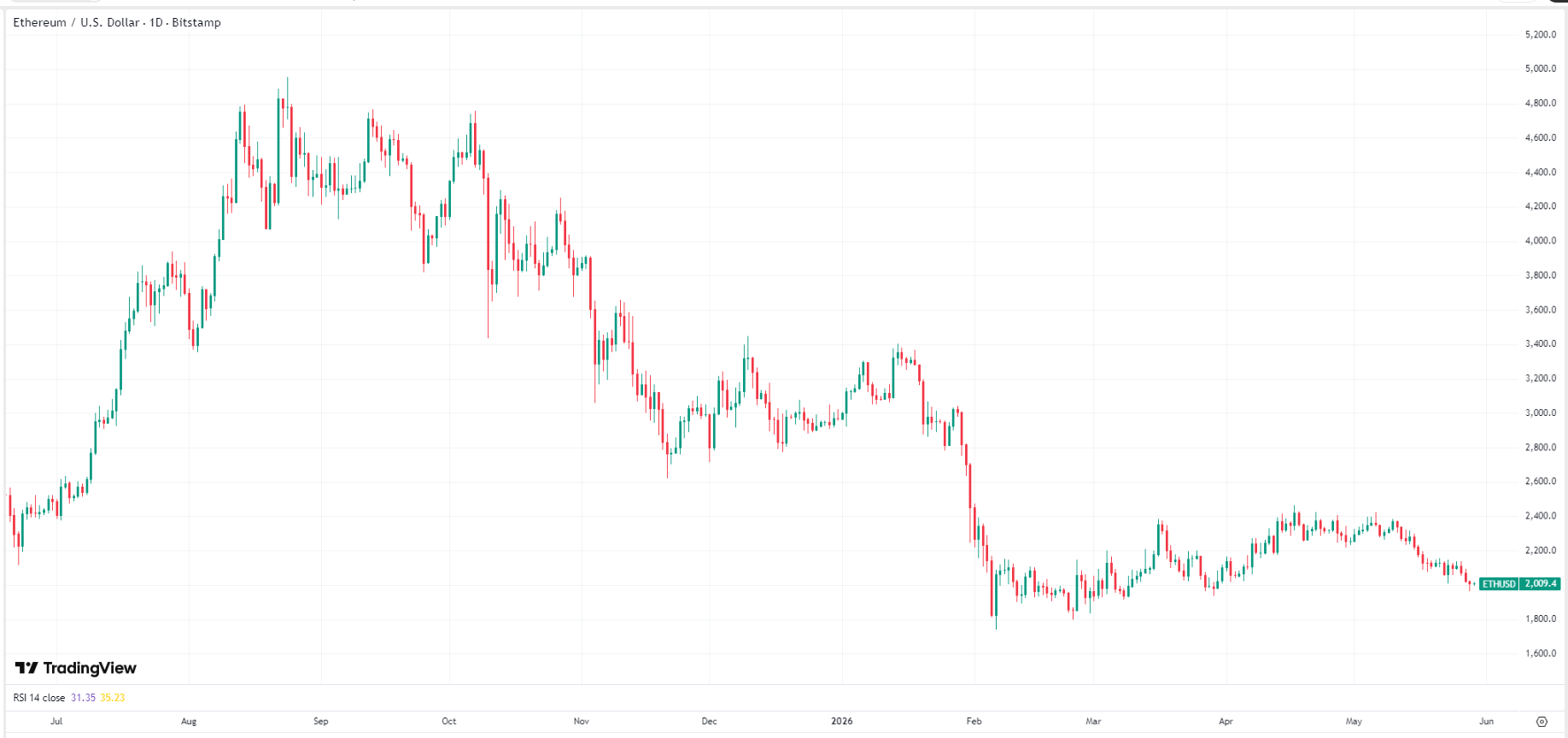 ETH price chart, source: TradingView
Prior to this, several events had already caused panic within the community, the most notable being the Ethereum Foundation's sell-off of ETH. Between April and May 2026, the Foundation conducted three consecutive large-scale OTC transactions with BitMine ( BMNR) totaling 25,000 ETH. Although these ETH did not enter the exchange market, BitMine reduced its on-exchange buy-side support to accommodate the purchase, which similarly weakened ETH's price support.
In addition to direct sales, the Foundation recently unstaked more than 38,000 ETH. The return of these large-scale holdings has led to high market suspicion that selling pressure will continue. Regarding the flow of these funds, officials claim they are being used to support long-term development plans; however, a lack of timely and transparent financial reporting has led to accusations of 'black box operations' and questions regarding the Foundation's excessive cash burn rate.
Furthermore, a major 'reshuffle' of the Ethereum core team has left the community worried that ETH will lose its core essence. Since January 2026, at least 8 senior executives and core researchers have resigned in succession, with 5 of them departing en masse during May—including Carl Beekhuizen, who was responsible for the PoS transition, and Julian Ma, who oversaw mechanism design and cryptoeconomics. In response to the Foundation's actions, former Ethereum Foundation researcher Dankrad Feist has advocated for the formation of a new organization to save Ethereum.
Despite the market losing confidence in Ethereum, Standard Chartered remains steadfastly bullish on its future. Geoffrey Kendrick, its Head of Digital Assets Research, compared Ethereum to Amazon ( AMZN ), citing Jeff Bezos's famous quote, 'The stock is not the company, and the company is not the stock,' essentially implying that ETH's price is inconsistent with its value and is undervalued by the market. However, is this truly the case?
In December 1999, Amazon's stock price soared to a peak of $113 amid a wave of market frenzy for 'Internet concepts.' As the Federal Reserve's consecutive interest rate hikes burst the dot-com bubble, Amazon's stock price fell to around $6 in 2001, but the company's business metrics showed no significant deterioration. In Geoffrey Kendrick's view, Ethereum's on-chain metrics—such as transaction volume and TVL—are equivalent to Amazon's business metrics and have not worsened, suggesting it could follow Amazon's path of explosive growth once again.
Standard Chartered's analogy between Ethereum and Amazon has a certain degree of rationality. Ethereum remains the leading public chain, but the macro environment is currently unfavorable for the entire cryptocurrency market, much like Solana in the past. In 2022, the price of SOL plummeted due to the impact of the FTX incident, yet it remained a high-quality public chain, leading to its explosion during the subsequent meme coin wave. In other words, Ethereum's plunge is not due to internal deterioration but is instead dragged down by the overall environment, and it is bound to break out again one day.
In Standard Chartered's view, the catalyst for ETH's future explosion is stablecoins and tokenization, with the belief that ETH will recover to $4,000 by the end of this year and rise to $40,000 by 2030. From the cases of Amazon and Solana ( SOL )'s comeback cases, a similar revival for Ethereum is highly probable. After all, it is the public chain with the strongest global utility, and stablecoins and tokenization are receiving support from the United States.
This content was translated using AI and reviewed for clarity. It is for informational purposes only.
Recommended Articles










Comments (0)
Click the $ button, enter the symbol, and select to link a stock, ETF, or other ticker.