


SpaceX Did Not Sell Bitcoin in Q2; Why Unleveraged Model Is More Bullish Than MicroStrategy



SpaceX’s Q2 earnings report highlights strong revenue growth alongside significantly narrowed losses. Despite record $18.4 billion capital expenditure, heavily weighted toward AI infrastructure, the company maintains its 18,700 BTC holding. Unlike MicroStrategy, which recently sold 1,638 BTC to manage high-leverage debt and dividend obligations, SpaceX utilizes an unleveraged treasury model. By relying on operating profits rather than debt, SpaceX avoids liquidity-driven sell-offs. Consequently, SpaceX’s commitment provides long-term stability for Bitcoin, contrasting with the market volatility triggered by MicroStrategy’s shift toward liquidating holdings to satisfy interest and preferred stock payment pressures.

TradingKey - Unlike MicroStrategy, SpaceX continued to hold its Bitcoin position unchanged in the second quarter, easing market selling pressure.
On August 4, Eastern Time, SpaceX ( SPCX) released its first quarterly earnings report since listing during post-market hours. Overall, the company's revenue performance was strong, beating Wall Street expectations, and its losses narrowed significantly. However, total capital expenditures (CapEx) reached a staggering $18.4 billion, with capital expenditures for AI computing infrastructure reaching $15.8 billion—accounting for as high as 85% of total CapEx, a metric that also triggered market panic.
Although SpaceX remains unprofitable and its sky-high capital expenditures have severely eroded free cash flow, the company remains firm in not selling its Bitcoin ( BTC ), preventing further panic in the crypto market. As of press time, SpaceX holds 18,700 BTC, ranking 12th globally, surpassing crypto firms like Coinbase ( COIN ), Riot Platforms ( RIOT ), and others.
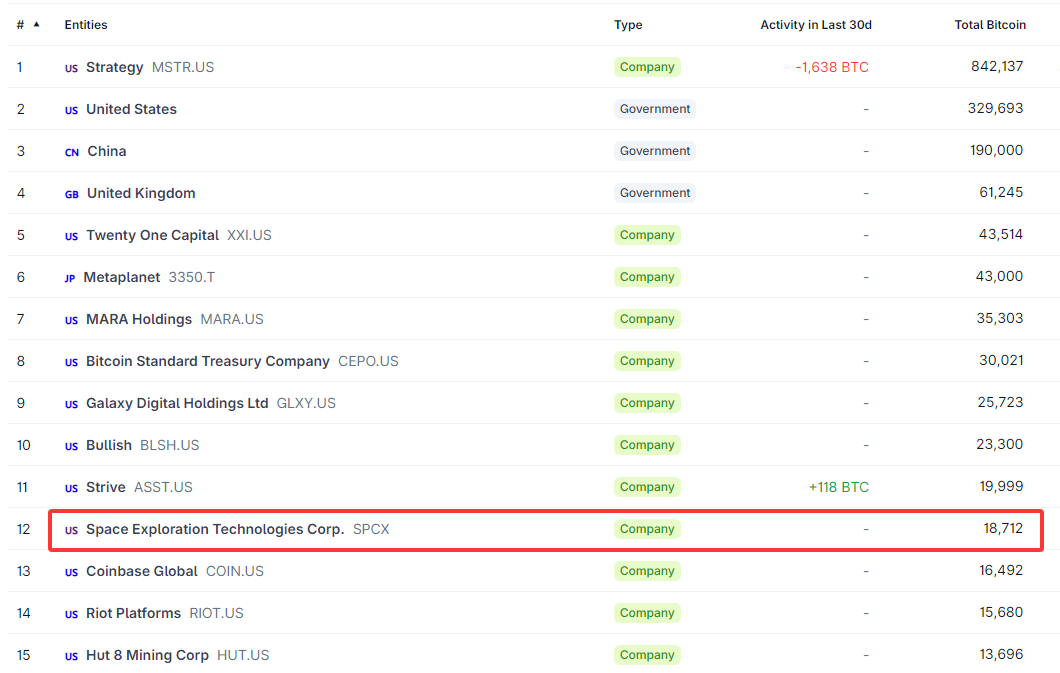 Selected entities holding Bitcoin, Source: CoinGecko
Between July 27 and August 2 this year, MicroStrategy ( MSTR) sold a total of 1,638 Bitcoins, cashing out over $100 million to maintain its balance sheet and the liquidity of its high-yield securities. This includes paying semi-monthly cash dividends on its Class A perpetual preferred stock, repurchasing preferred stock at a discount to reduce future dividend and interest expense burdens, and replenishing cash flow, among other things.
MicroStrategy has long been seen as a symbol of the ultimate bullish belief in "never selling" Bitcoin. Its breakthrough decision to start selling has been interpreted by some traders as a softening of the bull creed and a sell signal, igniting short-term emotional panic and causing the Bitcoin price to temporarily dive to around $62,000.
Compared to MicroStrategy's highly leveraged capital operation model, SpaceX's unleveraged treasury model has a greater and more sustainable positive impact on Bitcoin's long-term price health and overall market structure. At the very least, it will not be forced to sell Bitcoin due to financial difficulties. Ultimately, their differing sources of funding determine whether a risk of selling exists.
Dimension | MicroStrategy Model | SpaceX Model |
Source of Funds | Debt issuance, preferred stock issuance, equity offering (high leverage) | Operating profits, equity capital (unleveraged) |
Selling Pressure Risk | Need to liquidate and sell coins under interest/dividend payment pressure | No debt maturity or interest payment pressure, allowing for indefinite holding |
This content was translated using AI and reviewed for clarity. It is for informational purposes only.
Recommended Articles








Comments (0)
Click the $ button, enter the symbol, and select to link a stock, ETF, or other ticker.