


BTC Falls Below 70,000 Bloodbath, XRP Attracts 1.6 Billion Against Trend, Is It Time to Rotate?



AI Podcast


U.S. spot Bitcoin ETFs have experienced ten consecutive days of outflows totaling approximately $3 billion, while XRP spot ETFs have attracted $1.6 billion in inflows since May 20. This divergence is attributed to internal factors, not macroeconomics. Bitcoin faces selling pressure from institutional sales and Mt. Gox activity. XRP benefits from the Clarity Act, providing regulatory certainty, and significant RWA growth on its ledger. While XRP shows short-term outperformance and suits risk-tolerant traders, Bitcoin remains a more stable long-term investment due to its market consensus and scarcity. Diversification is also recommended.
TradingKey - Recently, U.S. Bitcoin ( BTC) spot ETFs have seen continuous capital outflows, while Ripple ( XRP) spot ETFs have not fully followed suit; instead, they have attracted significant capital inflows. This anomaly has not only sparked curiosity among crypto investors as to the cause, but has even led some to consider abandoning Bitcoin to bet on XRP. However, which one is ultimately more worth buying?
Ripple vs. Bitcoin: Defying the Trend with $1.6 Billion in Capital Inflows
Since May 20, U.S. spot Bitcoin ETFs have seen net outflows for ten consecutive trading days, shedding more than 40,000 BTC, totaling approximately $3 billion. Although spot Ripple (XRP) ETFs saw net inflows of over $4 million on June 3, other trading sessions during the same period saw either net inflows or zero flow, ultimately achieving total net inflows of as much as $1.6 billion.
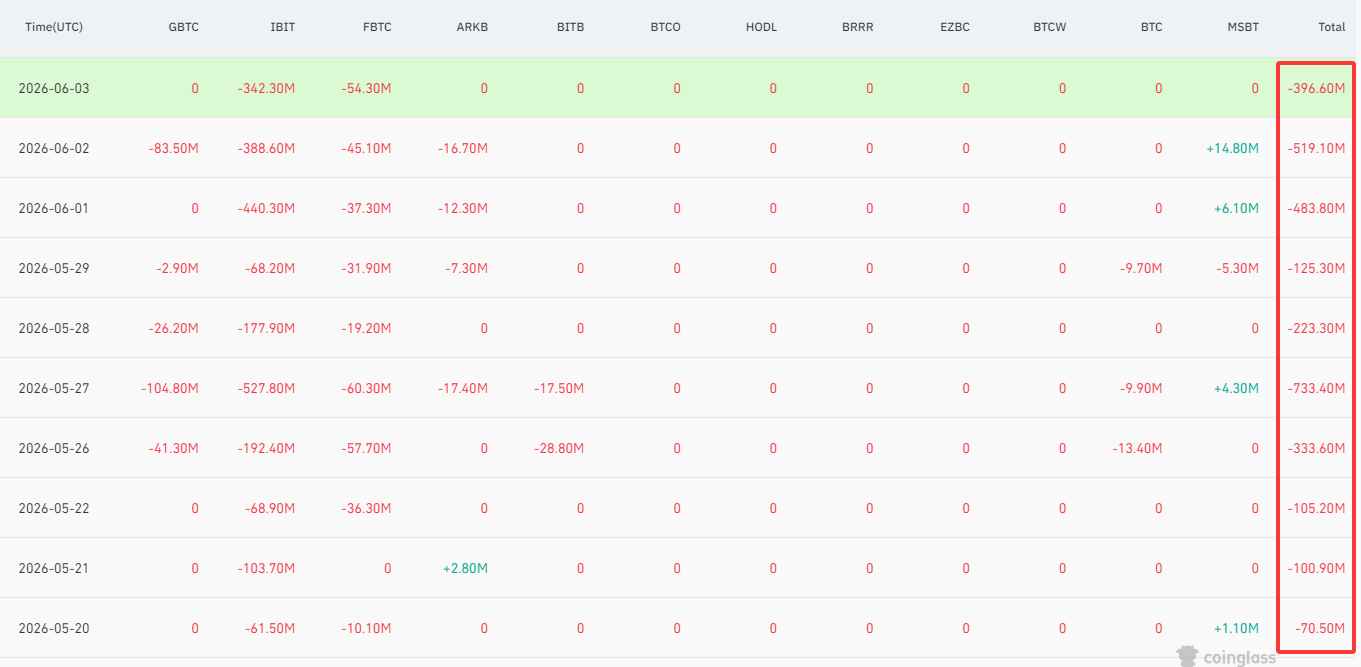 Spot Bitcoin ETF fund flows, Source: CoinGlass
Supported by capital inflows, although XRP did not stage an independent rally, it has proven more resilient than BTC. Over the past seven days, XRP fell by a cumulative 10%, outperforming Bitcoin's 15% decline; over the past 30 days, XRP dropped 15%, which was also narrower than Bitcoin's 20% slide.
What accounts for this "counter-trend"?
Against the same broader cryptocurrency backdrop, Ripple and Bitcoin spot ETFs have shown two distinct trajectories, which allows for the exclusion of external macroeconomic factors—such as the U.S.-Iran conflict or Federal Reserve rate hike expectations—suggesting that these anomalies are primarily driven by their respective intrinsic factors.
Amid an unfavorable macroeconomic environment, it was reported on June 1 that Strategy, the world’s largest DAT company, sold Bitcoin for the first time; furthermore, on June 2, transfer activity was observed from the defunct exchange Mt. Gox, which holds 35,000 BTC, further stoking panic among Bitcoin holders and leading to a subsequent fire sale of their BTC positions.
For Ripple, the primary drivers are the Clarity Act and Real-World Assets (RWA). The Act provides definitive federal recognition of XRP as a "digital commodity," and such compliance helps position XRP as a "policy safe haven" in the eyes of Wall Street. Currently, the bill has been placed on the full Senate's voting schedule. Additionally, Messari’s latest report indicates that the RWA market on the XRP Ledger surged 124% quarter-over-quarter, signaling significant progress in the network's practical adoption.
Bitcoin vs. Ripple: Which is the better buy?
From the perspectives of recent price performance, capital flows, and potential positive catalysts, XRP has outperformed Bitcoin. In a binary choice, XRP is more suitable for investors with a higher risk appetite who are eager to speculate on short-term policy breakthroughs and prefer swing trading.
However, XRP outperforming Bitcoin may be a brief and incidental phenomenon. When the timeframe is extended to a year or longer, Bitcoin's price performance typically surpasses that of XRP. Furthermore, BTC is the liquidity core of the entire crypto market and possesses an immutable supply cap; this scarcity gives it the strongest market consensus. Therefore, if you are an investor with a low-to-medium risk tolerance seeking steady long-term capital appreciation, Bitcoin is the more worthwhile choice.
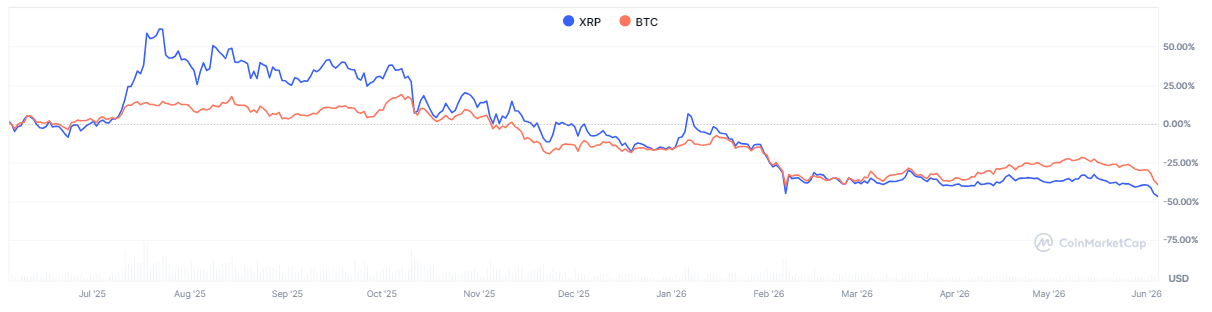 BTC and XRP price performance over the past year. Source: CoinMarketCap
Of course, investing is not an either-or proposition; diversification is possible, and seasoned traders prefer to leverage the complementarity of the two for position allocation. Therefore, one can hold both simultaneously. You could choose XRP for the short term and BTC for the long term, or allocate by ratio; for instance, if you seek to "win through stability," you might consider a 70% BTC and 30% XRP allocation.
This content was translated using AI and reviewed for clarity. It is for informational purposes only.
Recommended Articles









Comments (0)
Click the $ button, enter the symbol, and select to link a stock, ETF, or other ticker.