


Reversal in US-Iran Peace Agreement? WTI Crude Futures Once Surge Over 4%, Trump May Resume Military Strikes Against Iran



AI Podcast


Crude oil prices surged as President Trump threatened to resume military strikes against Iran, with WTI and Brent rising significantly. Despite this short-term geopolitical volatility, the IEA projects a shift toward structural oversupply by 2027. Forecasts indicate global supply growth of 8 million barrels per day against a demand increase of only 2 million barrels. If the U.S.-Iran agreement holds, the lifting of maritime blockades will restore regional production. This anticipated surplus provides a strategic window for nations to replenish commercial and strategic petroleum reserves, effectively bolstering global energy security against future supply shocks.

TradingKey - The two major crude oil benchmarks spiked in short-term trading after U.S. President Trump said military strikes against Iran could resume.
According to media reports, Trump said on Wednesday that the current memorandum of understanding reached with Iran is not a final agreement, and the U.S. could resume military strikes against Iran if he is dissatisfied with the progress of the deal.
At the G7 summit in France, Trump stated: "This is just a memorandum of understanding. If I don't like it, we will open fire again and continue dropping bombs on them."
He further warned: "If I am not satisfied, if they do not behave, we will resume bombing immediately, and the bombs will fall right on their heads, understand?"
Following the news, WTI crude oil futures jumped more than 4% at one point. As of press time, they were still up 2.34% at $77.03, while Brent crude rose 1.91% to $80.47.
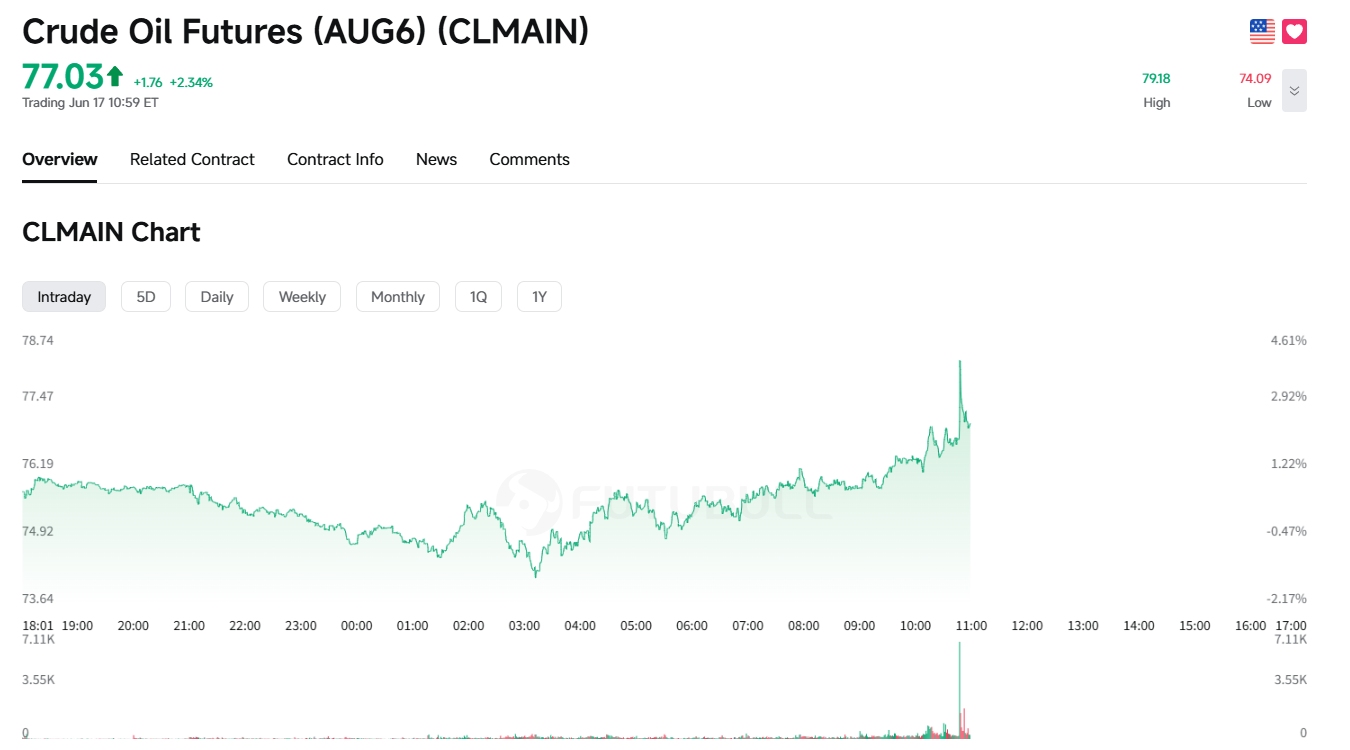
[Source: FutuBull]
Notably, the International Energy Agency (IEA) stated in its monthly oil market report that the global oil market will first gradually digest the supply shock caused by the blockade of the Strait of Hormuz and complete capacity restoration, before fully entering a cycle of deep oversupply by 2027.
Providing its first comprehensive outlook for the oil market's fundamentals in 2027, the agency estimates that global crude supply growth could reach 8 million barrels per day (bpd) that year, whereas demand is projected to grow by just 2 million bpd, signaling a highly clear trend of easing supply-demand conditions.
The IEA noted that as long as the interim U.S.-Iran agreement is steadily implemented, crude production and exports in the Gulf region will recover steadily. Specifically, once the U.S. maritime blockade is lifted, Iranian crude exports will be able to fully return to the global market.
The massive supply surplus in 2027, however, will offer countries an energy buffer window: nations worldwide are adjusting their energy policies in response to the Middle East energy crisis and could leverage this period of loose supply to replenish heavily depleted commercial inventories or expand their strategic petroleum reserves, thereby strengthening the global energy safety net.
This content was translated using AI and reviewed for clarity. It is for informational purposes only.
Recommended Articles










Comments (0)
Click the $ button, enter the symbol, and select to link a stock, ETF, or other ticker.