


Spot Gold Falls Below $4,000: US-Iran Conflict Intensifies, Surging US Treasury Yields Crush Gold Prices



AI Podcast


On July 16, rising US-Iran geopolitical tensions and threats to block the Bab el-Mandeb Strait pushed oil prices higher and increased US Treasury yields. The resulting strengthening of the US dollar exerted downward pressure on spot gold, which fell 1.4%. Despite these risks, Goldman Sachs anticipates the inflationary impact will fade, projecting the Federal Reserve will maintain current interest rates through 2026. However, analysts warn that a further escalation—specifically oil prices reaching $100 per barrel—could trigger supply shocks and unanchor inflation expectations, significantly complicating future monetary policy decisions.
TradingKey - On July 16, as tensions in the US-Iran conflict intensified, oil prices resumed their rally and US Treasury yields climbed, leading to a decline in spot gold prices.
Recently, the United States launched strikes against Iran in retaliation for attacks on commercial vessels in the Strait of Hormuz, after which the armed conflict escalated. Iran responded strongly and warned that it would close the Bab el-Mandeb Strait if the US attacked its power infrastructure. It is reported that Trump said in an interview on Tuesday evening that if no diplomatic breakthrough is achieved, the US military will launch strikes on Iran's critical infrastructure next week.
Closing the Bab el-Mandeb Strait would pose a major new threat to global energy supplies. Reports state that this idea has been discussed within the Iranian leadership, and this information has been conveyed to Iran's Houthi allies. Sources said the Houthis were recently informed of this demand from Tehran.
Oil prices took the lead in climbing slightly, with U.S. West Texas Intermediate (WTI) crude futures hovering around $80 and Brent crude futures hovering around $85.
Meanwhile, Treasury yields continued to climb, with the 10-year US Treasury yield (a key benchmark for US government borrowing) rising 3.2 basis points to 4.58%.
The 2-year US Treasury yield (seen as tracking the Fed's short-term interest rate policy) rose by 3.8 basis points to 4.17%. The longer-term 30-year Treasury yield also rose by 3.3 basis points to 5.11%.
Ticker | Name | Yield | Change |
US1Y | US 1-Year Treasury | 3.93% | 0.034 |
US2Y | US 2-Year Treasury | 4.17% | 0.038 |
US10Y | US 10-Year Treasury | 4.58% | 0.032 |
US30Y | US 30-Year Treasury | 5.11% | 0.033 |
The movement of US Treasury yields directly affects the US Dollar Index. When Treasury yields rise, they attract global capital inflows into the US market, pushing up the US dollar. Since gold is priced in US dollars, a stronger dollar increases the cost for non-dollar investors to purchase gold, thereby pressuring gold prices on the demand side.
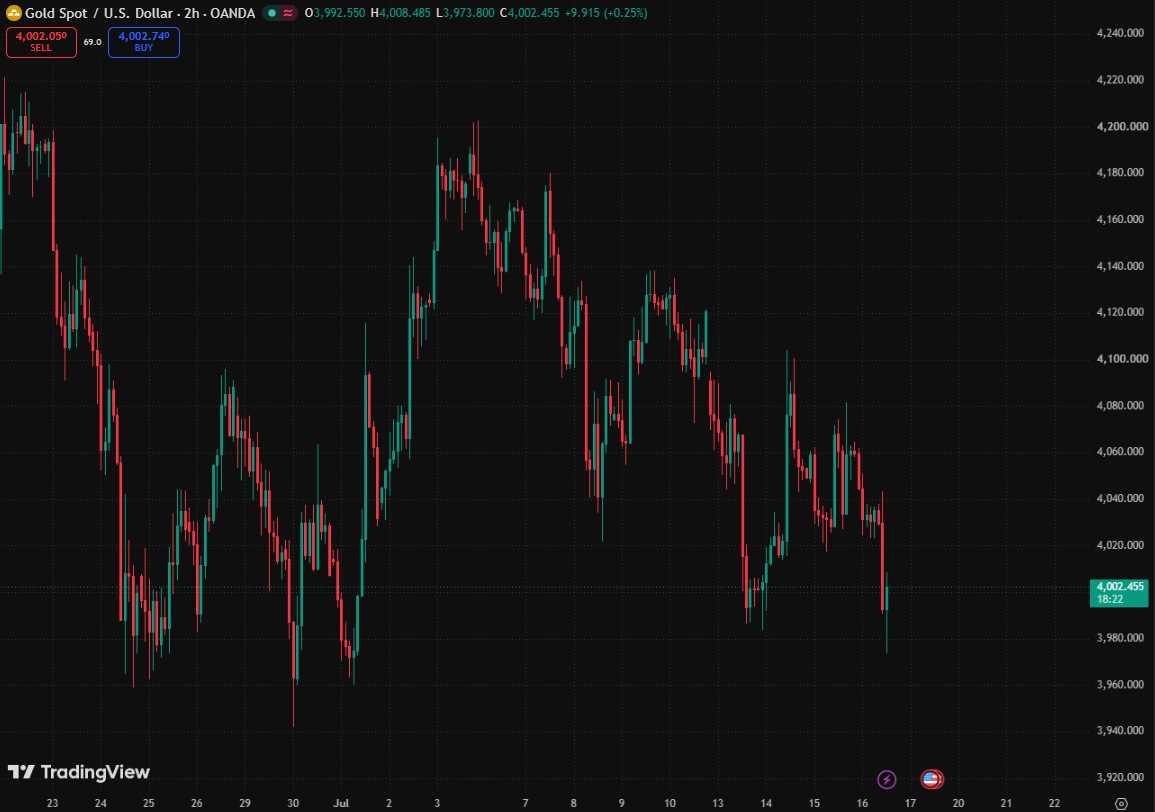
As of press time, spot gold ( XAUUSD) fell below $4,000, down 1.4%.
Source: TradingView
Although the US-Iran conflict continues to escalate, Goldman Sachs believes that the war's shock to US inflation is fading and is insufficient to unanchor inflation expectations, with the Fed expected to keep interest rates unchanged this year.
Goldman Sachs economists David Mericle and Pierfrancesco Mei pointed out on July 12 that commodity price shocks have receded significantly, and the inflationary pass-through effect is expected to weaken noticeably in the third and fourth quarters. Core PCE inflation is projected to record a monthly gain of 24 basis points in June and remain within the 20 to 23 basis point range thereafter, a trajectory sufficient to keep the Fed on hold for the remaining meetings of 2026, though the margin for error is extremely limited. A key prerequisite for this judgment is that the conflict does not escalate significantly further.
If oil prices return to $100 per barrel, it would push monthly core inflation up by an additional 3 to 4 basis points. More importantly, a new round of supply shocks would exacerbate market concerns about unanchored inflation expectations, and its impact on monetary policy debates could far exceed the numbers themselves.
This content was translated using AI and reviewed for clarity. It is for informational purposes only.
Recommended Articles









Comments (0)
Click the $ button, enter the symbol, and select to link a stock, ETF, or other ticker.