


Gold Drops Below $4,300 Erasing Year-to-Date Gains. This Week’s CPI May Ignite Rate Hike Expectations Will Gold Still Rise in 2026?



AI Podcast


Gold prices fell below $4,300/oz due to strong U.S. nonfarm payrolls and escalating Middle East tensions. Robust employment data and rising inflation expectations are reducing the likelihood of Federal Reserve rate cuts, increasing the opportunity cost of holding gold. Several investment banks have lowered gold price forecasts. However, Goldman Sachs remains bullish, citing sustained demand from global central banks, which resumed net purchases in April. Long-term geopolitical uncertainty and de-dollarization are expected to provide a floor for gold prices.
TradingKey - During Monday's Asian session, both spot and futures gold prices fell below the $4,300/oz support level. Spot gold touched an intraday low of $4,268.42, its lowest level since March 23, erasing all year-to-date gains.
On the news front, Middle East tensions escalated. Iran attacked an Israeli airbase with missiles on the 7th local time, the most serious violation of the ceasefire since early April; Israel also retaliated. Donald Trump stated that the attack did not change his willingness to finalize a U.S.-Iran deal but reiterated that military force will be used if no agreement is reached.
Furthermore, economic data has been another major factor pressuring gold prices. U.S. nonfarm payrolls for May were unexpectedly strong, increasing by 172,000—nearly double the market's 85,000 estimate. The unemployment rate remained at a low of 4.3% for the third consecutive month, further reducing rate-cut odds; market expectations for a rate hike this year have risen to 74.8% from 53.5% a week ago.
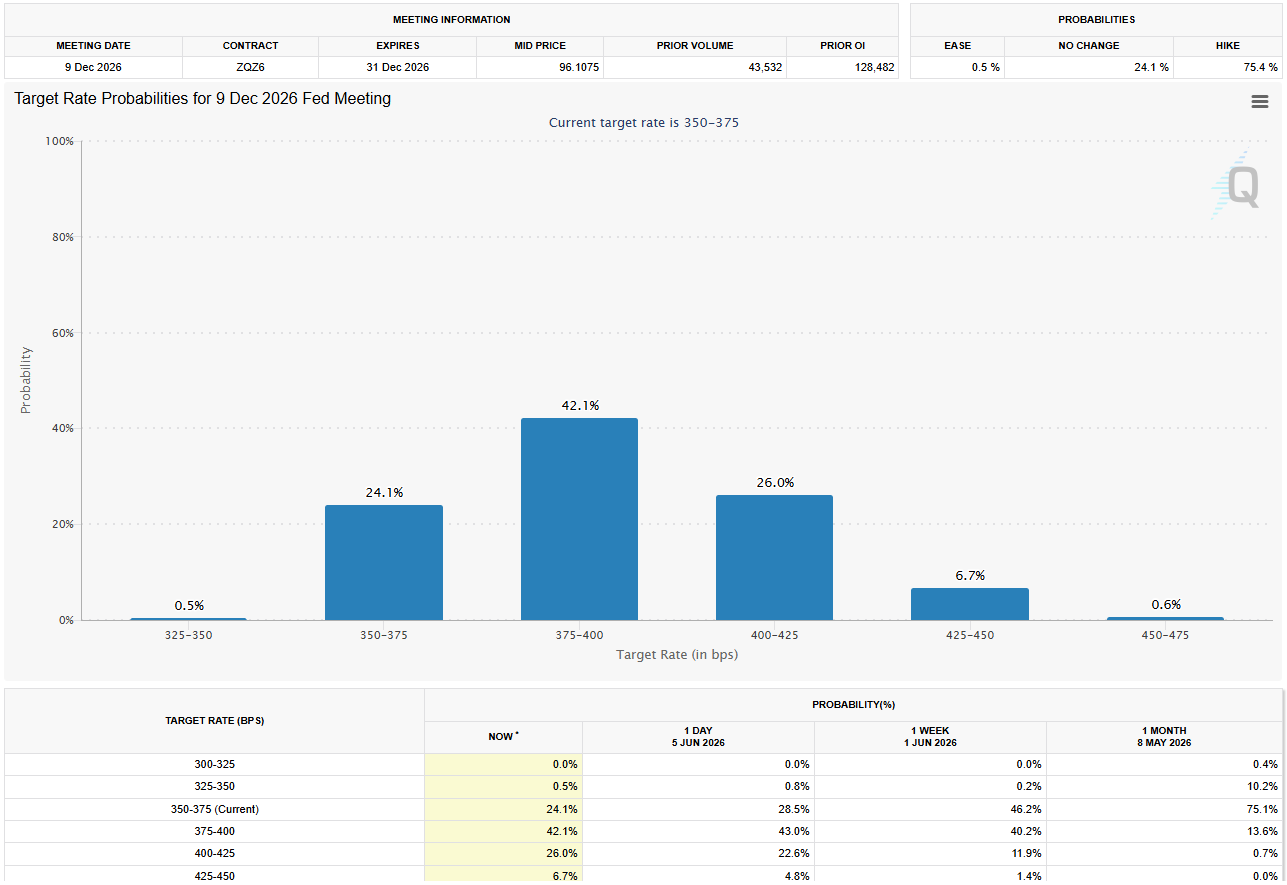
Probability of a rate hike within the year, Source: GME Group FedWatch
Will gold prices continue to rise in 2026 amid rate hike expectations?
Analysis indicates that ahead of Wednesday's release of the U.S. May Consumer Price Index (CPI), traders are concerned the data could show its largest increase in years. Following an annual CPI rate of 3.8% in April and against the backdrop of soaring energy prices, the market expects May inflation to accelerate further to 4.2%. If inflation remains sticky while employment is robust and unemployment slows, the probability of an interest rate hike will further intensify.
Goldman Sachs (GS) A report released last Friday indicates that the bank no longer expects the Federal Reserve to cut interest rates this year. Its forecast for the timing of rate cuts has been pushed back from December 2026 and March 2027 to June and December 2027, while the probability of a minor rate hike was raised from 10% to 20%. BNP Paribas now expects the Fed to begin raising rates in December and continue hikes in the following months.
Bart Melek, Head of Global Commodity Strategy at TD Securities, noted that given strong employment and significant inflationary pressure, the Fed has virtually no inclination to cut rates, and the opportunity cost of holding gold is becoming increasingly high.
Recently, several investment banks have lowered their gold price forecasts: Commerzbank reduced its end-2026 gold price forecast from $5,000 to $4,800; Citi (C) set a 0-3 month target price of $4,300, while warning that prices could drop further in the event of a major risk-off episode; JPMorgan (JPM) has lowered its 2026 average gold price forecast from $5,708 to $5,243.
Central banks resume increasing gold holdings: Can they reshape the gold price trajectory?
While several investment banks have recently lowered their gold price forecasts, Goldman Sachs remains steadfastly bullish, maintaining its price target of $5,400 per ounce by the end of 2026, citing sustained demand from global central banks.
According to a report released by the World Gold Council on June 3, central banks resumed net purchases of gold in April, adding approximately 17 tons after net sales of nearly 30 tons in March. The Central Bank of Turkey, the largest seller in March, largely halted its selling in April, while the National Bank of Poland remained the largest buyer, with year-to-date purchases reaching 45 tons. Data from the People's Bank of China showed that gold reserves stood at approximately 2,331.52 tons at the end of May, a month-on-month increase of about 9.95 tons and the 19th consecutive month of additions. Goldman Sachs expects average monthly gold purchases by central banks to potentially reach 60 tons this year, a significant increase from historical averages.
Goldman Sachs noted that over the long term, gold's status is being continuously bolstered by persistent global geopolitical uncertainty and the accelerating pace of de-dollarization, with long-term central bank demand expected to provide a solid floor for gold prices.
This content was translated using AI and reviewed for clarity. It is for informational purposes only.
Recommended Articles











Comments (0)
Click the $ button, enter the symbol, and select to link a stock, ETF, or other ticker.