tradingkey.logo
tradingkey.logo
Tìm kiếm

Dự báo giá EUR/USD: Có thể kiểm tra 1,1750 trong bối cảnh xu hướng tăng mạnh mẽ

FXStreet18 Th12 2025 05:03
facebooktwitterlinkedin
Xem tất cả bình luận0
  • EUR/USD có thể tiếp cận mức cao nhất trong hai tháng là 1,1804.
  • Chỉ báo sức mạnh tương đối (RSI) trong 14 ngày đứng ở mức 67,47, cho thấy động lực tăng mạnh.
  • Mức hỗ trợ chính nằm ở đường EMA chín ngày là 1,1715.

EUR/USD giữ nguyên sau hai ngày giảm nhẹ, giao dịch quanh mức 1,1740 trong phiên giao dịch châu Á vào thứ Năm. Trên biểu đồ hàng ngày, phân tích kỹ thuật cho thấy sự củng cố của tâm lý lạc quan, khi cặp tiền này tiếp tục giao dịch trong mô hình kênh tăng.

Cặp EUR/USD giữ trên các đường trung bình động hàm mũ (EMA) chín và 50 ngày đang tăng, củng cố tâm lý lạc quan. Đường EMA chín ngày nằm trên đường EMA 50 ngày, và cả hai đều có độ dốc cao hơn.

Chỉ báo sức mạnh tương đối (RSI) trong 14 ngày ghi nhận 67,47, gần mức quá mua, báo hiệu động lực tăng mạnh. Việc vượt qua mốc 70 sẽ cho thấy một sự điều chỉnh giảm trong thời gian ngắn.

Cặp EUR/USD có thể nhắm đến mức cao nhất trong hai tháng là 1,1804, đạt được vào ngày 16 tháng 12, tiếp theo là ranh giới trên của kênh tăng xung quanh 1,1820. Một mức đóng cửa hàng ngày trên rào cản đầu tiên có thể mở rộng lợi nhuận về phía mức cao hơn, trong khi việc không vượt qua nó sẽ giữ cho các đợt điều chỉnh được kiểm soát về phía mức trung bình ngắn hạn. Một sự phá vỡ trên vùng kháng cự hội tụ sẽ hỗ trợ cặp tiền này khám phá khu vực xung quanh 1,1918, mức cao nhất kể từ tháng 6 năm 2021.

Mức hỗ trợ ngay lập tức nằm ở đường EMA chín ngày là 1,1715, tiếp theo là mức tâm lý 1,1700 và ranh giới dưới của kênh tăng xung quanh 1,1690. Việc phá vỡ dưới khu vực hỗ trợ này sẽ làm yếu đi động lực giá ngắn hạn và tạo áp lực giảm đối với cặp EUR/USD để kiểm tra đường EMA 50 ngày ở mức 1,1644, tiếp theo là mức đáy ba tuần là 1,1589, được ghi nhận vào ngày 1 tháng 12.
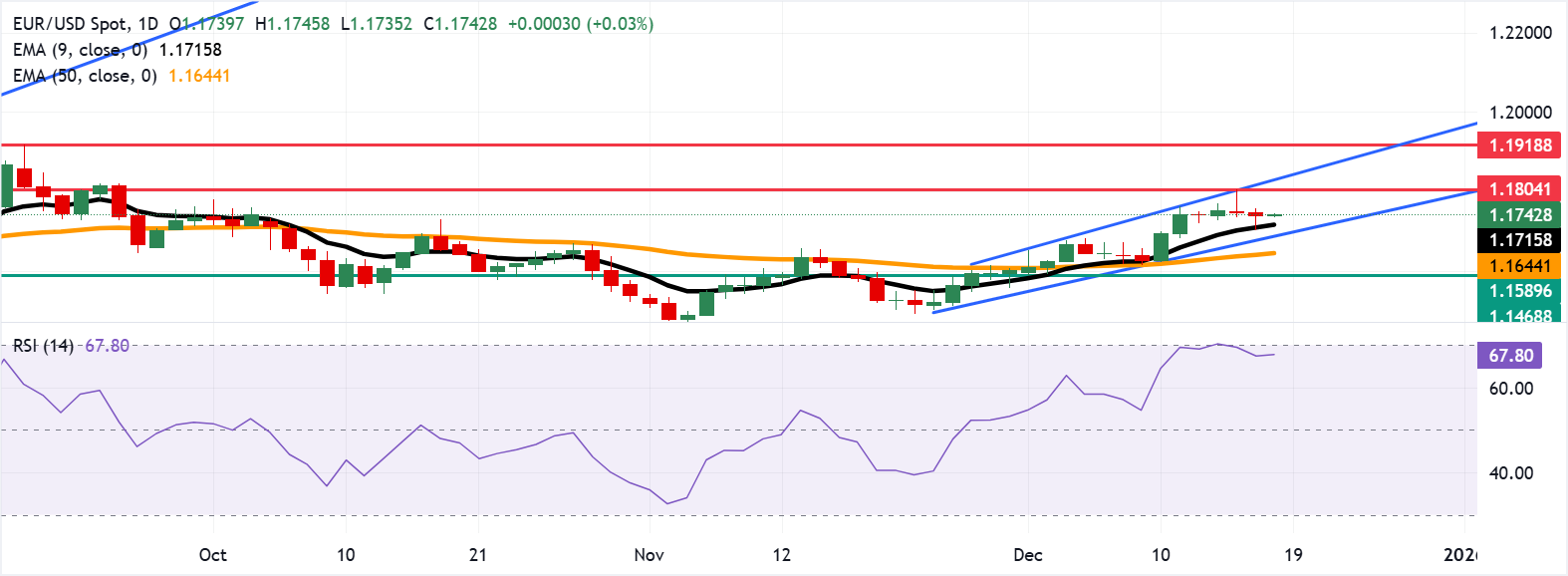
EUR/USD: Biểu đồ hàng ngày

Giá euro hôm nay

Bảng bên dưới hiển thị tỷ lệ phần trăm thay đổi của Đồng Euro (EUR) so với các loại tiền tệ chính được liệt kê hôm nay. Đồng Euro mạnh nhất so với Đô la New Zealand.

USD EUR GBP JPY CAD AUD NZD CHF
USD -0.03% 0.07% 0.03% -0.03% 0.05% 0.26% -0.07%
EUR 0.03% 0.10% 0.05% 0.00% 0.09% 0.29% -0.04%
GBP -0.07% -0.10% -0.04% -0.11% -0.02% 0.19% -0.14%
JPY -0.03% -0.05% 0.04% -0.06% 0.02% 0.20% -0.10%
CAD 0.03% -0.00% 0.11% 0.06% 0.09% 0.27% -0.04%
AUD -0.05% -0.09% 0.02% -0.02% -0.09% 0.20% -0.12%
NZD -0.26% -0.29% -0.19% -0.20% -0.27% -0.20% -0.33%
CHF 0.07% 0.04% 0.14% 0.10% 0.04% 0.12% 0.33%

Bản đồ nhiệt hiển thị phần trăm thay đổi của các loại tiền tệ chính so với nhau. Đồng tiền cơ sở được chọn từ cột bên trái, và đồng tiền định giá được chọn từ hàng trên cùng. Ví dụ: nếu bạn chọn Đồng Euro từ cột bên trái và di chuyển dọc theo đường ngang sang Đô la Mỹ, phần trăm thay đổi được hiển thị trong ô sẽ đại diện cho EUR (đồng tiền cơ sở)/USD (đồng tiền định giá).

(Phân tích kỹ thuật của câu chuyện này được viết với sự trợ giúp của một công cụ AI.)

Tuyên bố miễn trừ trách nhiệm: Thông tin được cung cấp trên trang web này chỉ mang tính chất giáo dục và cung cấp thông tin, không nên được coi là lời khuyên tài chính hoặc đầu tư.

Bình luận (0)

Nhấn vào nút $ , nhập ký hiệu, và chọn để liên kết với một cổ phiếu, ETF, hoặc mã khác.

0/500
Hướng dẫn bình luận
Đang tải...

Bài viết đề xuất

SpaceX Giảm Sâu 7% Trong Ngày Đầu Tiên Gia Nhập Nasdaq. "Tiên Tri Bong Bóng" Cảnh Báo Nguy Cơ Sụp Đổ 90%

TradingKey - Ngay khi SpaceX chuẩn bị được đưa vào chỉ số Nasdaq, nhà đầu tư huyền thoại Jeremy Grantham, người được mệnh danh là "nhà tiên tri bong bóng", đã đưa ra một cảnh báo lớn. Trong một cuộc phỏng vấn, bậc thầy đầu tư giá trị 83 tuổi kiêm đồng sáng lập GMO tuyên bố thẳng thắn rằng có 90% khả năng giá cổ phiếu của SpaceX sẽ phải gánh chịu một đợt sụp đổ lịch sử trong tương lai.of_the_same_kind_with_a_higher_index? No. The answer is no. Example 2: - and standard logic formula inside is: $\neg (\forall y) (P y \land S x)$? No. There's a free $x$ variable inside. So the answer is no. Example 3: Is the formula $(\exists y) Q y$ of the same kind with a higher index as $(\exists x) Q x$? Let's see: $(\exists x) Q x$ has index 1. $(\exists y) Q y$ has index 2. Is it the same kind? Yes, they both have a single existential quantifier. Do they differ only in the bound variable, and does $y$ have a higher index than $x$? Yes, $y$ (index 2) is higher than $x$ (index 1). So the answer is yes. Let me carefully construct the definition of "being of the same kind with a higher index". Let $F$ be a formula. We want to check if $F$ is of the same kind with a higher index as $G$ (which is $D$ in our case, where $D$ is the given first-order logic formula). Actually, we need to find "all formulas $F$ of the same kind with a higher index as $D$". Wait, the definition of "of the same kind with a higher index" is: "We say that a formula $F$ is of the same kind with a higher index as $G$ if $F$ is obtained from $G$ by replacing a bound variable in $G$ (and all its bound occurrences) with a new variable that has a higher index than the original, and that is not already used in $G$." Let's check this definition. If $G = (\exists x) P x$. Bound variable is $x$ (index 1). We can replace $x$ with $y$ (index 2), which is not used in $G$. So $F = (\exists y) P y$. This has a higher index. If we replace $x$ with $z$ (index 3), $F = (\exists z) P z$. So any variable $v$ with index $i > 1$ can replace $x$, as long as it's not in $G$ (but here the only variable in $G$ is $x$, so any variable with index $> 1$ is fine). So the formulas of the same kind with a higher index as $(\exists x) P x$ are: - $(\exists y) P y$ - $(\exists z) P z$ - $(\exists u) P u$ - etc. Let's look at the given formula $D$: $D = (\forall x) (P x \rightarrow (\exists y) (Q x y \land R y))$ First, let's identify the bound variables in $D$. The quantifiers in $D$ are: 1. $(\forall x)$ - this binds $x$ (index 1). 2. $(\exists y)$ - this binds $y$ (index 2). So the bound variables in $D$ are $x$ and $y$. There are no free variables in $D$ (since all occurrences of $x$ and $y$ are bound by their respective quantifiers: the first $x$ in $Px$ and $Qxy$ are bound by $\forall x$, and the $y$ in $Qxy$ and $Ry$ are bound by $\exists y$). Let's verify: In $P x \rightarrow (\exists y) (Q x y \land R y)$: The $x$ in $Px$ is within the scope of $(\forall x)$. The $x$ in $Qxy$ is also within the scope of $(\forall x)$. The $y$ in $Qxy$ is within the scope of $(\exists y)$. The $y$ in $Ry$ is within the scope of $(\exists y)$. Thus, both $x$ and $y$ are bound variables in $D$. The set of variables currently used in $D$ is $\{x, y\}$. According to the definition, $F$ is of the same kind with a higher index as $D$ if $F$ is obtained from $D$ by replacing *a* bound variable in $D$ (and all its bound occurrences) with a new variable that has a higher index than the original, and that is not already used in $D$. Wait, does "replacing a bound variable" mean we replace exactly ONE bound variable, or can we replace more? "replacing a bound variable in G (and all its bound occurrences) with a new variable..." Usually, "a bound variable" means one of the bound variables. Let's see if we can do it for $x$, or for $y$, or both? Usually, "a bound variable" implies we choose one variable to replace. Let's consider both cases: replacing $x$, or replacing $y$. Case 1: Replace $x$ (index 1) with a new variable $v$ that has a higher index than $x$ (i.e., index $> 1$) and is not already used in $D$. The variables used in $D$ are $\{x, y\}$. So the new variable $v$ cannot be $x$ or $y$. Since $x$ has index 1, $v$ must have index $> 1$. The variables with index $> 1$ are $y, z, u, w$. But $v$ cannot be $y$ (since $y$ is already used in $D$). So the allowed new variables to replace $x$ are $z, u, w$. Replacing $x$ with $z$ (index 3) gives: $F_1 = (\forall z) (P z \rightarrow (\exists y) (Q z y \land R y))$ Replacing $x$ with $u$ (index 4) gives: $F_2 = (\forall u) (P u \rightarrow (\exists y) (Q u y \land R y))$ Replacing $x$ with $w$ (index 5) gives: $F_3 = (\forall w) (P w \rightarrow (\exists y) (Q w y \land R y))$ Case 2: Replace $y$ (index 2) with a new variable $v$ that has a higher index than $y$ (i.e., index $> 2$) and is not already used in $D$. The variables used in $D$ are $\{x, y\}$. So $v$ cannot be $x$ or $y$. Since $y$ has index 2, $v$ must have index $> 2$. The variables with index $> 2$ are $z, u, w$. Since these are not used in $D$, they are all valid. Replacing $y$ with $z$ (index 3) gives: $F_4 = (\forall x) (P x \rightarrow (\exists z) (Q x z \land R z))$ Replacing $y$ with $u$ (index 4) gives: $F_5 = (\forall x) (P x \rightarrow (\exists u) (Q x u \land R u))$ Replacing $y$ with $w$ (index 5) gives: $F_6 = (\forall x) (P x \rightarrow (\exists w) (Q x w \land R w))$ Wait! Can we replace both $x$ and $y$? The definition says "replacing a bound variable". This is singular. It refers to replacing one bound variable. Let's re-read carefully: "replacing a bound variable in G... with a new variable..." Yes, "a bound variable" means we choose one of the bound variables in $G$ and replace it. So the resulting formulas should be those obtained by replacing either $x$ or $y$ (but not both simultaneously, unless it's done in steps, but the definition of "is of the same kind..." typically refers to a single relation step. If it were multiple, it would say "replacing one or more" or "replacing the bound variables"). Wait, let's think: is "being of the same kind with a higher index" a transitive relation? If $F$ is of the same kind with a higher index as $G$, is it defined by a single variable replacement? "obtained from $G$ by replacing a bound variable..." Yes, "a bound variable" means exactly one. So the formulas are $F_1, F_2, F_3, F_4, F_5, F_6$. Let's write down these formulas clearly. First, let's list the formulas obtained by replacing $x$ (index 1): The new variable $v$ must have index $> 1$ and not be in $\{x, y\}$. So $v \in \{z, u, w\}$. - For $v = z$: $(\forall z) (P z \rightarrow (\exists y) (Q z y \land R y))$ - For $v = u$: $(\forall u) (P u \rightarrow (\exists y) (Q u y \land R y))$ - For $v = w$: $(\forall w) (P w \rightarrow (\exists y) (Q w y \land R y))$ Second, let's list the formulas obtained by replacing $y$ (index 2): The new variable $v$ must have index $> 2$ and not be in $\{x, y\}$. So $v \in \{z, u, w\}$. - For $v = z$: $(\forall x) (P x \rightarrow (\exists z) (Q x z \land R z))$ - For $v = u$: $(\forall x) (P x \rightarrow (\exists u) (Q x u \land R u))$ - For $v = w$: $(\forall x) (P x \rightarrow (\exists w) (Q x w \land R w))$ Let's double check if there are any other bound variables or any other interpretation. What if $y$ was replaced by something else? No, only $z, u, w$ have higher indices than $y$ (index 2) and are not $\{x,y\}$. What if $x$ was replaced by something? $y, z, u, w$ have higher indices than $x$ (index 1), but $y$ is already used in $D$, so we cannot use $y$. Thus only $z, u, w$ are allowed. This matches exactly the 6 formulas. Let's write down the final response clearly, listing these 6 formulas.To find all formulas of the same kind with a higher index than the formula: $D = (\forall x) (P x \rightarrow (\exists y) (Q x y \land R y))$ we need to follow the definition: A formula $F$ is of the same kind with a higher index as $D$ if $F$ is obtained by replacing **one** bound variable in $D$ (and all its bound occurrences) with a new variable from $\{x, y, z, u, w\}$ that is not currently used in $D$ and has a higher index than the original variable. The variables used in $D$ are $\{x, y\}$, where: * $x$ has index 1 * $y$ has index 2 The remaining available variables with their indices are: * $z$ (index 3) * $u$ (index 4) * $w$ (index 5) --- ### Case 1: Replacing the bound variable $x$ (index 1) We can replace $x$ with any variable that has an index $> 1$ and is not already in $\{x, y\}$. The valid replacement variables are $z, u,$ and $w$. This gives the following 3 formulas: 1. **Replacing $x$ with $z$:** $(\forall z) (P z \rightarrow (\exists y) (Q z y \land R y))$ 2. **Replacing $x$ with $u$:** $(\forall u) (P u \rightarrow (\exists y) (Q u y \land R y))$ 3. **Replacing $x$ with $w$:** $(\forall w) (P w \rightarrow (\exists y) (Q w y \land R y))$ --- ### Case 2: Replacing the bound variable $y$ (index 2) We can replace $y$ with any variable that has an index $> 2$ and is not already in $\{x, y\}$. The valid replacement variables are $z, u,$ and $w$. This gives the following 3 formulas: 4. **Replacing $y$ with $z$:** $(\forall x) (P x \rightarrow (\exists z) (Q x z \land R z))$ 5. **Replacing $y$ with $u$:** $(\forall x) (P x \rightarrow (\exists u) (Q x u \land R u))$ 6. **Replacing $y$ with $w$:** $(\forall x) (P x \rightarrow (\exists w) (Q x w \land R w))$ --- ### Conclusion The 6 formulas of the same kind with a higher index than $D$ are: 1. $(\forall z) (P z \rightarrow (\exists y) (Q z y \land R y))$ 2. $(\forall u) (P u \rightarrow (\exists y) (Q u y \land R y))$ 3. $(\forall w) (P w \rightarrow (\exists y) (Q w y \land R y))$ 4. $(\forall x) (P x \rightarrow (\exists z) (Q x z \land R z))$ 5. $(\forall x) (P x \rightarrow (\exists u) (Q x u \land R u))$ 6. $(\forall x) (P x \rightarrow (\exists w) (Q x w \land R w))$
tradingkey.logo
* Tham chiếu, phân tích và chiến lược giao dịch do bên thứ ba là Trading Central cung cấp. Quan điểm được đưa ra dựa trên đánh giá và nhận định độc lập của chuyên gia phân tích, mà không xét đến mục tiêu đầu tư và tình hình tài chính của nhà đầu tư.
Cảnh báo Rủi ro: Trang web và Ứng dụng di động của chúng tôi chỉ cung cấp thông tin chung về một số sản phẩm đầu tư nhất định. Finsights không cung cấp và việc cung cấp thông tin đó không được hiểu là Finsights đang đưa lời khuyên tài chính hoặc đề xuất cho bất kỳ sản phẩm đầu tư nào.
Các sản phẩm đầu tư có rủi ro đầu tư đáng kể, bao gồm cả khả năng mất số tiền gốc đã đầu tư và có thể không phù hợp với tất cả mọi người. Hiệu suất trong quá khứ của các sản phẩm đầu tư không phải là chỉ báo cho hiệu suất trong tương lai.
Finsights có thể cho phép các nhà quảng cáo hoặc đối tác bên thứ ba đặt hoặc cung cấp quảng cáo trên Trang web hoặc Ứng dụng di động của chúng tôi hoặc bất kỳ phần nào trong đó và có thể nhận thù lao từ họ dựa trên sự tương tác của bạn với các quảng cáo đó.
© Bản quyền: FINSIGHTS MEDIA PTE. LTD. Mọi quyền được bảo lưu.