


From Optical Interconnect Veteran to Full-Stack 'Picks-and-Shovels' Player: Why LITE?



$Lumentum(LITE.US)
Dolphin Research previously noted in its optical connectivity review that regardless of where the optical module sits, the optical engine, with high value content and barriers, remains the core and most defensible asset. This time we start with a legacy leader in the lane, Lumentum. Its share price has surged nearly 10x in a year, lifting market cap above $70 bn, and it drew a $2 bn direct investment from NVIDIA slated for Mar 2026.
Break down a single optical link in a data center: data must pass through electro‑optical conversion. Electrical signals are first converted into light, transmitted through fiber, then converted back to electrical. The module that performs this translation is the optical transceiver, and the most critical, complex, and expensive component inside is the laser die that emits light — essentially the ‘bulb’ of the entire link. Lumentum sells this ‘bulb’ and is among the few players globally that can build in‑house starting from indium phosphide (InP) wafers.
But selling light‑source dies alone does not explain the current re‑rating. The real shift is that the AI super cycle has reset pricing logic for optical components. Traditionally, optical parts are a highly cyclical business, tracking cloud capex and legacy DC buildouts, with balanced supply‑demand, intense competition, and annual price declines. The AI cluster build wave rewired this: massive horizontal GPU interconnect drove exponential demand for high‑speed optical links, and the move from 800G to 1.6T further increased per‑system laser die content.
On the supply side, the mismatch is stark — volume production of high‑end high‑speed lasers (200G+) carries very high barriers, with only a handful of players worldwide able to expand. Capacity adds rely on self‑built fabs, making near‑term supply inelastic and the mid‑to‑long ramp lengthy. Explosive demand and slow capacity catch‑up have muted prior cyclicality, pushing the industry into a supply‑constrained sellers’ market. Tier‑1 capacity owners are enjoying a trifecta of product premiums, long‑term locked pricing, and rising GPMs.
This is why Dolphin Research lists Lumentum as a core name in AI optical interconnect. In this note we organize Lumentum’s businesses and focus on two questions: 1) In an 800G/1.6T module, why are lasers both the key value driver and the primary yield bottleneck? 2) Where do Lumentum’s five product lines (EML, CW, telecom devices, optical modules, OCS) sit within AI clusters, and how is the competitive landscape? (Due to space, this piece emphasizes the first two product lines.)
Below is the main text:
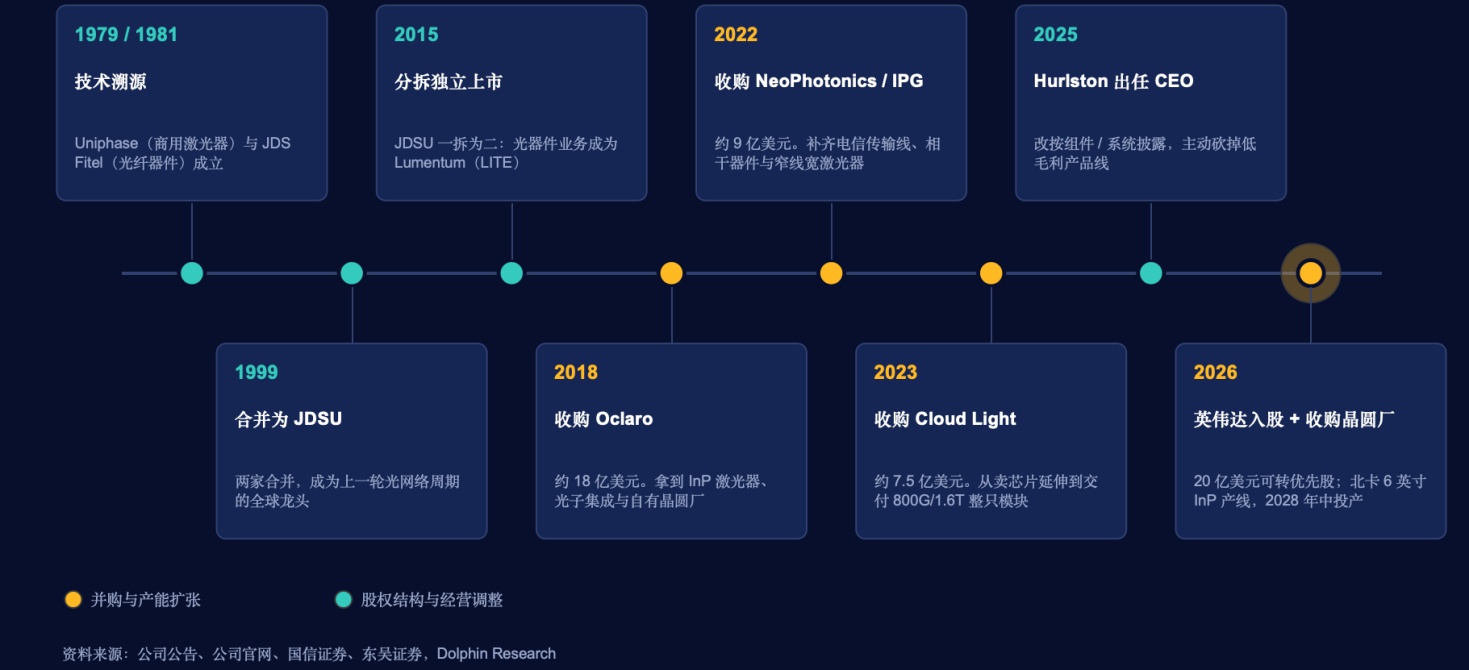
I. From discrete optical devices to an integrated photonics platform ‘Yi‑Zhong‑Tian’ is a nickname Chinese investors use for three local optical module vendors (Eoptolink, InnoLight, TFC). But the true old guard in optical comms is Lumentum. Uniphase (commercial lasers, founded 1979) and JDS Fitel (optical fiber components, founded 1981) merged in 1999 to form JDSU, a star of optical networking during the last internet bubble.
In 2015, JDSU split in two: the optical components biz for comms and data centers listed independently as Lumentum, while the remainder, retaining network test instruments and specialty optics, was renamed Viavi (VIAV). Post spin, Lumentum’s growth has leaned heavily on M&A integration.
a: In 2018, it acquired Oclaro for about $1.8 bn, securing InP laser and photonic integrated circuit know‑how and lines. This remains the core tech foundation of its AI high‑speed laser narrative. b: In 2022, it bought NeoPhotonics to add ITLAs (narrow‑linewidth tunable lasers, the core light source in coherent), high‑speed coherent PICs, and coherent transceiver subassemblies (TROSAs). It also acquired IPG’s telecom transmission unit, gaining in‑house coherent DSP companion ASIC capability and full coherent modules for carriers.
The two deals completed Lumentum’s coherent transmission stack, enabling full coherent solutions for DCI, metro, and long‑haul markets. c: In Nov 2023, it paid about $750 mn for Cloud Light, a high‑speed module supplier to hyperscalers. This marked Lumentum’s move beyond chips/components into delivering complete optical modules directly.
Collectively, these acquisitions transformed Lumentum from a discrete device vendor into an integrated photonics platform spanning short‑reach AI scale‑out links, long‑reach coherent transport, and high‑speed module systems.
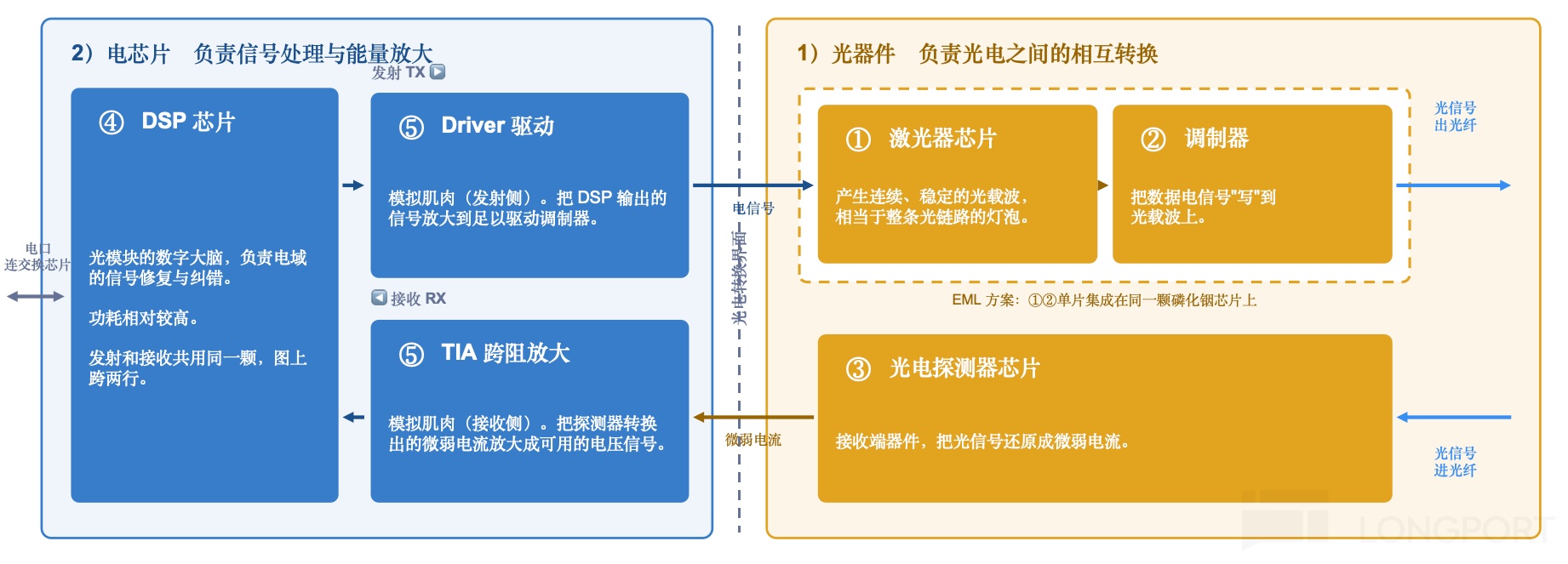
II. Product and biz matrix To understand Lumentum’s lines, start with the tech. In a traditional pluggable high‑speed module (800G/1.6T), core hardware along the E/O chain splits into 1) optical devices and 2) electrical chips.
1) Optical devices: perform electro‑optic conversion ① Laser die — the continuous, stable light carrier source, the ‘bulb’ of the link. ② Modulator — imprints data from the electrical domain onto the optical carrier.
③ Photodiode die — the receive‑side device that converts light back into a small electrical current. 2) Electrical chips: handle signal processing and amplification ④ DSP — the module’s digital brain, responsible for signal recovery and FEC, with relatively high power draw.
⑤ Driver and TIA — the analog muscle. On Tx, the driver boosts DSP output to drive the modulator; on Rx, the TIA amplifies the photodiode’s weak current into a usable voltage.
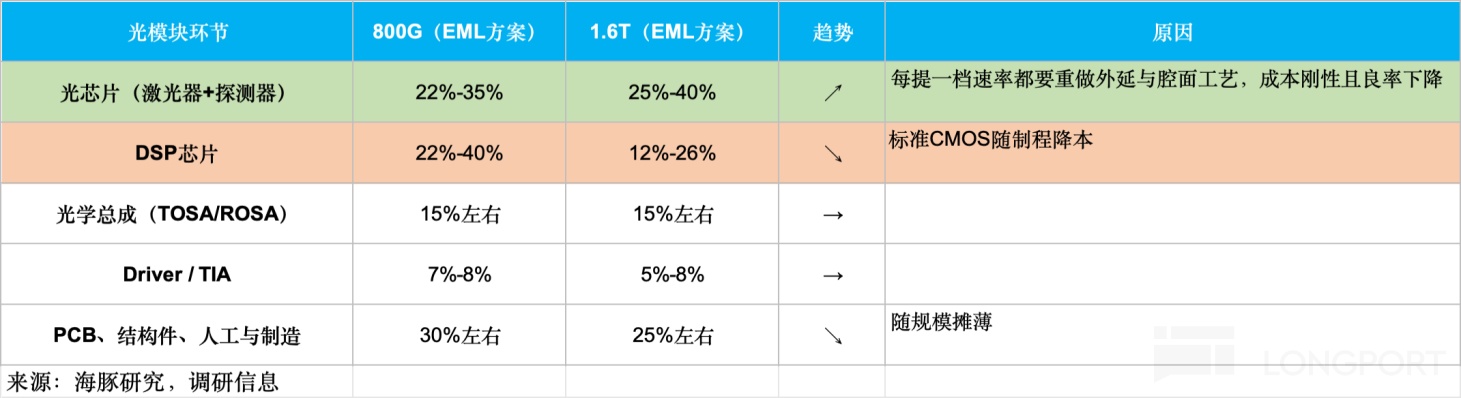
Critically, optical devices and electrical chips differ fundamentally in manufacturing models and capacity elasticity. Electrical chips like DSPs are silicon CMOS and usually fabless, taped out at foundries like TSMC. While advanced nodes face quota limits, once slots are secured, foundries can flex volumes via mature lines, giving strong capacity elasticity without the chip vendor building fabs.
Optical devices follow a very different physics. Silicon cannot emit light efficiently, so ultra‑high‑speed lasers must use compound semis like InP. Yet compound optical chips lack a TSMC‑like, highly standardized third‑party foundry ecosystem.
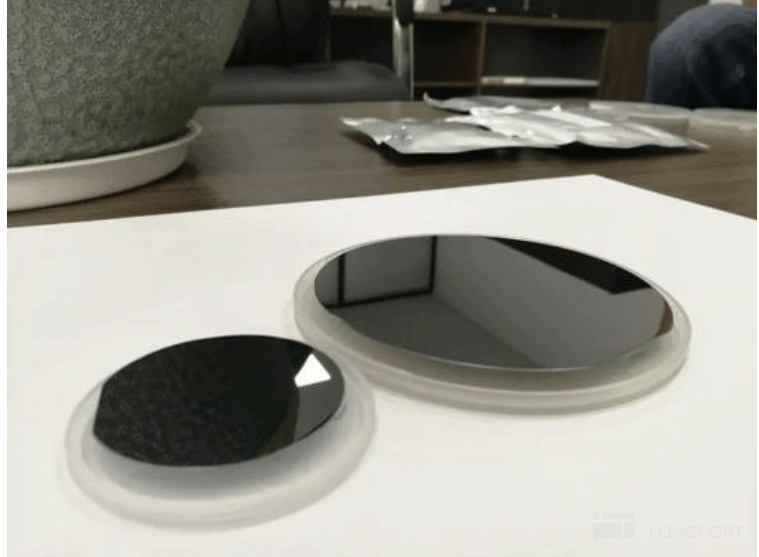
As a result, leading players run vertically integrated IDM models — self‑built fabs, in‑house epi growth, wafer processing, and coatings. Capacity adds require build, debug, and yield ramps over typically 2–3 years, far less elastic than electrical chips. There are a few InP foundries for small‑lot tapeouts by smaller customers, but they cannot support large, stable shipments of high‑end high‑speed optical dies.
With this optical versus electrical context, Lumentum’s positioning becomes clear. Its core products are optical devices, with capacity heavily tied to self‑built InP wafer lines. This means even if AI lifts module demand quickly, Lumentum cannot meaningfully spike shipments in the short run. Capacity elasticity is structurally constrained.
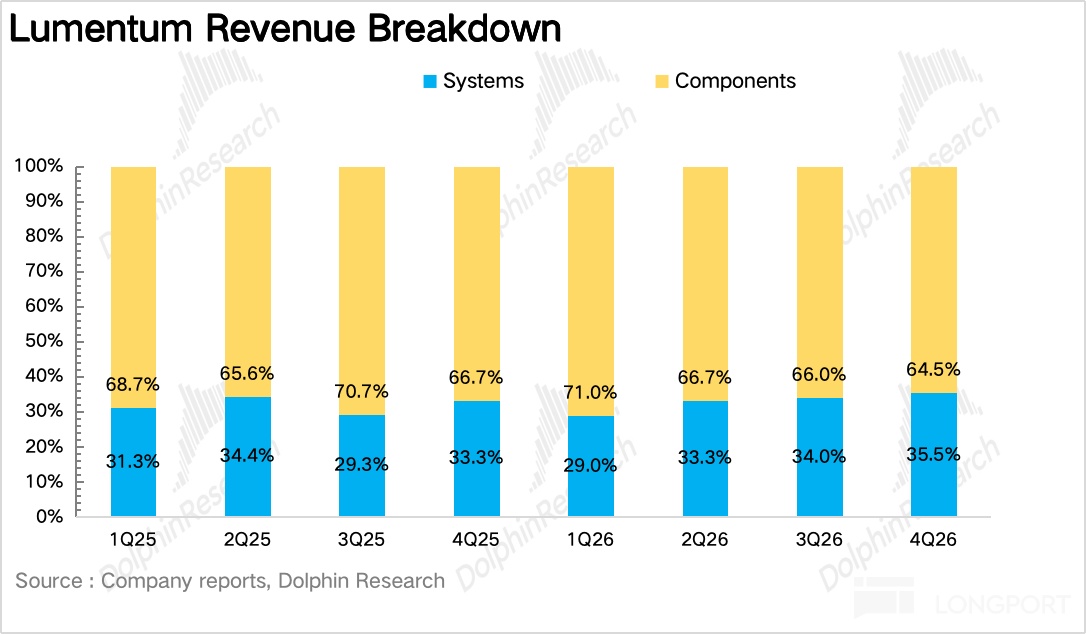
Against this backdrop, Lumentum reports two primary revenue segments: 1) Components: mainly EML high‑speed laser dies, CW continuous‑wave laser dies, and various legacy telecom devices. 2) Systems: high‑speed optical modules from Cloud Light and OCS optical circuit switches. It also has an industrial laser biz, which is non‑comms and smaller in scale.
As shown below, the systems mix has been rising sequentially, driven by faster module shipments.
Because both segments blend AI and non‑AI exposure, it is hard to unpack the underlying drivers from filings alone. So we organize by five core product lines — EML, CW, telecom devices (components), and optical modules plus OCS (systems). For each, we discuss technical positioning, competition, and growth runway.
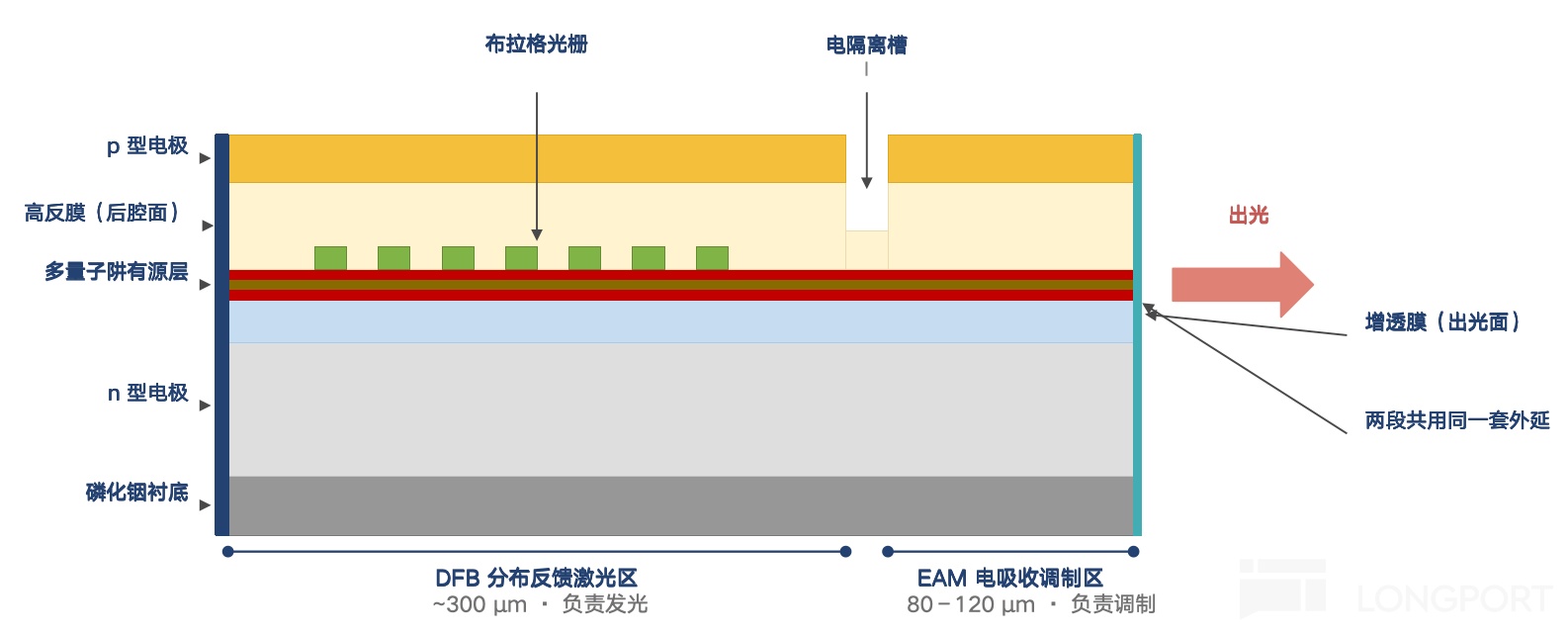
We start with the base of Lumentum’s optical chip biz — high‑speed lasers. The mainstream high‑speed laser dies have three distinct routes based on how emission and modulation are integrated: a) EML (electro‑absorption modulated laser) — integrated, edge‑emitting: emission and modulation are monolithically integrated on a single InP die, outputting high‑speed modulated light. This is the mainstream for pluggable modules. b) CW (continuous‑wave laser) — separated, edge‑emitting: only provides high‑power, stable continuous light, with modulation handled by external silicon photonics. This is the core light source for SiPh packaging and CPO. c) VCSEL (vertical‑cavity surface‑emitting laser) — low‑cost, vertical emission: supports low‑cost array production but short reach, used mainly in 3D sensing and short‑range automotive LiDAR.
Note EML and CW are both edge‑emitters (EELs), requiring complex steps like wafer cleaving and facet coatings, with much higher process difficulty than VCSELs.
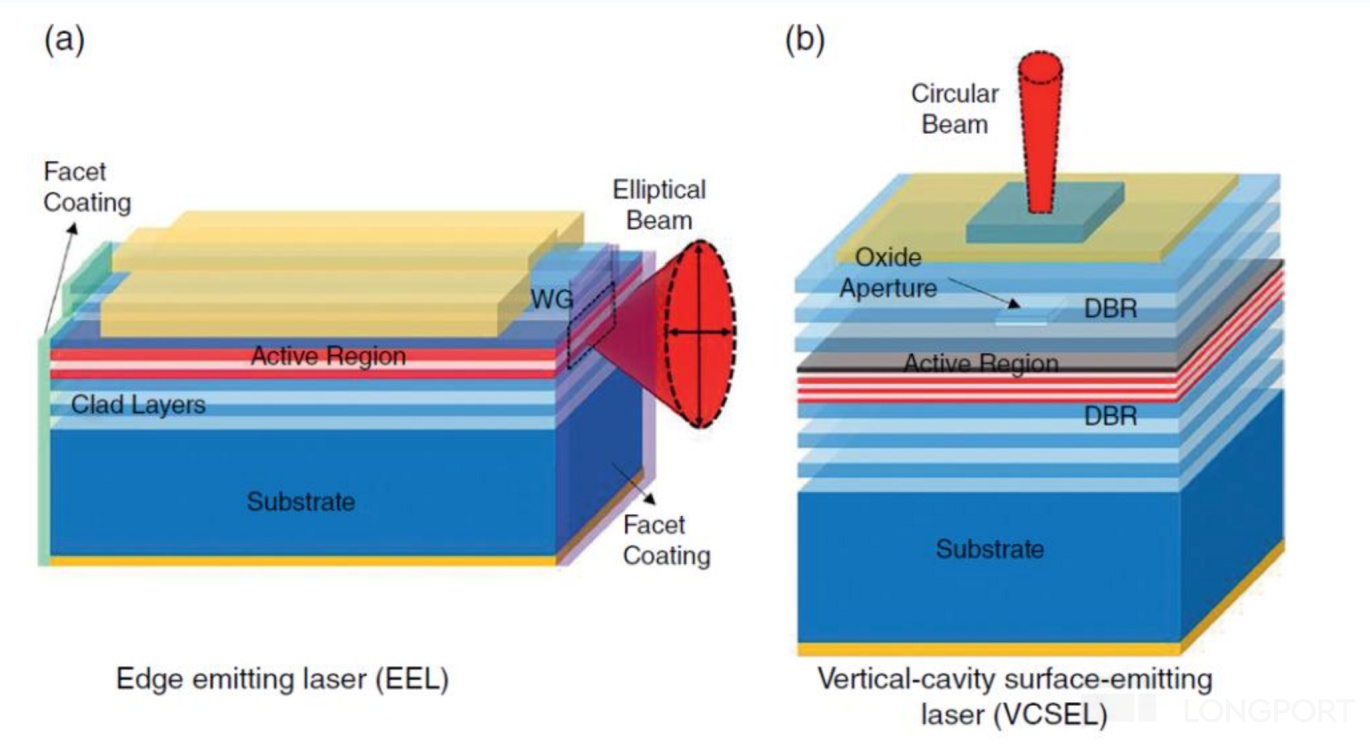
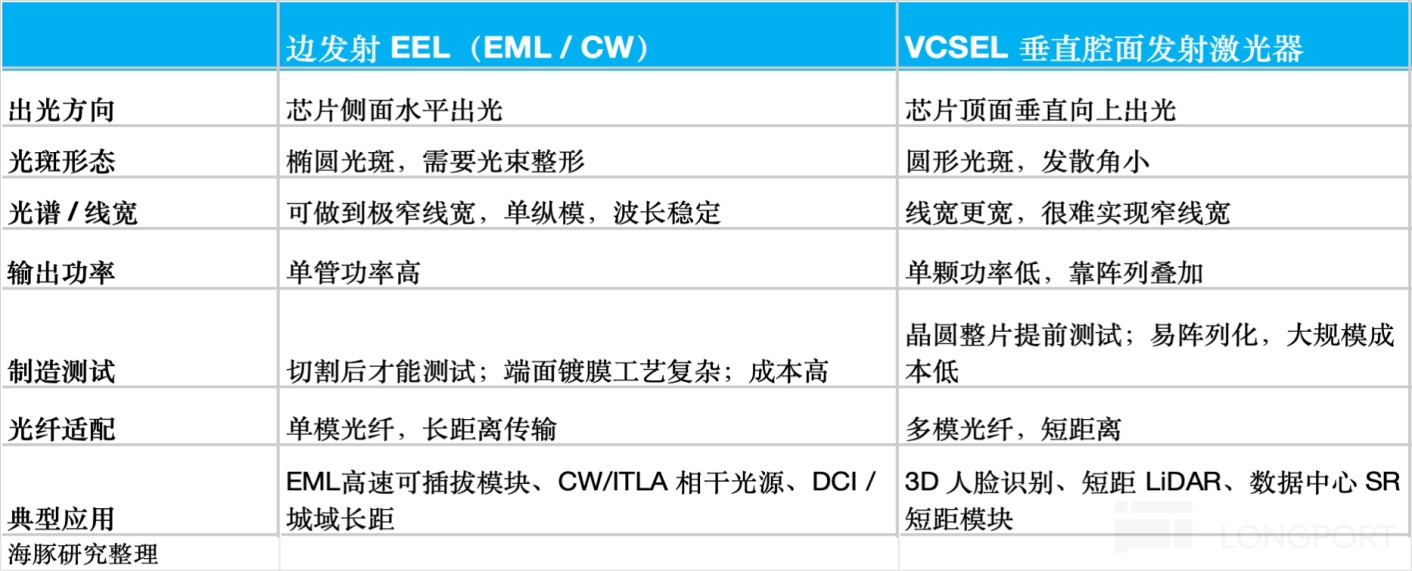
These routes drive stark differences in process difficulty, ASPs, GPMs, and competition. We compare them in the table below. Given VCSELs are mainly consumer/industrial and now less than 10% of Lumentum revenue with limited relevance to AI comms, we focus on EML and CW.
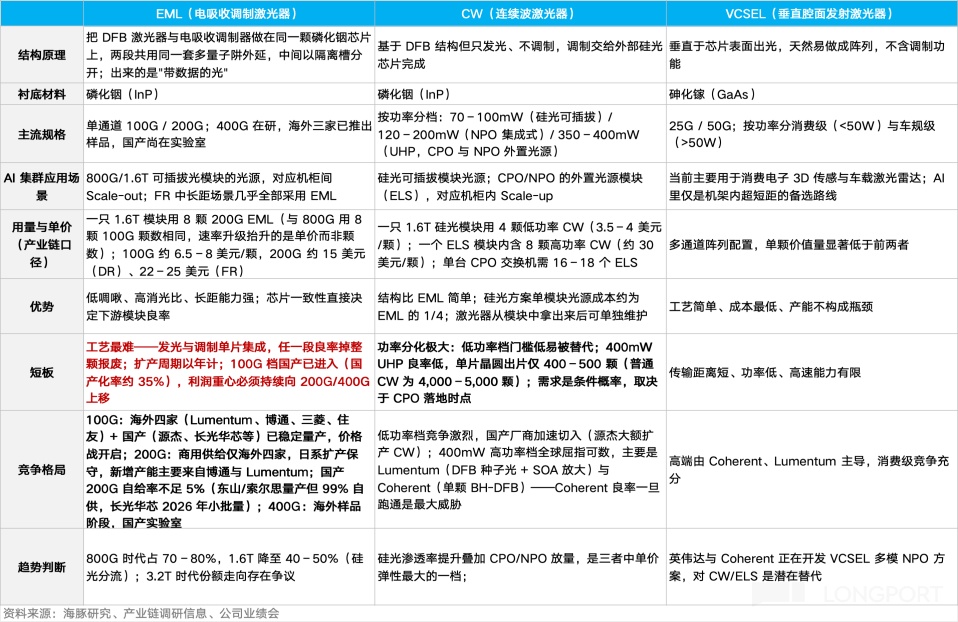
1) EML laser dies: the Scale‑out foundation EML is the mainstream for 800G/1.6T pluggable modules with discrete light sources. A 1.6T module typically needs eight 200G EMLs.
By deployment, EML targets Scale‑out interconnect between AI racks, covering links from GPU racks to leaf switches and leaf to spine switches over tens to 500 meters. Key downstream customers include InnoLight, Eoptolink, and Coherent on the module side, ultimately supplying North American hyperscalers. This is Lumentum’s core base in optical chips.
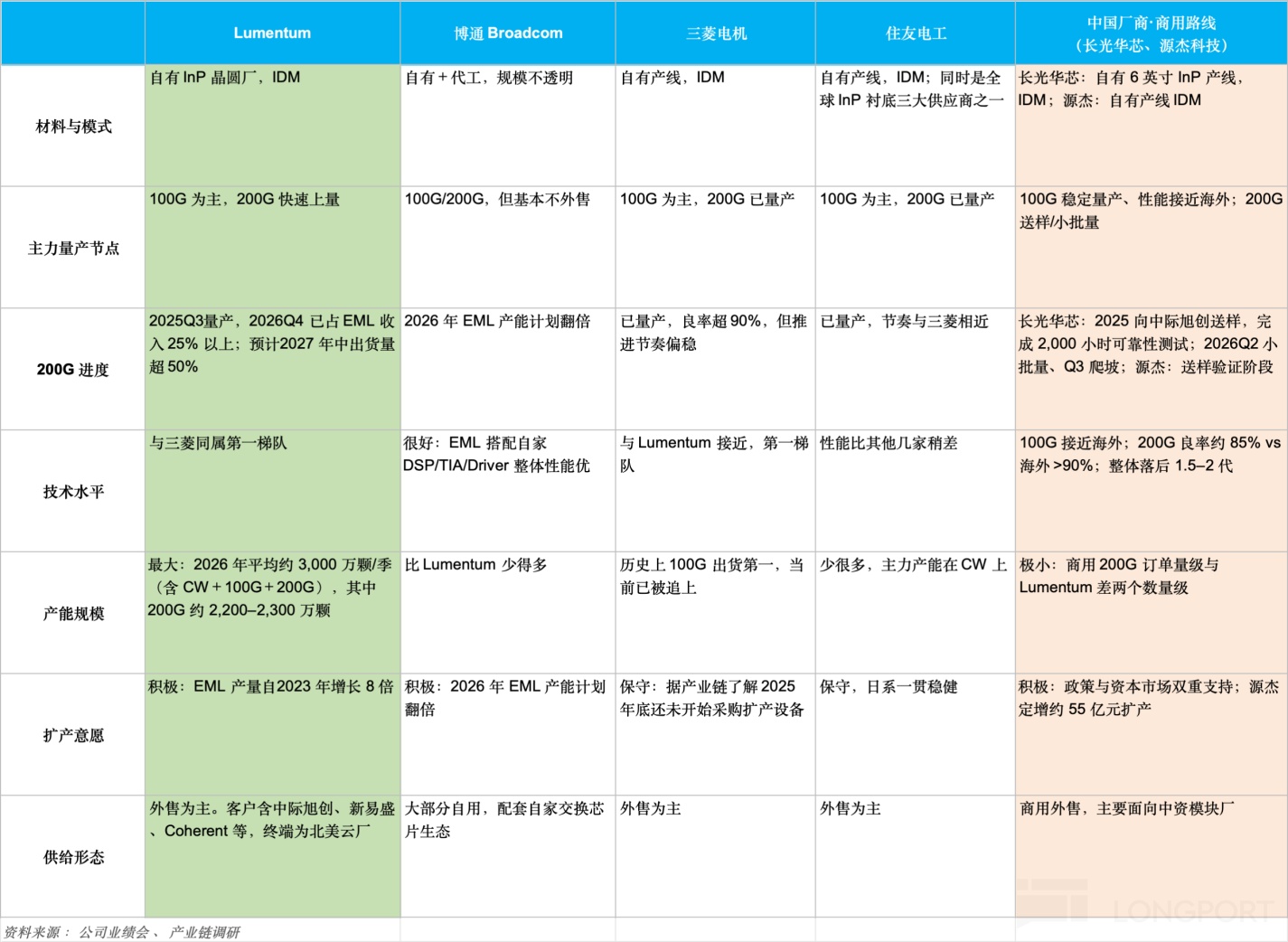
Industry checks indicate that because EML monolithically integrates a DFB emit section and an EAM modulator on InP, the required second epi growth on InP is very complex, with high process barriers and challenging yields. Today, only four vendors can reliably mass‑ship 200G EML to top module makers at high yields — Lumentum, Mitsubishi Electric, Sumitomo Electric, and Broadcom — who together hold over 80% share. Lumentum ranks in the first tier by capacity scale.
In 100G EML, Chinese vendors have been catching up, with Raybow, CIG, and others in stable mass production. Domestic share is near 35% and price competition has begun. In contrast, local content in 200G EML remains below 5%, with most players still in sampling or small pilot runs.
Moreover, after overcapacity pain in the last 5G cycle, the two Japanese vendors (Mitsubishi and Sumitomo) are cautious this round, limiting new 200G EML adds. Most high‑end 200G EML incremental capacity is coming from Lumentum and Broadcom. As a result, Lumentum is pivoting its mix aggressively toward higher‑value 200G EML. Management guides that by mid‑2027, 200G EML will exceed 50% of its EML shipments.
Based on checks, Lumentum’s EML laser revenue is about $640 mn (around 20% of total), with both volume and ASP up. On one hand, AI cluster expansion is driving explosive 800G/1.6T pluggable demand, lifting EML unit shipments. On the other, mix is shifting from 100G to 200G EML, with per‑die ASPs nearly doubling, amplifying revenue elasticity.
Profitability is strong, with blended GPM above 60%, making EML the largest profit contributor and the product with the strongest pricing power today.
2) CW/UHP lasers: the largest Scale‑up upside Unlike EML’s integrated ‘emit + modulate’, CW is a specialization play: it only provides the ‘bulb’, a high‑power, stable continuous light, with modulation handled by external SiPh.
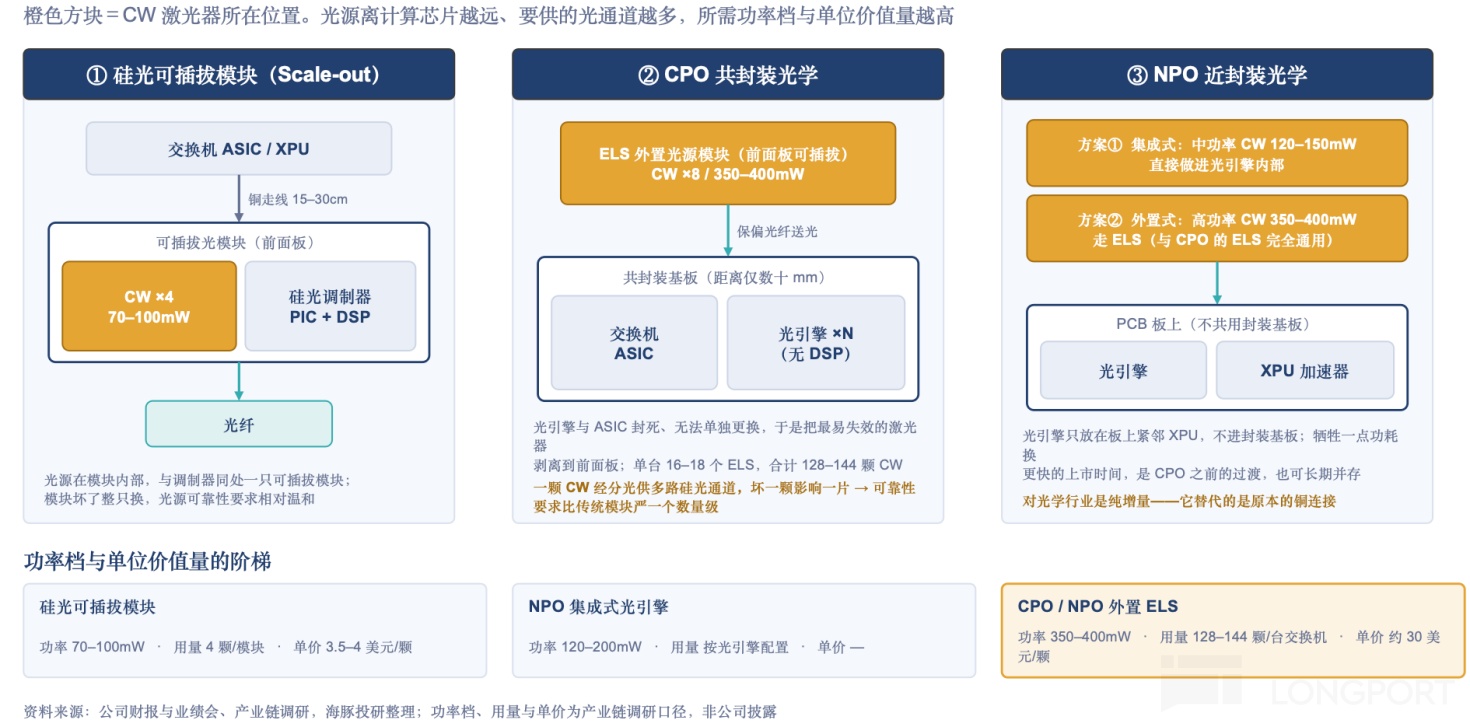
Generally, the farther the light source sits from the SiPh die, the higher the total link loss, implying higher CW output power requirements. This raises per‑die process barriers (noise and heat must be managed) and value. By power class, CW covers three core use cases:
a) 70–100 mW — SiPh pluggables for Scale‑out Yole estimates SiPh penetration in DC modules near 30% today, rising to 60%+ by 2030. For Lumentum, this is an intra‑stack route shift: 800G SiPh displaces 100G EML, and 1.6T SiPh displaces 200G EML.
The value, however, differs. In 1.6T, an EML design needs eight 200G EMLs (ASP $15–25 each), whereas a SiPh design needs four CWs (ASP $3.5–4 each). Switching to SiPh lowers light‑source value per module. Management has said interest here is limited — units may rise, but per‑module value and margin elasticity trail EML.
b) 120–200 mW — integrated light engines for NPO (near‑package optics), a Scale‑up path As a bridge from pluggables to CPO, NPO mounts the module on the PCB to boost signal speed between switch and optics. Versus 70–100 mW CW in SiPh pluggables, this class faces tighter specs in output power, noise, and high‑temp reliability. Per‑die value and technical hurdles rise meaningfully. It is pure incremental demand and does not cannibalize EML.
c) 350–400 mW (UHP) — external light sources for CPO/NPO, a Scale‑up play ELS is the mainstream external light source for CPO architectures, serving cabinet‑level GPU direct high‑speed links. In CPO, SiPh engines and switch dies share a substrate via advanced packaging. Because lasers are the most failure‑prone part of the link and are heat‑sensitive, co‑packaging would force full engine swaps for a single laser failure. The industry consensus is ELS: make CW lasers front‑panel pluggable modules and deliver light inside via polarization‑maintaining fiber.
In terms of value, a CPO switch typically needs 16–18 ELS modules, each integrating eight UHP CW dies. This implies 128–144 CW dies per switch. An ELS module sells for about $500–600, with eight CW dies around $240, or 40–50% of the module.
In other words, one ELS equals the CW revenue content of roughly 15 traditional SiPh pluggable modules. Overall, UHP CW carries the highest technical barriers, is a pure AI‑driven incremental market, and does not erode EML stock demand. It is Lumentum’s largest mid‑term growth lever.
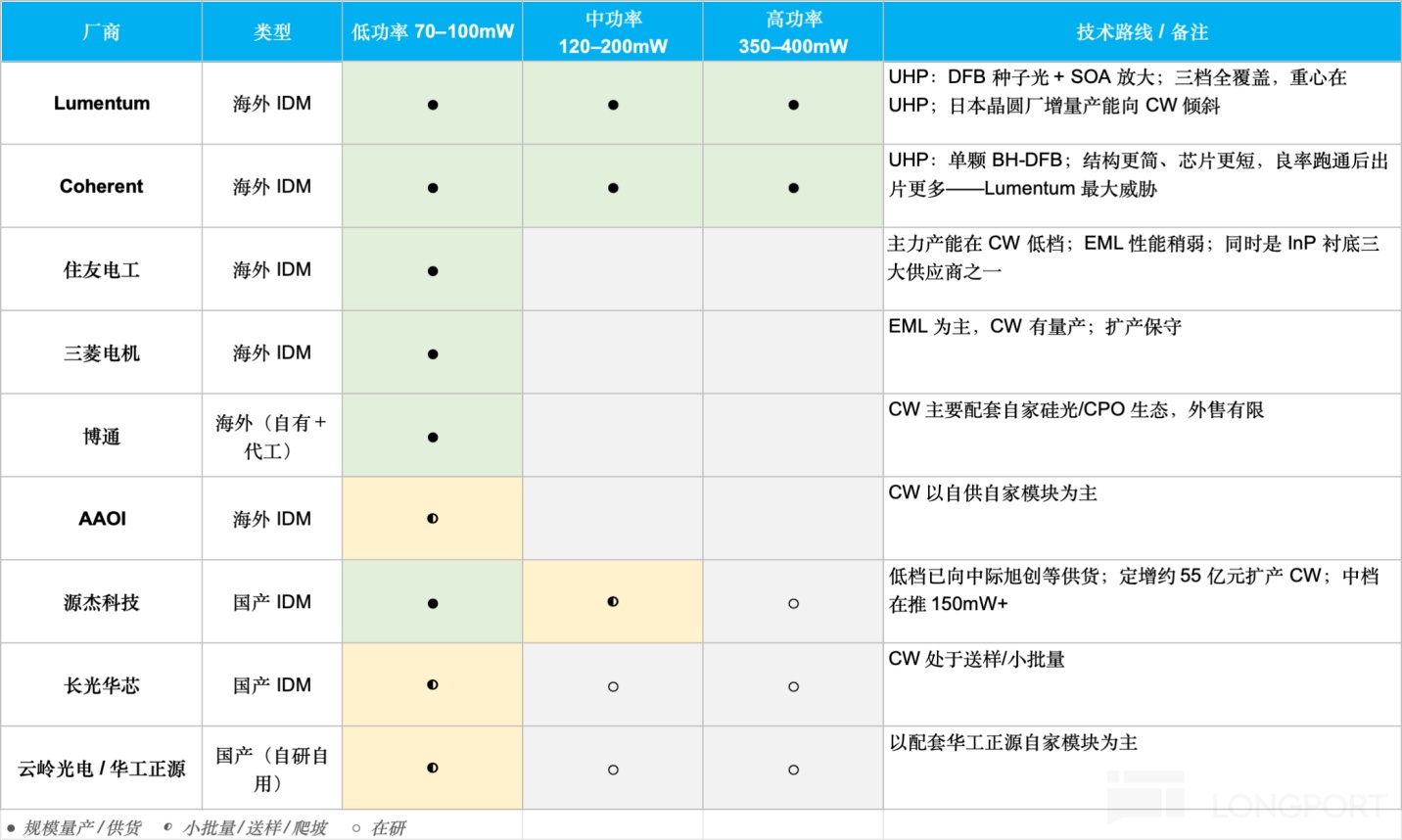
Competition varies by power class. At low power, InP epi and die structures are mature, and the challenge is cost and high‑yield delivery. This is a red ocean. Chinese vendors (Raybow, CIG, CloudLight Opto, etc.) and low‑cost overseas IDMs (e.g., AAOI) are expanding, multiple vendors have passed top module maker quals, and customers like InnoLight and Eoptolink multi‑source to push prices down.
At high power (350–400 mW UHP), only Lumentum and Coherent can stably mass produce today, and they follow different tech paths. Coherent: single‑die ‘hard‑push’ (BH‑DFB) — akin to a single large‑displacement engine, one buried heterostructure DFB die pushes 400 mW. The upside is a very compact structure, small die area, and high die count per wafer. The trade‑off is that heat, linewidth, and long‑term reliability all rest on one die, making early yield ramps slow.
Lumentum: two‑stage ‘separated’ path (DFB seed + SOA) — like a mature small engine with turbo. A clean, low‑noise DFB seed provides the light, then an on‑die SOA boosts power to 400 mW. Each stage operates in a mature window, improving reliability and allowing the same platform to down‑bin for mid‑power, which aids R&D efficiency. The cost is obvious: adding SOA increases die length, slashing die per wafer from 4,000–5,000 for standard CW to just 400–500 at UHP, a near 10x reduction.
In short, Coherent is betting that as yields climb, smaller die area will unlock extreme wafer cost advantages. Lumentum is trading wafer area for higher device reliability. Given today’s tight supply, hyperscalers prioritize delivery and stability over cost, making Lumentum’s ‘area‑for‑reliability’ engineering more attractive. Industry checks suggest current ELS share is roughly Lumentum ~60% and Coherent ~40%.
Over the long run, once Coherent lifts yields, its cost edge should emerge and pressure Lumentum. For mid‑power, any vendor capable of 400 mW can readily do 150–200 mW, making mid‑power a ‘by‑product volume zone’ for high‑power players. For challengers moving up from low power, 150–200 mW is a necessary step. But without breaking into high power, they miss wafer binning scale benefits, making mid‑power wafer costs hard to match against the ‘by‑product’ low‑cost advantage of the leaders.
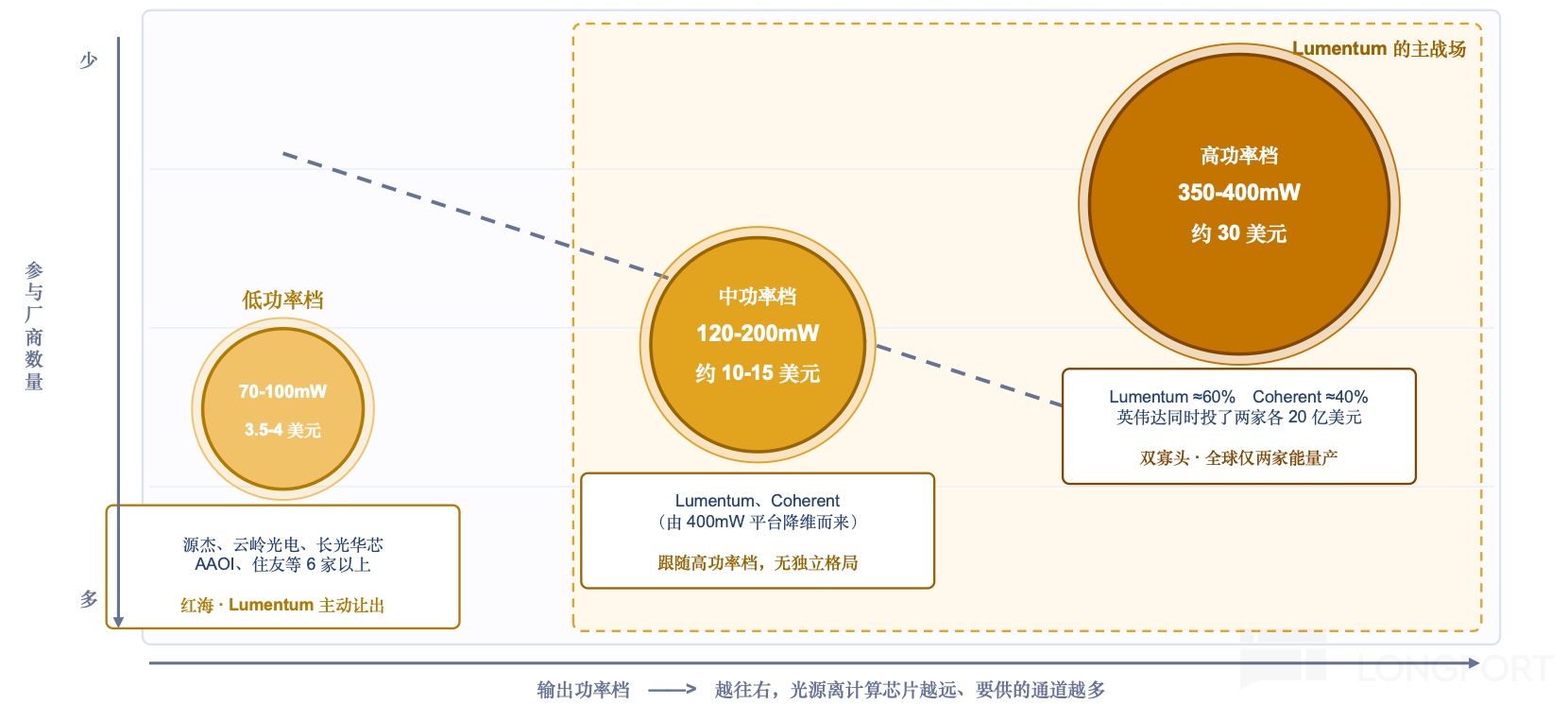
Checks indicate Lumentum’s CW laser revenue is about $50 mn per year, just ~2% of total, still small. This is mainly early SiPh pluggable demand and CPO sampling. Ultimately, CW upside depends on how fast NPO/CPO architectures land. As the industry migrates from pluggables to CPO, CW demand should inflect exponentially. (We will quantify in the next piece.)
Risk disclosure and statement: 海豚君免责声明及一般披露
Dolphin Research optical interconnect series:
‘AI 超连接时代:AI 向 ‘光’ 飞奔?’
‘‘铜’ 牛夫人 不走!CPO:真机会 or 镜中花?’
‘叫板英伟达霸权,谷歌 ‘光网’ 凭什么?’
Recommended Articles









Comments (0)
Click the $ button, enter the symbol, and select to link a stock, ETF, or other ticker.