


The No. 1 Holding in Warren Buffett's $786 Million "Secret" Portfolio Is a Bona Fide Millionaire-Maker (but There's a Catch)



Key Points
Although Warren Buffett retired as Berkshire Hathaway's CEO on Dec. 31, his legacy is lasting.
The Oracle of Omaha's "secret" portfolio, which can be traced to a Berkshire acquisition in 1998, is highly diverse and ETF-oriented.
The top holding of Buffett's secret portfolio tracks an index that hasn't generated a negative rolling 20-year total return (including dividends) since 1900.
The trillion-dollar company that Warren Buffett helped build, Berkshire Hathaway (NYSE: BRKA)(NYSE: BRKB), has entered uncharted territory. For the first time in well over half a century, the Oracle of Omaha, who outperformed the benchmark S&P 500 (SNPINDEX: ^GSPC) by more than 6,000,000% over six decades, is not at the helm.
But just because Buffett retired as CEO on Dec. 31 and handed the reins to his protégé, Greg Abel, it doesn't mean his legacy isn't lasting.
Will AI create the world's first trillionaire? Our team just released a report on the one little-known company, called an "Indispensable Monopoly" providing the critical technology Nvidia and Intel both need. Continue »
Two weeks ago, an update of Warren Buffett's $786 million "secret" portfolio revealed that a time-tested investment and proven millionaire-maker is still the No. 1 holding.
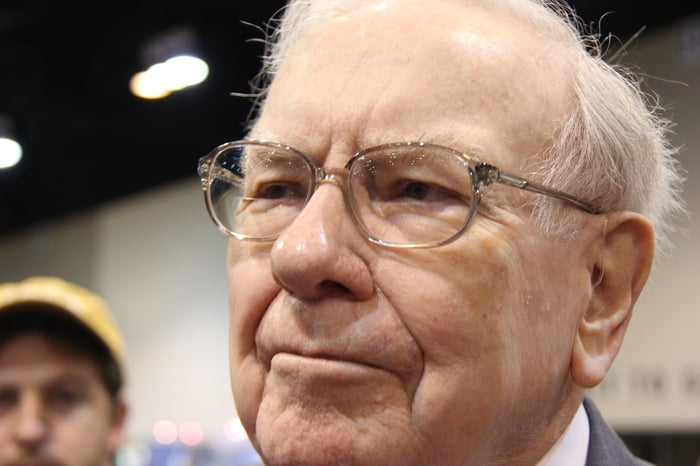
Warren Buffett retired as Berkshire Hathaway's CEO on Dec. 31, 2025. Image source: The Motley Fool.
The Oracle of Omaha's "secret" portfolio is nothing like Berkshire's $333 billion portfolio
In 1998, Berkshire Hathaway acquired General Re in an all-stock deal valued at approximately $22 billion. Though the catalyst of this deal was General Re's reinsurance operations, this wasn't the only puzzle piece of this acquisition. General Re also owned a specialty investment firm, New England Asset Management (NEAM). Upon completion of the deal, NEAM became a subsidiary of Berkshire Hathaway.
Although Buffett didn't oversee NEAM's portfolio in the same way that he directed traffic for Berkshire's $333 billion investment portfolio, NEAM's assets are, ultimately, part of Berkshire. This connection is what makes NEAM Buffett's "secret" portfolio.
Institutional investors with at least $100 million in assets under management are required to file a Form 13F with regulators every quarter, detailing their buying and selling activity. NEAM handily exceeds this threshold, allowing investors to track trades in this under-the-radar portfolio.
New England Asset Management's latest 13F shows 99 holdings, with a big emphasis on exchange-traded funds (ETFs), preferred stocks, and time-tested dividend stocks. This is in stark contrast to Berkshire's concentrated investment portfolio.

Image source: Getty Images.
This top holding is a surefire moneymaker (with a catch)
Sitting atop the pedestal in Buffett's secret portfolio is Wall Street's first-ever ETF, the SPDR S&P 500 ETF Trust (NYSEMKT: SPY). This $66.3 million position accounts for 8.4% of NEAM's investment portfolio.
As its name implies, this ETF attempts to mirror the performance of the S&P 500, less fees and expenses. Its net expense ratio of 0.09% means only $0.90 of every $1,000 invested goes toward management and marketing costs.
More importantly, the S&P 500 has a phenomenal track record of making investors richer, with a catch. According to data from Crestmont Research, Wall Street's benchmark index has never delivered a negative total return, including dividends, over any rolling 20-year period, dating back to 1900.
In other words, if you, hypothetically (since the SPDR S&P 500 ETF Trust didn't debut until January 1993), purchased an S&P 500-tracking index at any point between 1900 and 2006 and held it for 20 years (the aforementioned catch), you made money every time. Though index investing may sound boring, the S&P 500's roughly 3,000% total return since the start of 1990 looks pretty good in investors' portfolios and has helped create countless millionaires.
Warren Buffett may not be Berkshire's CEO any longer, but his secret portfolio continues to generate gains.
Should you buy stock in SPDR S&P 500 ETF Trust right now?
Before you buy stock in SPDR S&P 500 ETF Trust, consider this:
The Motley Fool Stock Advisor analyst team just identified what they believe are the 10 best stocks for investors to buy now… and SPDR S&P 500 ETF Trust wasn’t one of them. The 10 stocks that made the cut could produce monster returns in the coming years.
Consider when Netflix made this list on December 17, 2004... if you invested $1,000 at the time of our recommendation, you’d have $471,072!* Or when Nvidia made this list on April 15, 2005... if you invested $1,000 at the time of our recommendation, you’d have $1,303,352!*
Now, it’s worth noting Stock Advisor’s total average return is 983% — a market-crushing outperformance compared to 210% for the S&P 500. Don't miss the latest top 10 list, available with Stock Advisor, and join an investing community built by individual investors for individual investors.
*Stock Advisor returns as of May 29, 2026.
Sean Williams has no position in any of the stocks mentioned. The Motley Fool has positions in and recommends Berkshire Hathaway. The Motley Fool has a disclosure policy.
Recommended Articles


Comments (0)
Click the $ button, enter the symbol, and select to link a stock, ETF, or other ticker.