


NVDA GTC: AI's marquee event—hyped going in, a letdown coming out?



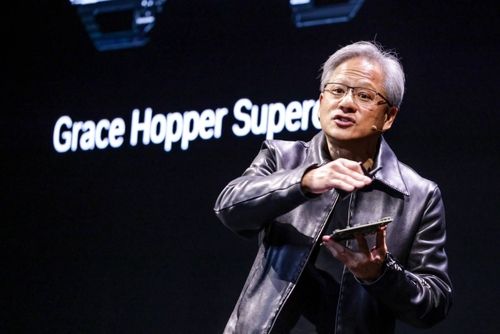
On Mar 16, 2026, Jensen Huang, founder and CEO of NVIDIA, delivered the GTC 2026 keynote. The core themes covered the 20th anniversary of the CUDA platform, the inflection in inference and the surge in compute demand, the Vera Rubin system architecture, Groq integration, the OpenClaw agent revolution, and Physical AI and robotics.
I. GTC 2026 Key Takeaways
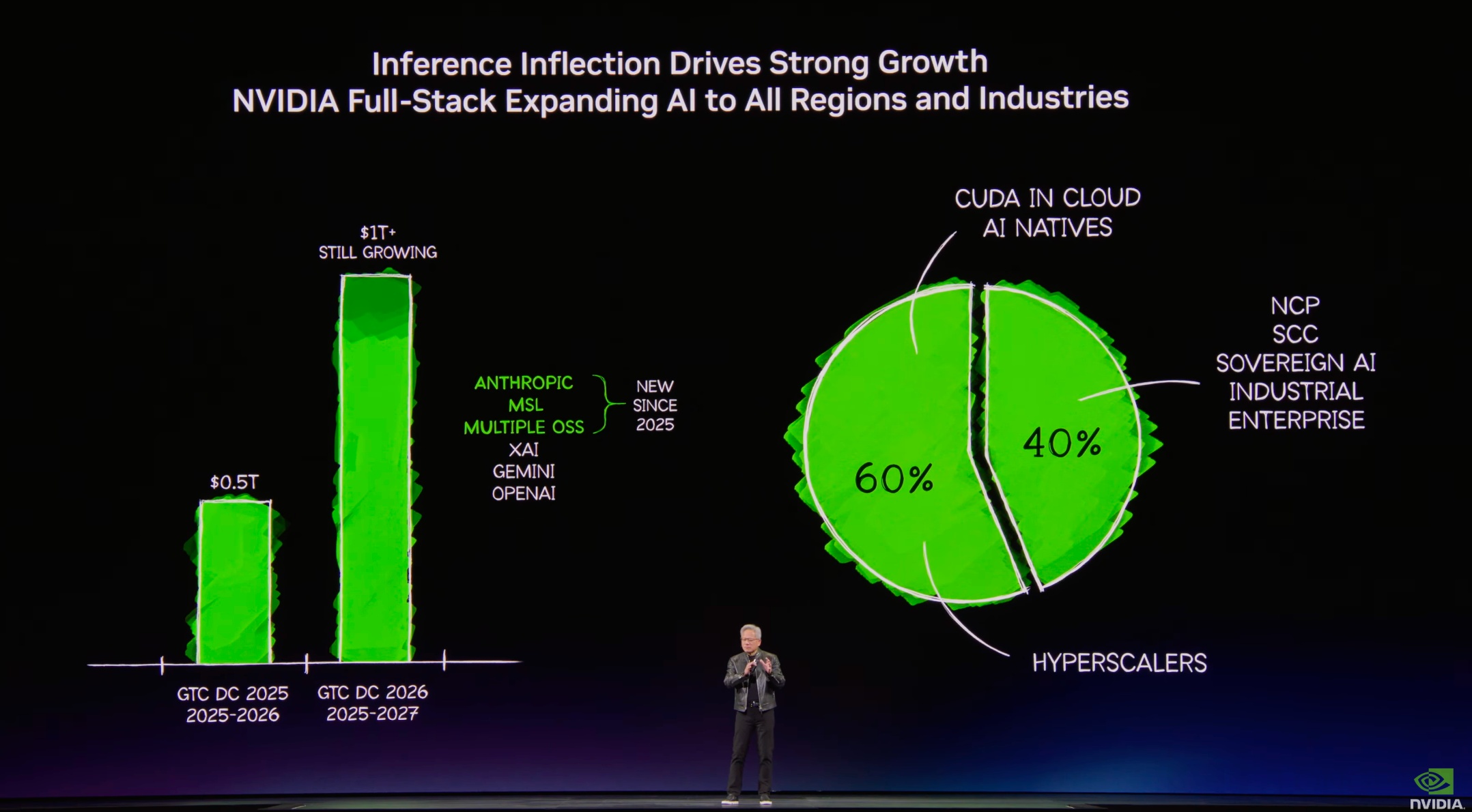
1) Data center revenue outlook: For 2025–2027, $NVIDIA(NVDA.US) expects cumulative data center revenue to reach $1tn, in line with expectations. Last GTC guided to $500bn for 2025–2026. The Street has already moved its base case above $1tn and is looking for firmer order visibility and related details.
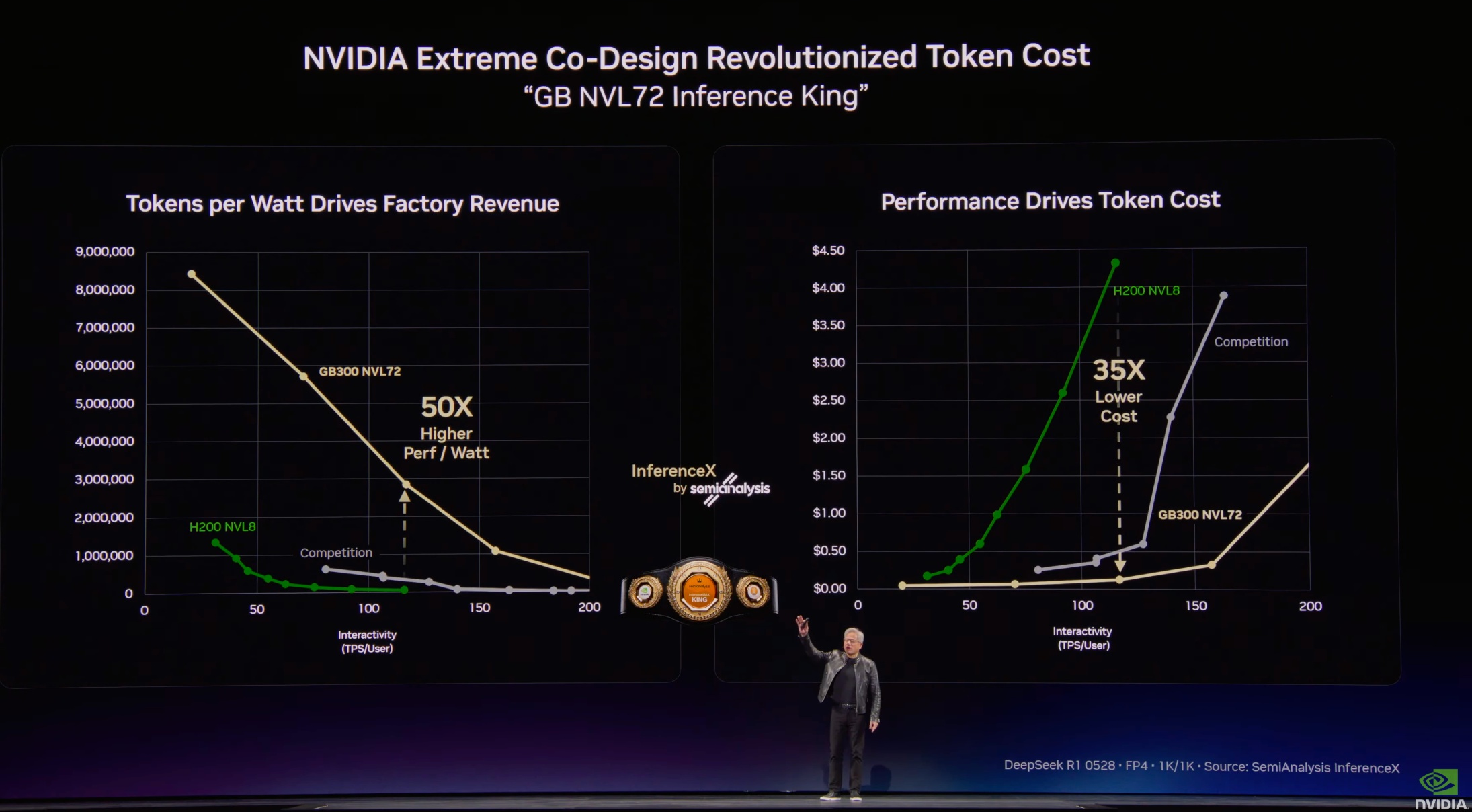
2) Performance and cost: NVIDIA leads globally on both tokens/watt (throughput) and token speed (model responsiveness). It also has the lowest token cost globally. These metrics underscore a widening efficiency gap at scale.
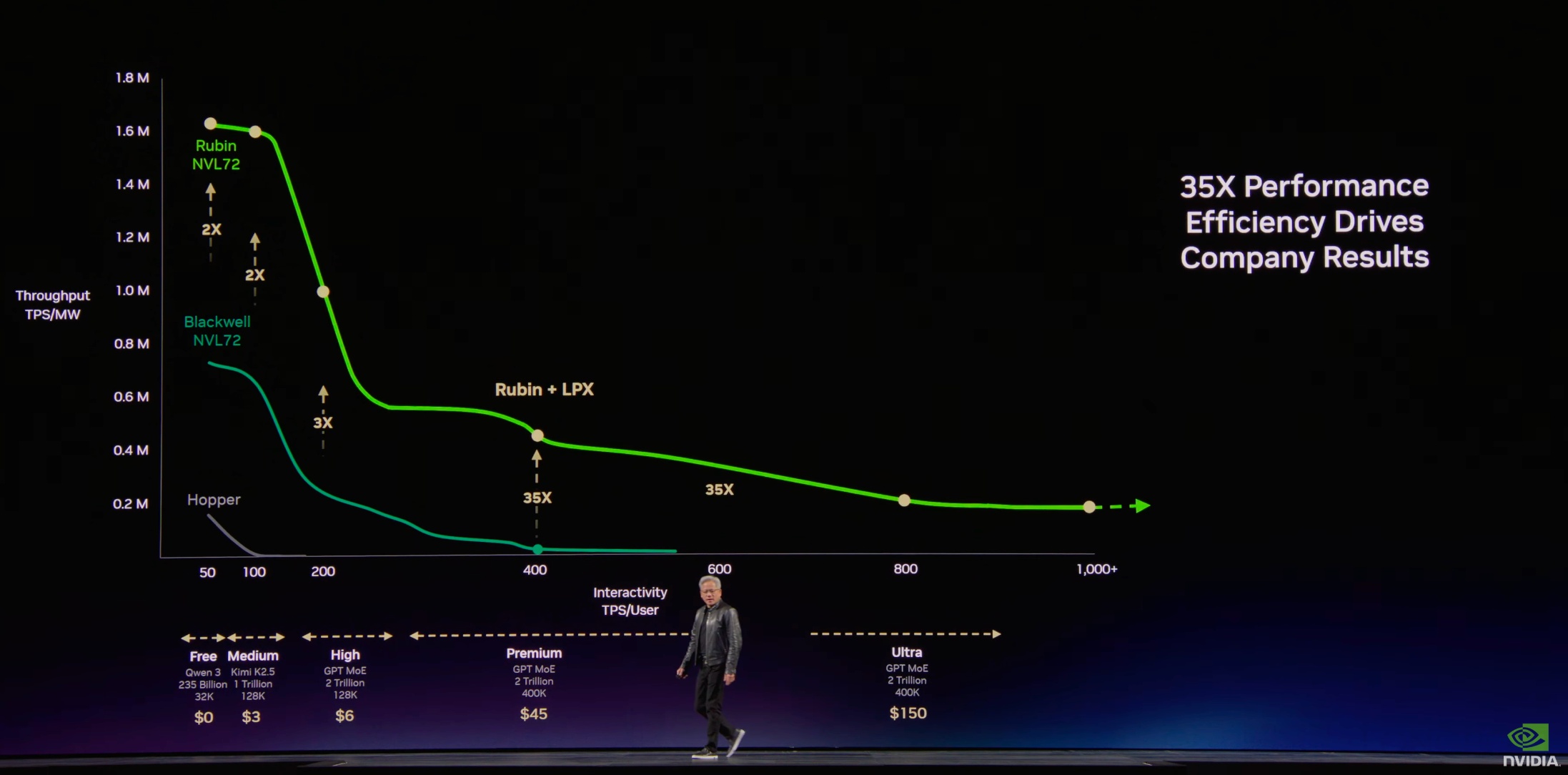
3) Data centers as 'token factories': Each factory is power-limited (e.g., 1 GW), so operators must manage token throughput and speed. Tokens will be tiered like commodities: free tier (high throughput, low speed) -> $3 per 1mn tokens -> $6 per 1mn tokens -> $45 per 1mn tokens -> $150 per 1mn tokens (top-tier, low-latency, high-bandwidth compute). In a 1 GW data center, each 25% power slice maps to a tier: Grace Blackwell can generate 5x Hopper revenue, and Vera Rubin adds another 5x.
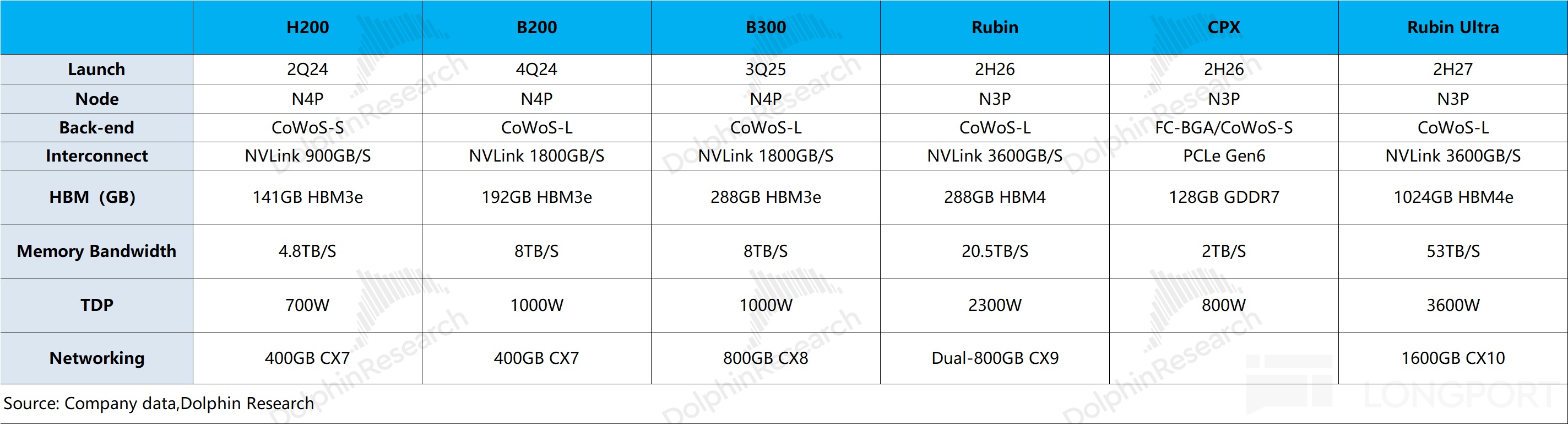
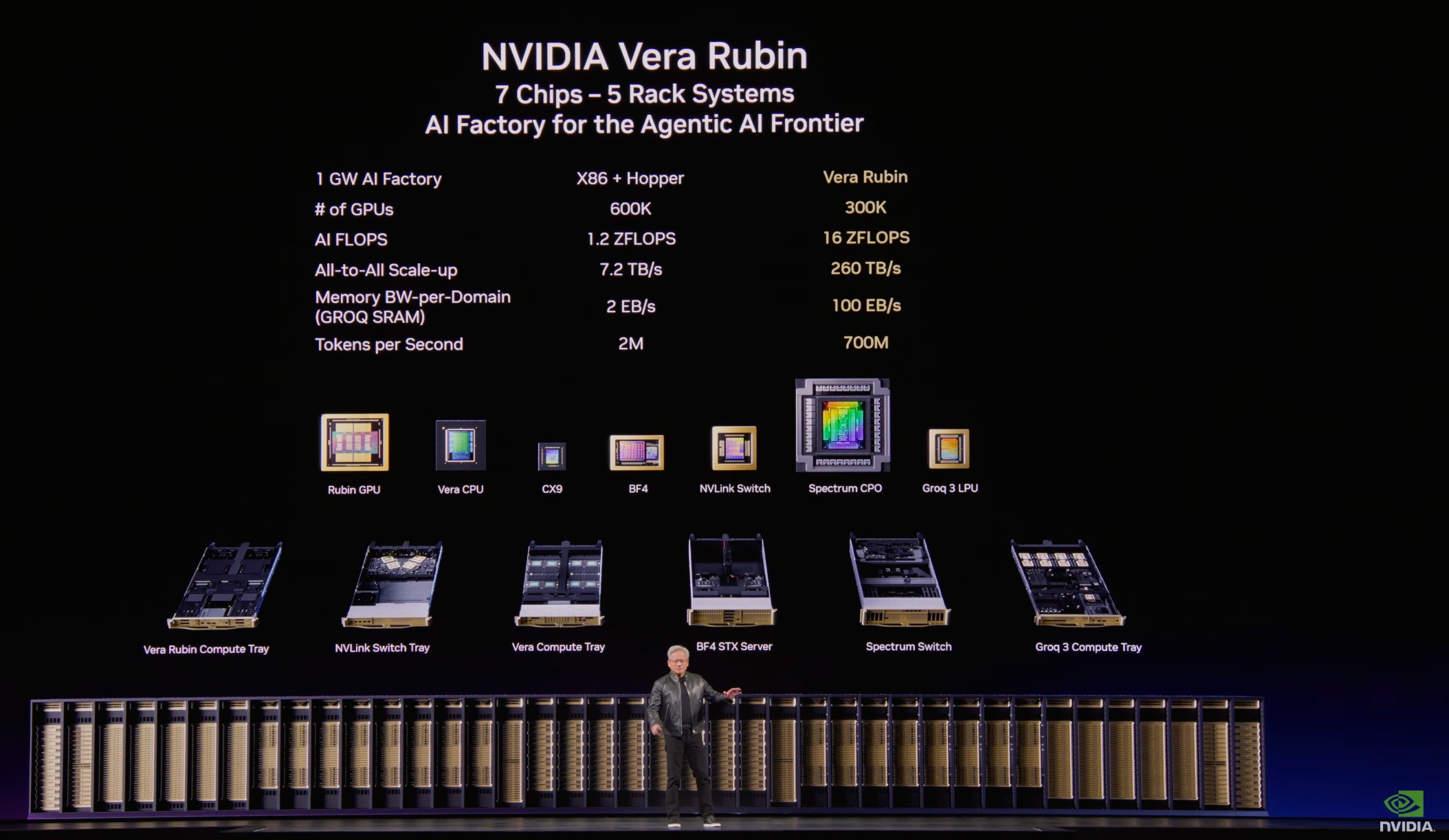
4) Vera Rubin: adding Groq 3 LPU to the prior six chip classes.
i) Vera Rubin: 100% liquid-cooled (45°C hot-water) with all cables eliminated. Install time drops from two days to two hours. This simplifies deployment and serviceability at rack scale.
ii) CPO (co-packaged optics) Spectrum-X switches: now in full mass production, co-developed with TSMC. CPO enables higher bandwidth and lower power interconnects in dense fabrics.
iii) CPU: the world’s only data center CPU using LPDDR5, sold standalone and set to be a multi‑bn‑dollar business. Vera CPU Tray targets agentic workloads, with a single Vera Compute Tray integrating eight Vera processors, each with 88 cores and eight-channel LPDDR5x. A single socket supports 1.2 TB/s memory bandwidth, and the CPU Tray integrates two BF4 DPUs. This design maximizes memory bandwidth per socket while offloading networking and storage to DPUs.
iv) Vera Rubin: live on Microsoft Azure (first rack). NVIDIA’s supply chain can ship several thousand systems per week, building AI factory capacity at multi‑GW per month. This points to rapid fleet-scale rollout.
v) Rubin Ultra: Rubin boards insert horizontally into racks, while Rubin Ultra mounts vertically into the new Kyber rack. 144 GPUs reside in a single NVLink domain, with NVLink switches behind the midplane replacing copper cables. This increases bandwidth density and reduces cabling complexity.
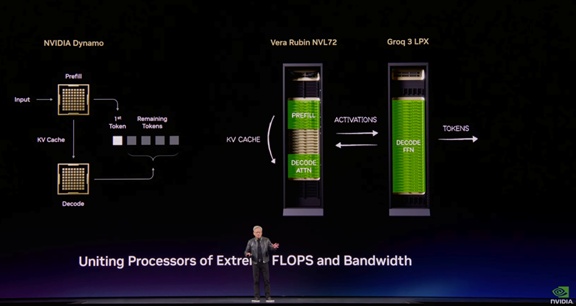
5) Groq 3 LPU (new chip): Groq plus HBM, as expected
Built by the acquired Groq team, Groq LP30 is manufactured by Samsung and slated to ship in Q3. A single Groq die has 500 MB SRAM vs. 288 GB HBM on a single Rubin die, so Groq alone cannot host mainstream model parameters and KV cache. The solution: a Dynamo software stack that decomposes inference into stages.
1. Prefill stage: batch processing of user prompts, which is compute-centric, runs on Vera Rubin. This maximizes throughput during context ingestion.
2. Attention during decoding: computes relations between the current token and history (KV cache), balancing compute and memory, also on Vera Rubin with frequent HBM reads. This leverages Rubin’s high-bandwidth HBM for context lookups.
3. Feed-forward network (FNN) during decoding: after attention establishes context, the FNN outputs the probability distribution for the next token and selects it. Each layer reads model weights and processes one token per read; compute stalls waiting for data from HBM, creating the true ‘memory wall’. By splitting decoding with software, context memory stays on HBM while most weights move to Groq’s on-die SRAM, enabling ultra‑low‑latency weight reads and speeding up token emission.
Rubin and Groq are tightly coupled over Ethernet, and an RDMA-based special link roughly halves inter‑chip latency. This co-processing reduces end-to-end decode latency.
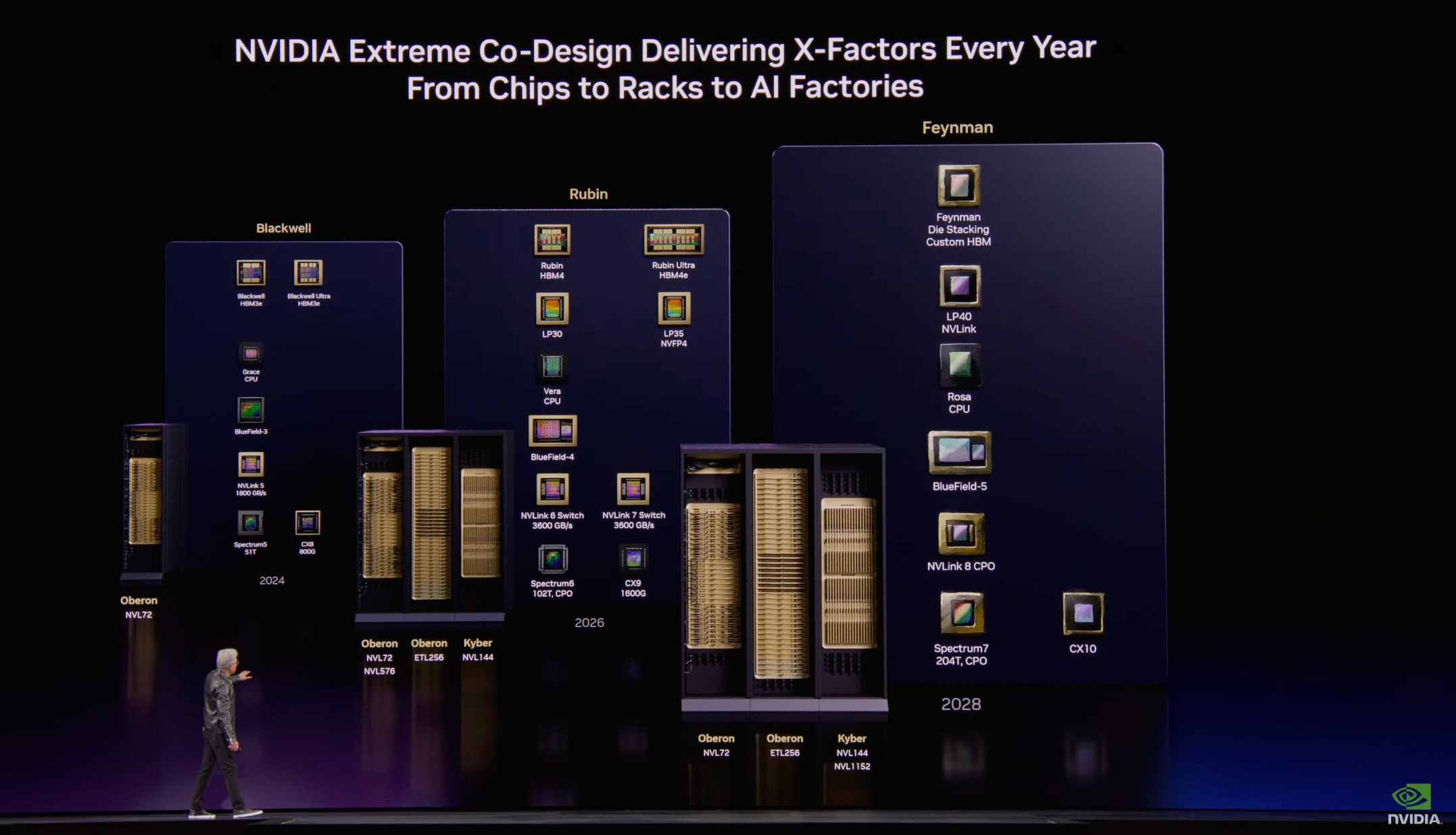
6) Feynman: a new GPU + LP40 (LPU) + Rosa CPU (named for Rosalind) + BlueField‑5 + CX10. Kyber copper scale‑up plus Kyber CPO scale‑up (first time supporting both copper and CPO scale‑up). This means even at the Feynman node, mixed copper and CPO will be supported.
While NVIDIA sees CPO as the long‑term direction, many customers prefer to push copper to its limits before moving to CPO, given simpler deployment and maintenance. The roadmap reflects this transitional preference.
7) Other updates:
i) Space data centers: to address energy constraints, NVIDIA announced Vera Rubin Space‑1, aiming to deploy data centers in space. This requires solving radiative heat dissipation, as space lacks conduction and convection, leaving only radiation. Thermal design is thus the critical blocker.
ii) OpenClaw: every SaaS firm will become a GaaS provider (Agent‑as‑a‑Service). Agents in enterprise networks can access sensitive data, execute code, and communicate externally—demanding enterprise‑grade security. NVIDIA partnered with OpenClaw founder Peter Steinberger to launch NemoClaw (OpenClaw’s enterprise security reference design), integrating OpenShell with a network guardrail and a privacy router, and connecting to SaaS policy engines. This provides a reference stack for secure agent deployment.
iii) Physical AI and robotics: in autonomous driving, BYD, Geely, Hyundai, Nissan and others joined Robotaxi and partnered with Uber. On robotics, KUKA, ABB and many robotics/UAV platforms were highlighted. This broadens ecosystem engagement across mobility and automation.
Overall, beyond clarifying that copper and CPO will be used in parallel, the headline addition is an LPU option from Groq inside servers. This was widely expected after the Groq acquisition. Even the three‑year $1tn revenue guide was already below some market expectations. The arc of NVIDIA’s iterations shows recent focus shifting away from micro‑architecture, with Hopper to Blackwell solving composition and interconnect, marking a pivot from selling chips to selling systems and services.
From Blackwell to Rubin, the newly added DPU (with NAND) and the rush‑integrated LPU (with SRAM) address the memory wall as AI enters the inference and agent era. This targets end‑to‑end token latency and memory bandwidth bottlenecks.
II. NVIDIA near term: muted guidance, needs a new growth story
NVIDIA’s stock has been range‑bound at $170–200 over the past six months. Even as hyperscalers lift capex and results keep beating, shares have not broken out. The market is concerned about several issues. These include capex sustainability, AI chip share, and product competitiveness.
a) Hyperscaler capex sustainability: Meta, Google and others have raised 2026 capex, with the Big Four clouds potentially topping $660bn in 2026 (+60% YoY). Notably, capex as a share of revenue is already at a relatively high level. At Meta, 2026 capex is guided to $115–135bn, putting capex/revenue above 50%, leaving limited room to move higher. Even with raised 2026 plans, the Street still worries about growth persistence beyond that.
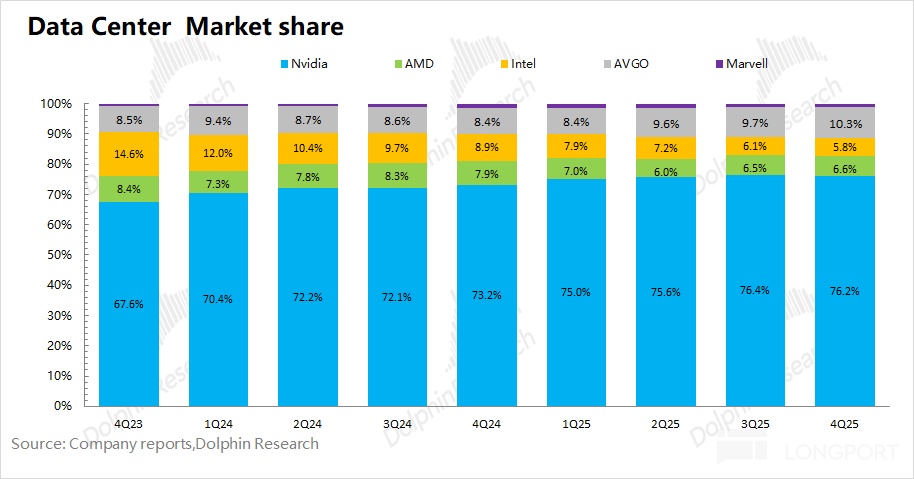
b) AI chip market share: NVIDIA holds 75%+ share in AI accelerators. High prices and a near‑monopolistic structure are pushing clouds to seek alternatives. Beyond Google, Broadcom (AVGO) has secured large orders from Anthropic and OpenAI, and many customers are pursuing in‑house designs. Even with Rubin coming, consensus expects NVIDIA’s share to gradually decline.
3) Product competitiveness: Google’s TPUv7 in FP8 and related modes is roughly on par with NVIDIA’s B200 (mass production in Q4 2024), leaving Google about one year behind. NVIDIA introduced NVFP4 in Blackwell, which can double inference performance vs. FP8, but FP8 already meets most current needs, making TPUv7 a viable alternative. To counter competition, NVIDIA is using strategic investments and capacity to lock in the stack, e.g., chip‑deployment‑linked investments in OpenAI ($30bn) and Anthropic ($10bn), and supplying Meta’s new AI lab MSL with millions of GPUs, with some deals implying pricing incentives to secure demand.

Against those concerns, valuation looks relatively undemanding. On Dolphin Research’s model using 2025–2027 data center revenue of $1.15tn (above company guide), at a $4.4tn market cap, NVDA trades at roughly 13x FY2028E net income (assuming a two‑year revenue CAGR of 64%, GPM 72%, tax rate 18%). Shares did not rally on the last beat because 2027 revenue expectations are already priced in, and with cloud capex intensity above 50%, upside to capex looks constrained.
Theoretically, as a second‑derivative supplier to clouds, if customer capex flat‑lines at a high level, NVDA’s cloud revenue growth could flatten too. The market is reluctant to assign a high multiple to post‑2027 earnings, leaving NVDA at ~13x 2027 profit and muting positioning appetite. From this GTC, ‘$1tn+ cumulative data center revenue through 2027’ is actually below where many on the Street already are.
Much of the event focused on product marketing and roadmap, with more implications for the supply chain (mixed copper/CPO deployment, LPU/HBM task split) and limited incremental info for NVDA’s own fundamentals. For a renewed multiple re‑rating, Dolphin Research believes beyond faster, broader AI application rollout, NVDA needs a new growth curve, e.g., ‘Physical AI’ or space compute.
Stay tuned for Dolphin Research’s detailed GTC breakdown
Risk disclosure and disclaimer:Dolphin Research Disclaimer and General Disclosure
Recommended Articles







Comments (0)
Click the $ button, enter the symbol, and select to link a stock, ETF, or other ticker.