


LLMs bleed -360%; Is MiniMax still a market darling? --- ---



Old guard out, new champ in! Today, Hong Kong’s hot pick and China’s independent model developer $MINIMAX-WP(00100.HK) released its FY2025 report card.
But vs. a 4.5x rally in roughly two months, Dolphin Research’s read on Q4 looks underwhelming. Let’s dig in:
I. Revenue: C slowed, B accelerated — a better mix?
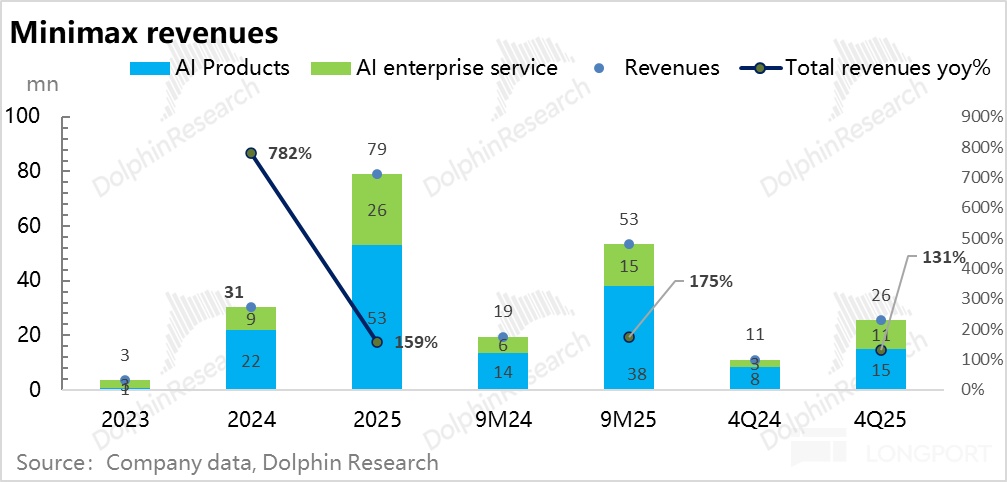
1) Growth cooled: FY2025 revenue totaled ~$79 mn (+~160% YoY), still a strong surge. With 9M already disclosed, Q4 is inferred at ~$26 mn, with YoY growth easing from ~175% in 9M to ~130%, a clear deceleration.
2) C down, B up: is ‘model = revenue’ taking shape?
MiniMax is the only major China LLM player with broad C-end traction but relatively weaker B-end, prompting doubts about its competitiveness when the model itself is the product. Q4 suggests that if core model capability is solid, both C and B can monetize.
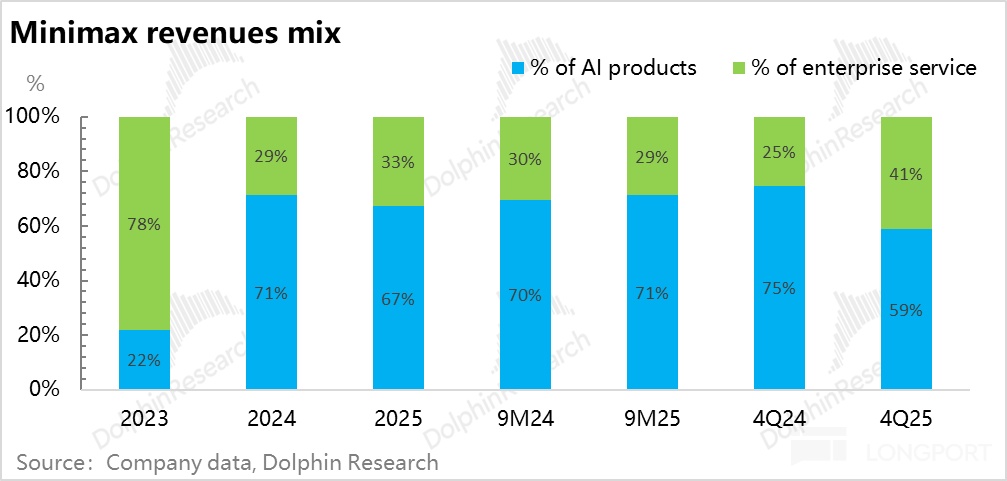
a. The MiniMax AI product family (MiniMax, video generator Hailuo AI, audio generator MiniMax Audio, Talkie — mainly Talkie and Hailuo AI) delivered just over ~$15 mn. YoY growth halved from ~150% in 9M to 82%, driving the slowdown.
b. Enterprise services via MiniMax API accelerated from ~160% YoY to 278%, topping ~$10.55 mn in the quarter. As overseas revenue didn’t accelerate, both domestic and intl clients likely ramped API calls.
API revenue is essentially ‘model = revenue’ monetization. Faster growth shows enterprises are paying up for the model’s value-for-money as a productized service.
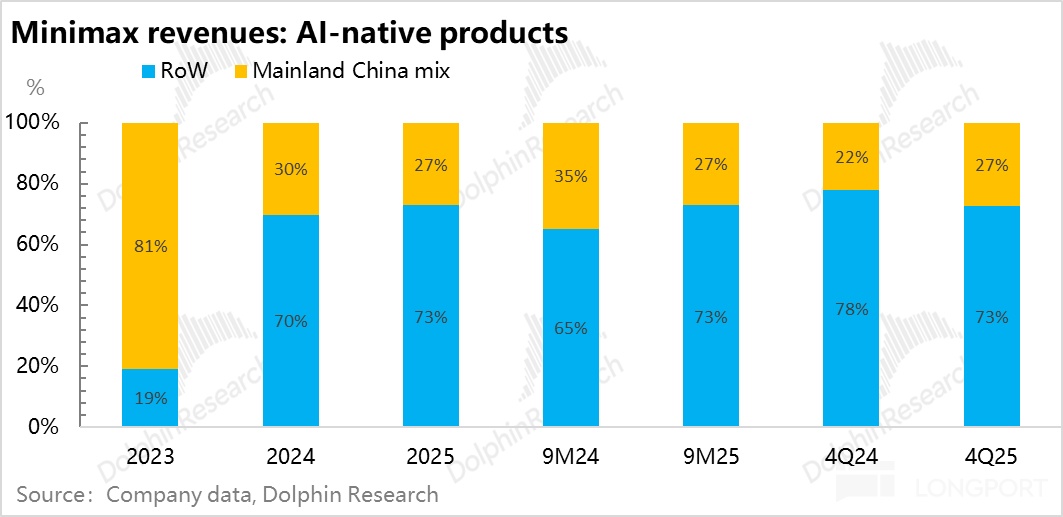
3) Overseas revenue share stable at 73%: MiniMax’s overseas revenue is broadly split among the U.S., Singapore and other regions. After rising to 73% in 9M with help from Hailuo, the share stayed put rather than climbing further.
Even so, OpenRouter call volumes and the 73% overseas revenue share both point to success. MiniMax is emerging as a successful China LLM exporter.
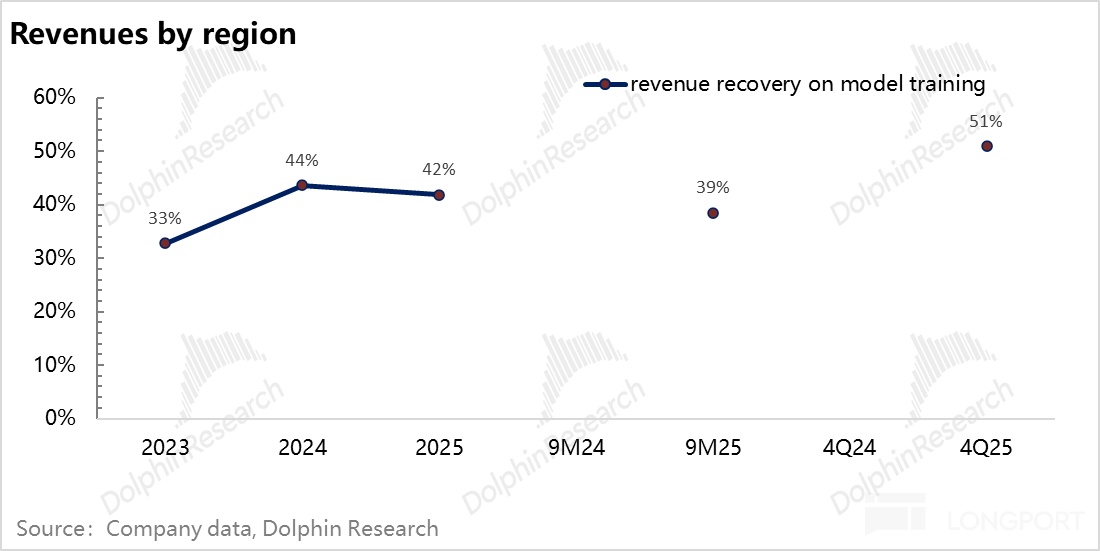
4) How well do current-period revenues cover prior-gen training spend?
Base models update annually, and each generation effectively serves for about a year. One way to gauge economics is to compare a model’s same-year direct/indirect revenues with the prior-year training spend.
For MiniMax, despite rapid revenue growth, FY2025 revenues covered a smaller share of FY2024 training costs. Until model evolution reaches a plateau, LLM vendors remain in a ‘bleeding-edge’ battle.
Financing can bridge gaps in the process, but real-world deployment and monetization will matter more over time. Vendors need to monetize by all means and grow revenue faster and steadier than peers to validate model value.
Based on Q4 vs. 9M avg., if MiniMax can add ~$8 mn per quarter on top of ~$26 mn in Q4, FY2026 revenue could exceed ~$130 mn. That would keep FY2026 revenue coverage vs. FY2025 R&D spend of ~$250 mn near Q4’s ~50%.
II. Enterprise services: price cuts to win share?
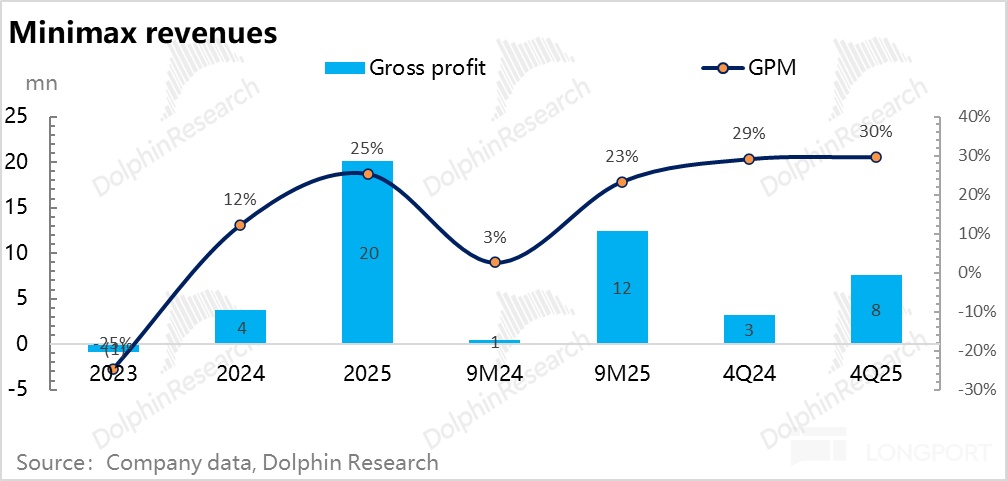
Enterprise services carry higher margins (cloud token inference cost vs. MiniMax’s token pricing). Enterprise API clients generally pay, putting segment GPM above 60%, and close to 70% in 9M.
Yet MiniMax’s overall GPM didn’t surge in Q4 despite a larger enterprise services mix. It merely recovered from ~23% in 9M to ~30%. Full-year GP was ~$20 mn, with GPM at ~25%.
As C-end paid conversion improves, C-end margins should be trending up. If we assume C-end GPM rose from ~4.7% in 9M to ~5%, enterprise service GPM likely eased to around ~65%.
The GPM decline in enterprise services suggests that post-listing, MiniMax is pushing commercial monetization for APIs and related interfaces. The path forward should be two-legged across B and C.
III. $26 mn revenue, $92 mn operating loss — already a relatively lean-loss LLM template!
LLM margins can look decent. That’s mainly because the largest expense — training — sits under R&D.
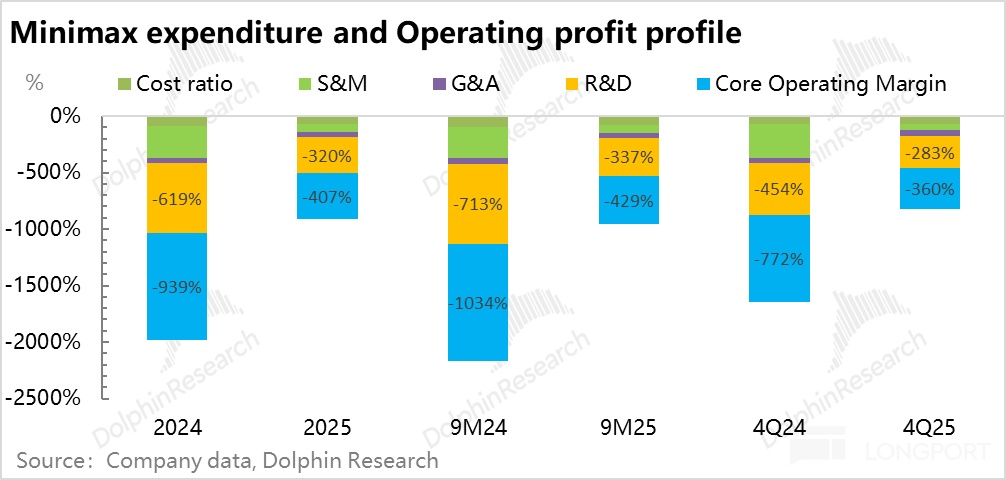
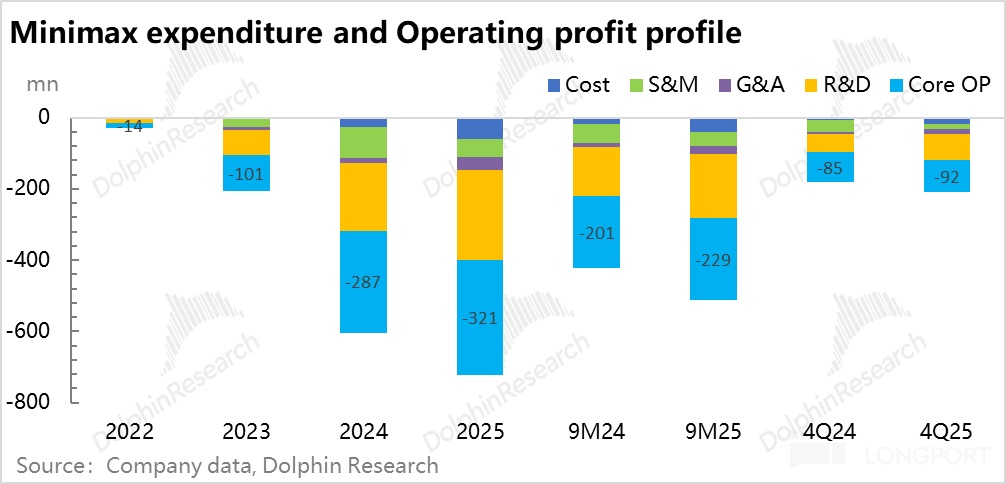
R&D typically runs 3–5x revenue, so turning a profit is near impossible while training and iterating rapidly (click for why). In Q4, R&D (mainly training) was ~$72.5 mn, ~2.8x quarterly revenue.
Even with selling expenses down sharply (-63% YoY, reflecting a belief that AI-era growth hinges on model capability rather than mobile-era ad spend) and modest G&A (Dolphin Research excludes IPO-related SBC, suggesting only a slight YoY uptick, with these two lines at ~70% of revenue), OP still came in at -$92 mn, ~3.6x revenue. Losses remain heavy.
Full-year OP loss was ~$320 mn; after backing out SBC and IPO costs, losses were still ~$290 mn, with a loss ratio of ~370%. That’s an improvement vs. the ~429% loss ratio across 9M.
By Dolphin Research’s tracking, MiniMax is already among the best domestically at controlling both absolute loss and loss ratio. The company stands out among China LLM peers.
Also, media reports of a ~$1.9 bn net loss are largely noise. The bulk reflects a ~$1.6 bn accounting loss tied to CB conversion at inflated valuation upon listing, which isn’t economically meaningful.
Dolphin Research’s take: structurally bullish long term
Shares doubled on Jan 9, 2026, then rallied another ~60% into the Feb holiday season. Less than one quarter post-IPO, MiniMax trades at ~4.5x its offer price.
Q4, as implied by FY2025, isn’t particularly eye-catching. This compares with the 9M data disclosed in the IPO filing.
The structural bright spot is API and enterprise services. As a primarily AI-to-C company, MiniMax is now leaning into B. While it offered some price concessions, the rapid B-side ramp shows the ‘model as product’ offers strong value-for-money for enterprise users.
The main drag is a faster-than-expected slowdown in AI product revenue. With operating metrics not disclosed in the annual report, Dolphin Research infers native AI-to-C apps like Talkie, with lower marketing budgets, rely on large model upgrades and viral breakout to scale users — but Q4 saw no base-model-level upgrade, so paid conversion didn’t spike.
Given the release cadence, Q4 financials no longer reflect fundamentals. The model roadmap has moved on.
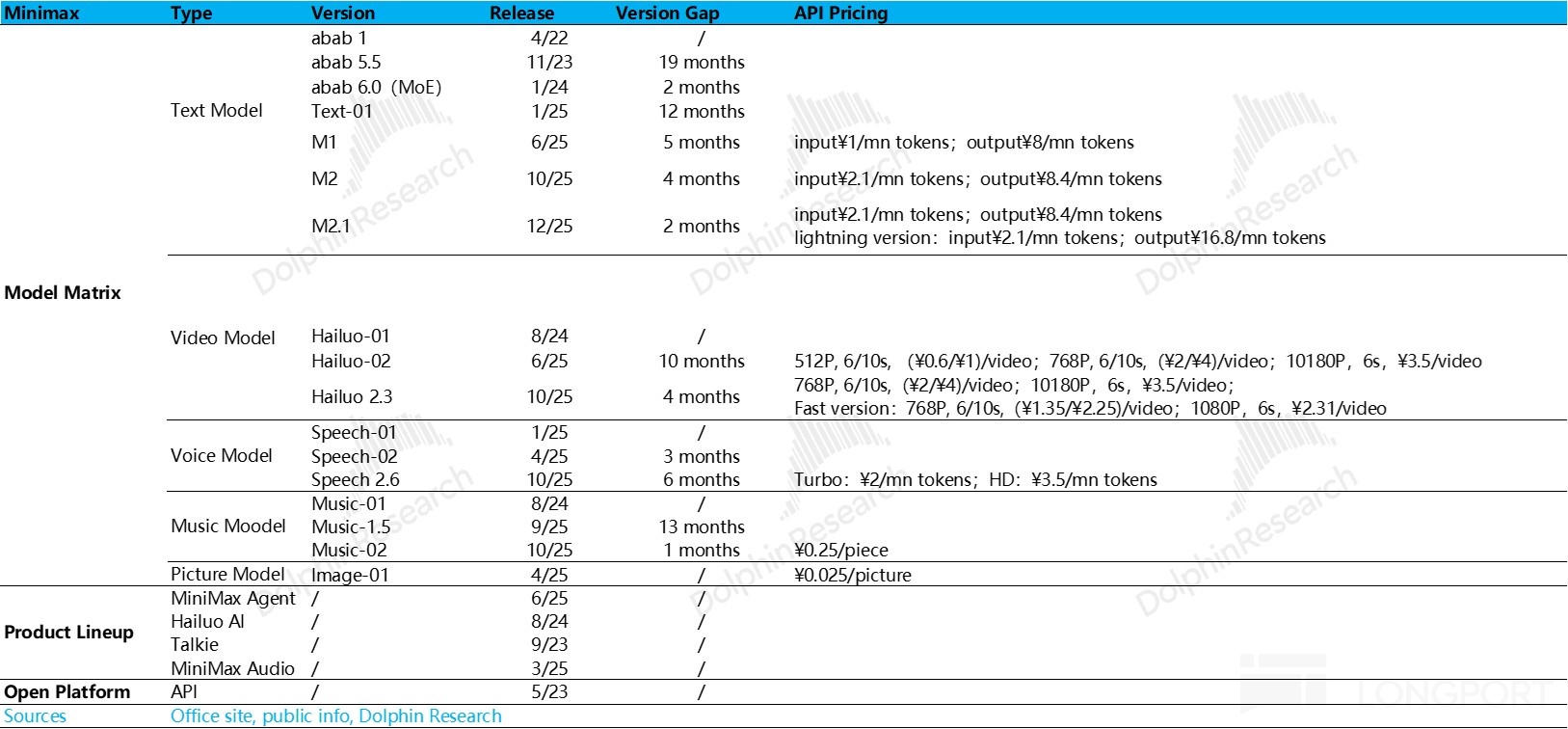
Since Q4 2025, all modalities have been iterating quickly. The key is the M2.5 base model in Feb 2026, which pivots to Agent functionality focused on coding, tool use and office scenarios, aiming to turn AI from assistant to ‘AI colleague’.
MiniMax also integrated the popular Agent framework OpenClaw, and token calls began to surge. Based on the latest token consumption.
a. MiniMax M2 text model’s Feb daily token consumption has risen to ~6x Dec 2025. Usage ramp is notable.
b. Within that, the Coding Plan’s token consumption is ~10x Dec. Coding demand is leading.
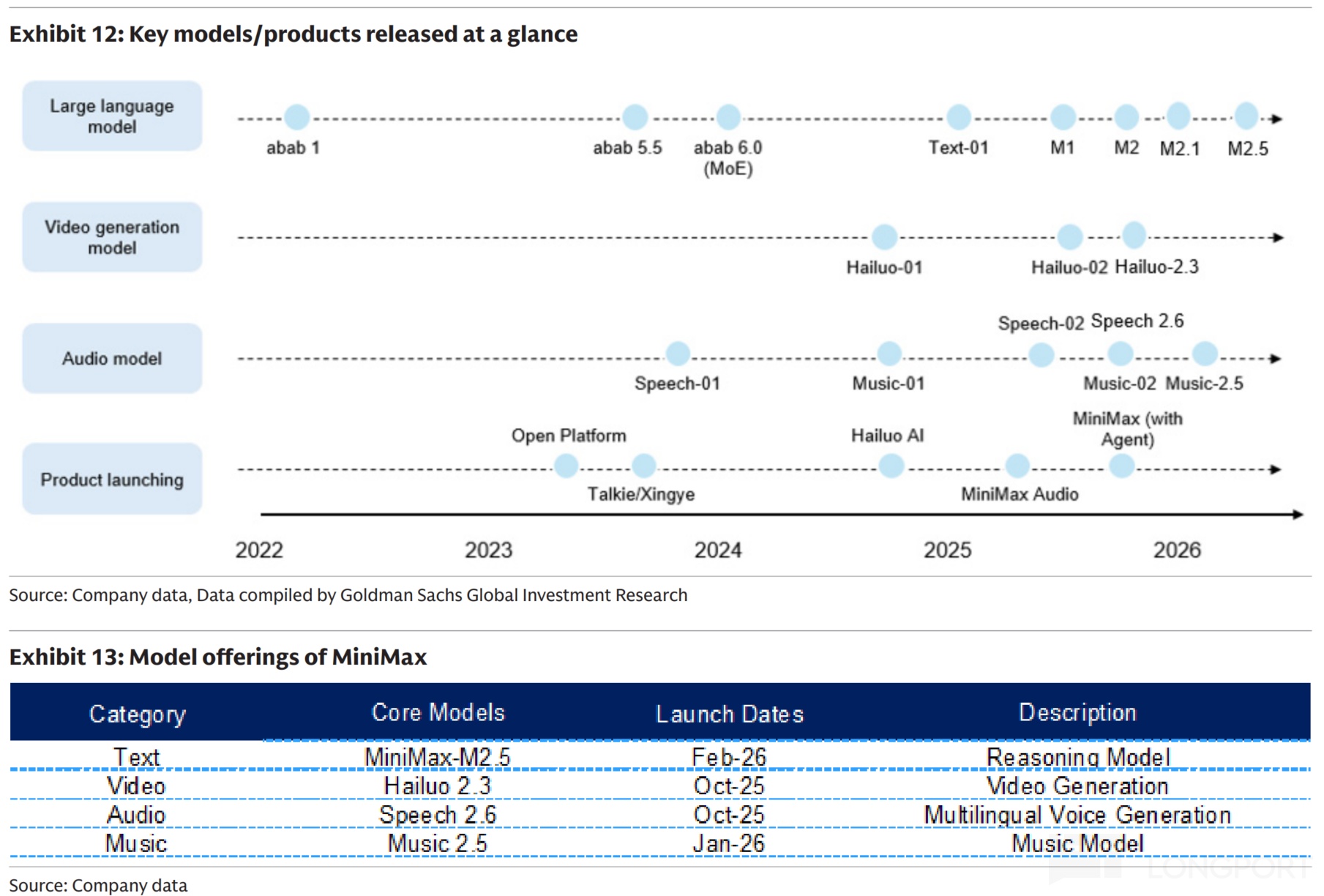
The Feb 2026 rally is mainly pricing in M2.5’s consumption upside. A 6x MoM jump in monthly tokens already signals a successful new model.
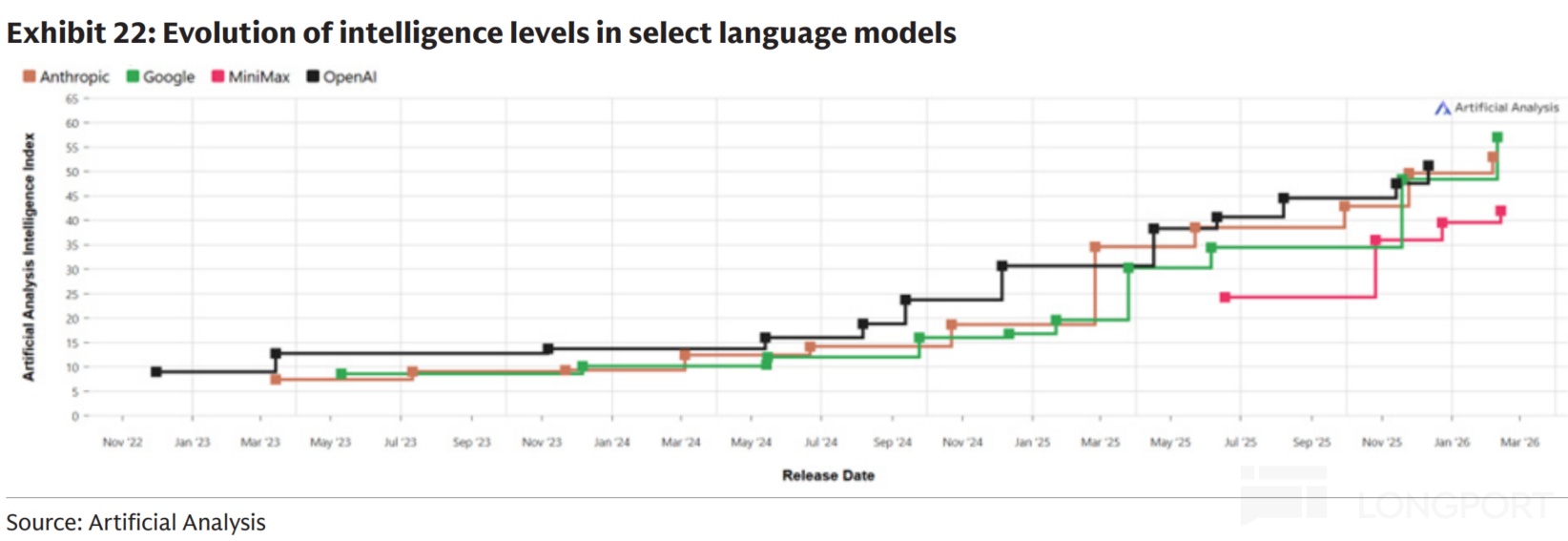
Near term, with the model just launched and success mostly priced in, the stock may face pullback pressure as open-source rival DeepSeek preps a new base model (likely also emphasizing coding and Agents). In a staggered race, volatility is likely.
On long-cycle durability, factors extend beyond model intelligence. Independent vendors ultimately compete on R&D efficiency, cash stamina and product deployment.
First, on ‘survival cash’: the IPO raised ~$700 mn, and cash plus cash-like balances were near ~$1 bn at Q4-end. Even if next-gen models need heavier spend, at the FY2025 training level of ~$250 mn, MiniMax has runway.
In FY2025, with 428 employees, MiniMax spent roughly ~$250 mn on training and generated nearly ~$80 mn in revenue, delivering a globally competitive model with standout efficiency. Among domestic players, it is one of the few executing model iteration, monetization and operations in tandem.
Related articles:
‘Deep-dive on MiniMax vs Zhipu: LLMs, compute intensity and financing stamina’
Recommended Articles






Comments (0)
Click the $ button, enter the symbol, and select to link a stock, ETF, or other ticker.