


Luckin: Are delivery wars holding the coffee leader hostage? ---



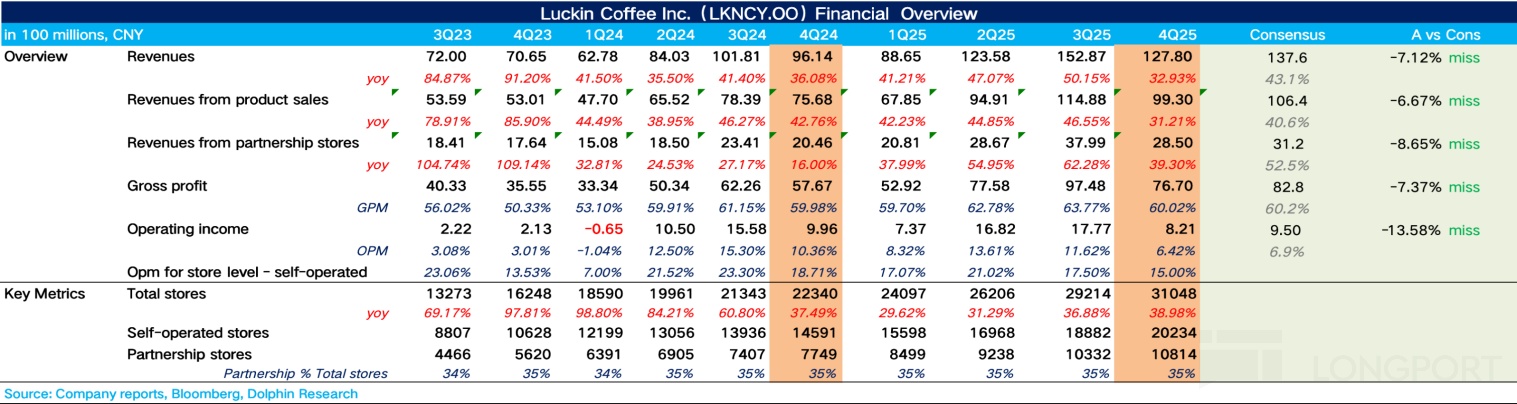
Luckin Coffee (LKNCY) released its Q4 2025 results (for the quarter ended Dec 2025) before the U.S. market open on the afternoon of Feb 26, Beijing time. Overall, with food-delivery subsidies easing and Luckin scaling back its own subsidies, revenue growth slowed notably. The ongoing 'delivery war' kept fulfillment costs elevated and continued to squeeze margins in Q4, leaving results below market expectations.$Luckin Coffee(LKNCY.US)
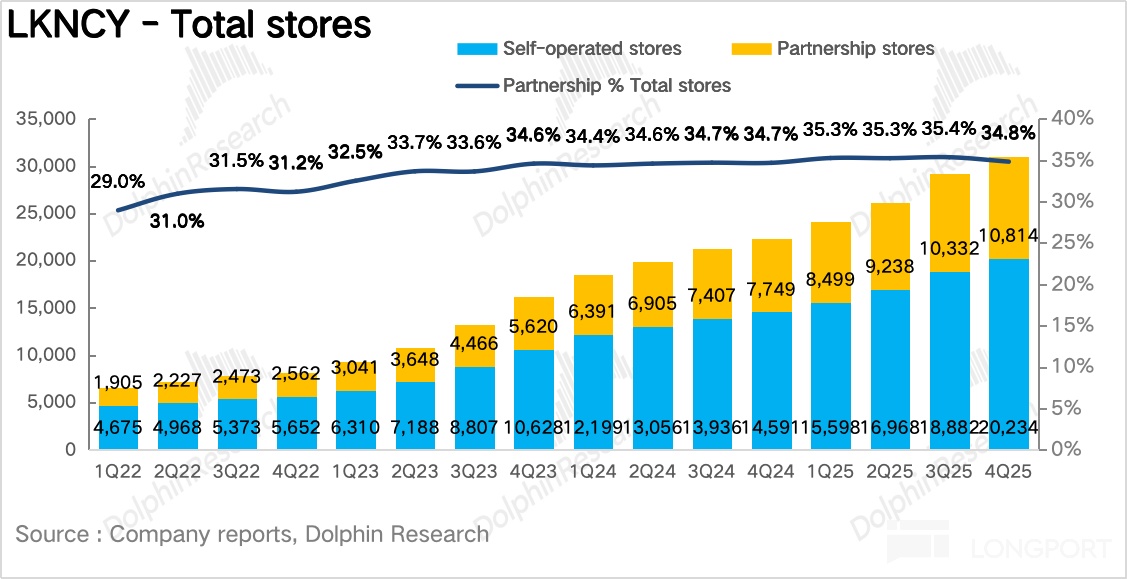
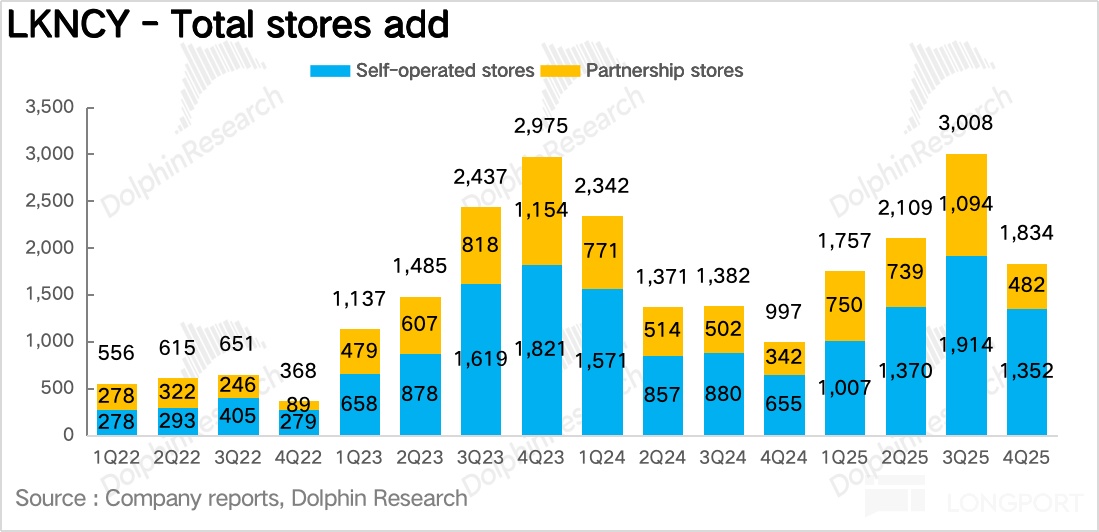
1、开店节奏有所放缓。Luckin added a net 1,834 stores in Q4, with sequential growth decelerating. Dolphin Research believes the main driver was a surge in delivery-related store fulfillment expenses amid the 'delivery war,' which pressured store-level margins and led the company to slow the opening pace to prioritize single-store profitability. Separately, the opening pace in Southeast Asia (Singapore, Malaysia) picked up.
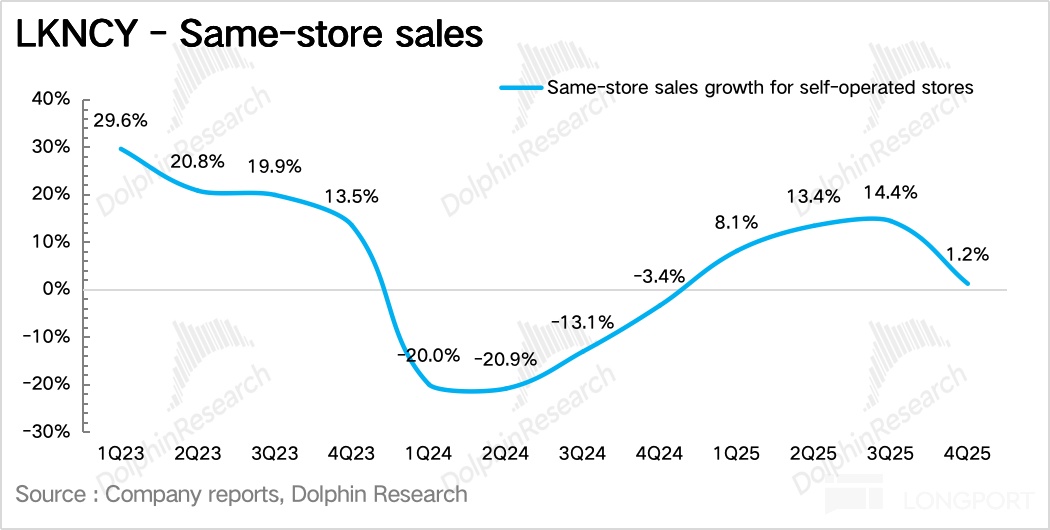
2、同店营业额增速下降明显。As the core metric of organic single-store growth excluding new store effects, SSSG rose 1.2% YoY. With subsidies tightened in Q4 and selective price moves, the actual same-store performance suggests price hikes are difficult. Consumers proved highly price-sensitive, resulting in lower-than-expected cup volume.
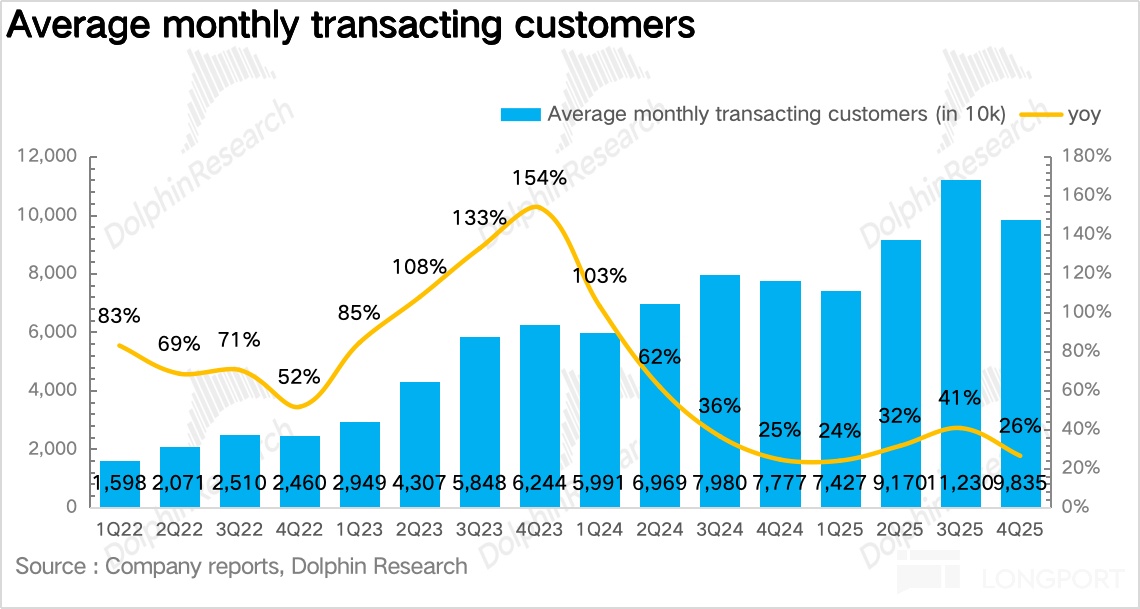
3、月活跃付费用户数环比放缓。Monthly active paying users reached 98 mn in Q4, up 27% YoY, but slowed vs. Q2–Q3. Dolphin Research believes delivery users show low private-domain conversion and retention, and repurchase intent dropped sharply once subsidies were reduced.
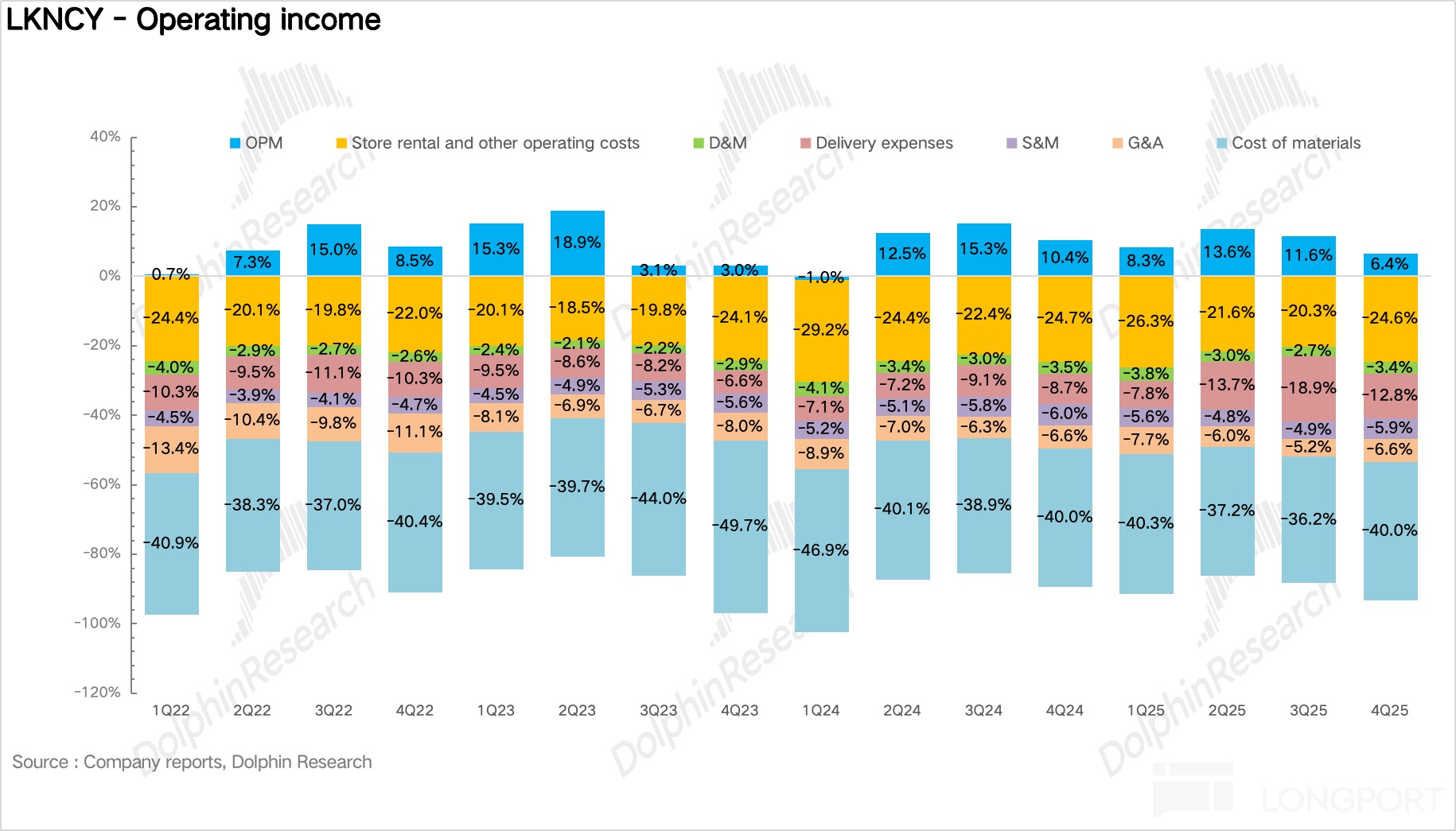
4、履约成本维持高位,侵蚀利润。Q4 GPM was broadly stable. On opex, the biggest issue remains the high share of delivery orders, which kept delivery expense ratio elevated at 13% (vs. a normal 7%–9%), eroding margins, and Luckin delivered Non-GAAP OP of RMB 960 mn, down 13% YoY.
核心业绩指标一览:
海豚君整体观点:
Q4 results were essentially similar to Q3: revenue growth with margin pressure. The market had hoped that as delivery subsidies fade, self-pickup share would rise, margins would steadily recover, and same-store growth would hold up. That pace is clearly slower than expected.
While regulators have intervened multiple times in the 'delivery war,' subsidies did not converge meaningfully in Q4. They dropped from the Jul–Aug peak but remain well above pre-war levels; based on field checks, Q4 subsidy intensity was roughly in line with May–Jun.
Both platform commissions and delivery fees weighed on Luckin’s margins. This essentially disrupted its ultra-low channel-cost model centered on self-pickup and dragged it into a high-cost delivery model, which is why Luckin aggressively cut user-side subsidies in Q4 to protect margins.
a、低价范围做减法:
Luckin reduced the RMB 9.9 product set from 8–10 SKUs in Q3 to 2 basic items (Americano and Latte), and also cut back the frequency of 'buy 2 get 1' and large coupons. Discount intensity on third-party platforms such as group-buy channels also tightened materially.
b、产品结构做加法:
For core products (Coconut Latte, Velvet Latte, etc.), instead of direct price increases, Luckin added value-add options such as 'extra large' and 'extra shot' to expand unit economics per cup. In addition, co-branded items (Minions) and seasonal hits (Solstice Five-Nourish Latte) were priced 30%–50% above basic SKUs.
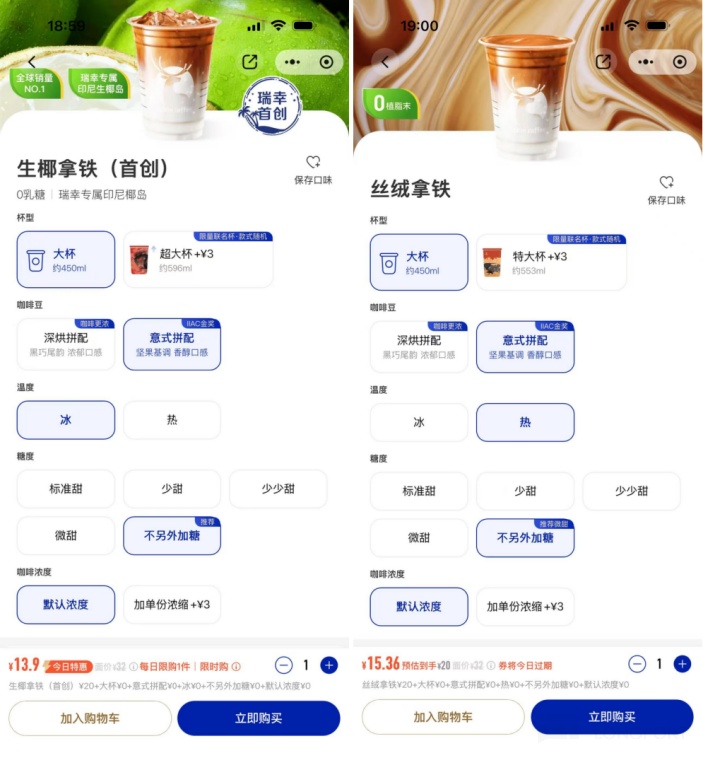
Combining a & b, Luckin can sustain its 'value-for-money' label at minimal cost to defend against ultra-low-price rivals like Xinyun Coffee, retain price-sensitive users, and maximize profit flexibility via differentiated pricing to uphold margins.
While user-side subsidies were reduced, Luckin increased subsidies to franchise stores in Q4, especially those with low cup volume. Dolphin Research believes this helps franchisees in lower-tier markets, which saw accelerated openings in 2025, bridge their first off-season (Q1), and also signals that even with 30k+ stores, the company still sees value in expanding via franchise to capture lower-tier locations.
Looking to 2026, although the store-opening pace slowed temporarily in Q4, leading brands will not slow openings while domestic coffee penetration is still rising. Share gains remain the core focus, not via price wars but via superior operational finesse.
On valuation, Dolphin Research estimates the current multiple implies ~15x for 2026. With profit CAGR likely above 20% over the next three years, and ignoring the OTC discount, the current valuation is not demanding.
From a trading perspective, Luckin’s medium/long-term competitiveness remains intact, and the delivery war’s margin hit looks transitory. If the market applies punitive de-rating near term, it could create a better entry point.
以下为详细分析
一、投资逻辑框架梳理
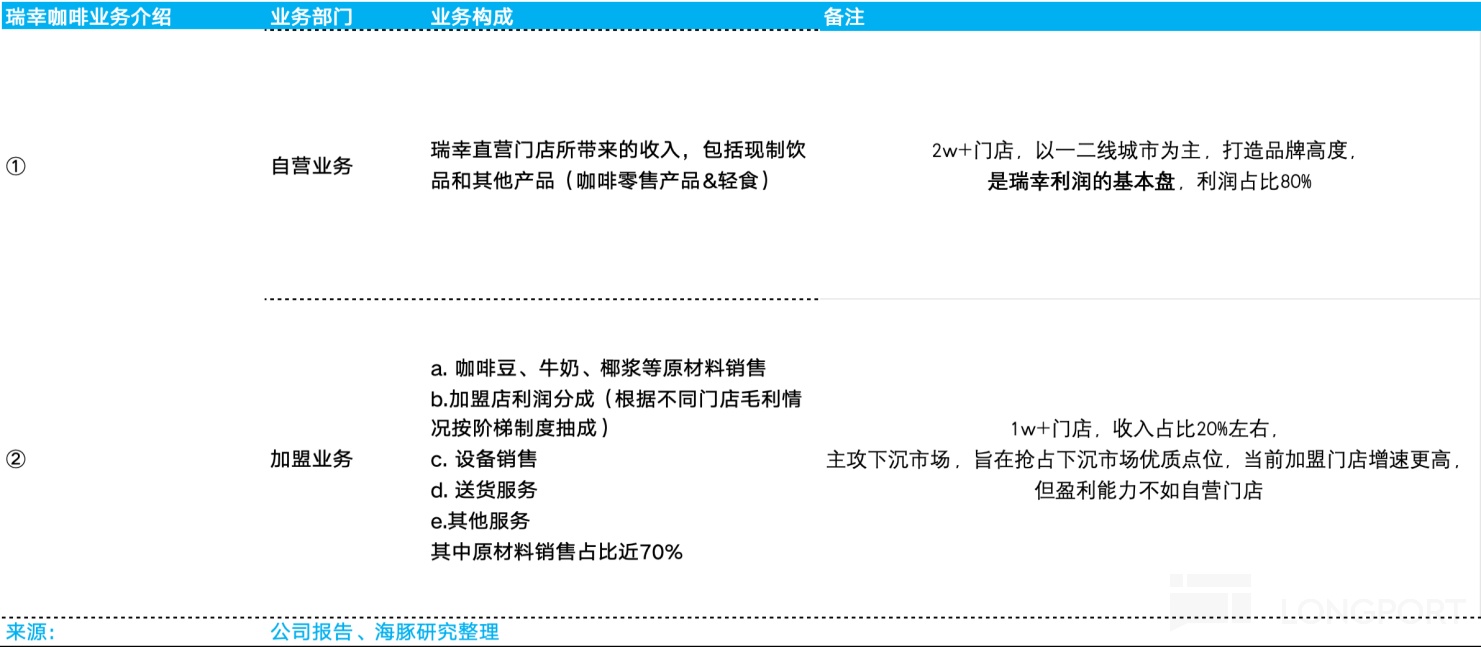
Per Luckin’s disclosures, the company operates two tracks: self-operated and franchise.
1)Self-operated revenue comes from directly operated stores, which now exceed 20,000 and are concentrated in Tier-1/2 cities, crucial for brand-building. Self-operated is the profit anchor, contributing over 80% of profit.
2)Franchise revenue includes raw material sales (coffee beans, milk, coconut milk), profit sharing (tiered by store GP), equipment sales, delivery services, and other services. Raw materials contribute nearly 70%, making them the core of franchise revenue; franchise stores exceed 10,000, contributing ~20% of revenue, focused on lower-tier markets to secure prime locations. Despite faster openings, franchise profitability trails self-operated.
二、开店节奏有所放缓
Luckin added a net 1,834 stores QoQ in Q4 2025, taking the total to 31,048. The opening pace slowed vs. Q3 but the full-year target of 8,000 new stores was still achieved.
Overseas, Southeast Asia remains the primary expansion front. In Singapore, Luckin uses 100% self-operated stores, replicating the domestic 'Quick Pick + Relax' dual format, prioritizing CBDs, campuses, and transport hubs. As of Q4 2025, it has opened 81 stores in Singapore and is profitable overall, serving as the benchmark overseas market.
Malaysia follows a franchise model, with a 10-year exclusive master franchise agreement with GASB, a subsidiary of D'nonce Industrial with extensive commercial real estate resources (GASB manages full-chain operations; Luckin provides brand licensing, digital systems, supply chain support, product standards, and training). Stores are concentrated in Kuala Lumpur and Penang with 100% Quick Pick format; as of Q4 2025, there are 70 stores, validating the franchise model in SEA and paving the way for Indonesia and Thailand.
In North America, facing high rents and low brand awareness, the business remains in single-site model refinement.
As the key metric excluding new store impact, SSSG rose 1.2% YoY but fell sequentially vs. Q3. Breakdown:
Cup price: With continued cuts to the RMB 9.9 base offerings in Q4 (now only Americano and a few items like Coconut Latte), most products returned to the RMB 10.9–13.9 range. Field checks indicate that upgrades to the membership system and stronger in-app promotions, combined with Lucky AI 1.0’s targeting, lifted paid memberships to 28%–30% (up 300bps QoQ). Paid members spend 30%–40% more per order, supporting cup price.
Cup volume: With tighter subsidies and structural price increases, same-store performance indicates pricing remains challenging. High price sensitivity led to lower-than-expected cup volume.
On product, Luckin launched 20 new items in Q4, at a faster pace than last year. For coffee, Luckin introduced the Samba dark roast line targeting heavy users seeking bolder flavor, and dark roast plus winter wellness limited series (Five-Nourish Latte) contributed 35%–40% of coffee cup growth.
For non-coffee: Upgrades were made to fruit/veg and light milk tea lines, and IP tie-ins (Honor of Kings & Minions) helped convert non-coffee users.
月活跃付费用户数增速放缓。Monthly active paying users were 98 mn in Q4, up 27% YoY but slowed vs. Q2–Q3. During the delivery war, heavy platform subsidies attracted many price-sensitive users; as subsidies receded, activity among these users dropped sharply, pulling down overall user growth and indicating low private-domain conversion/retention for delivery-acquired users.
- 履约成本维持高位,侵蚀利润
Q4 revenue was RMB 12.78 bn, up 32.9% YoY and below estimates. Self-operated store revenue was RMB 9.9 bn (+31.2% YoY); franchise revenue was RMB 2.85 bn (+39.3% YoY), outpacing self-operated as Luckin systematically lowered franchise thresholds in 2025 to accelerate lower-tier expansion.
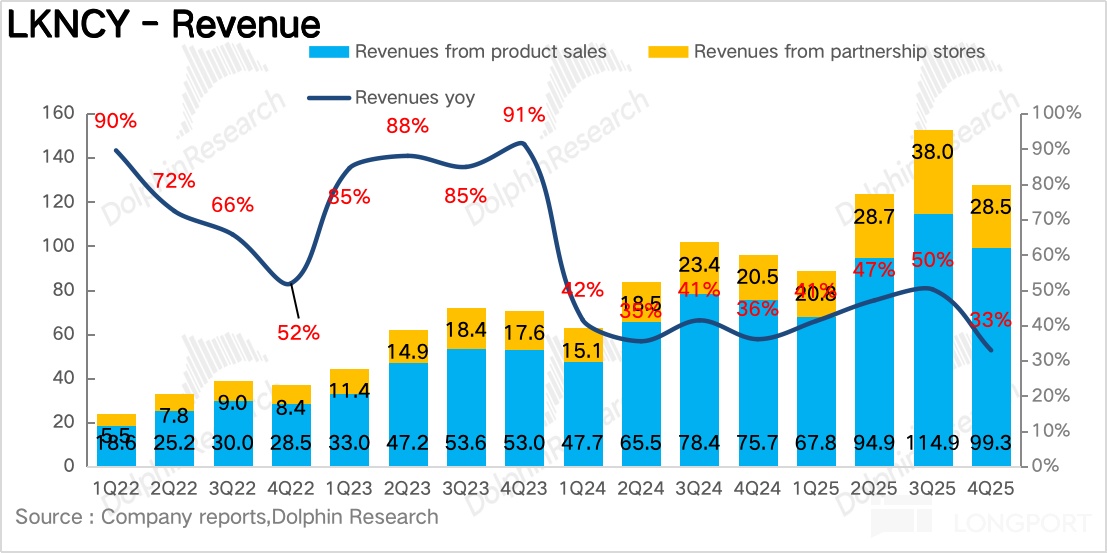
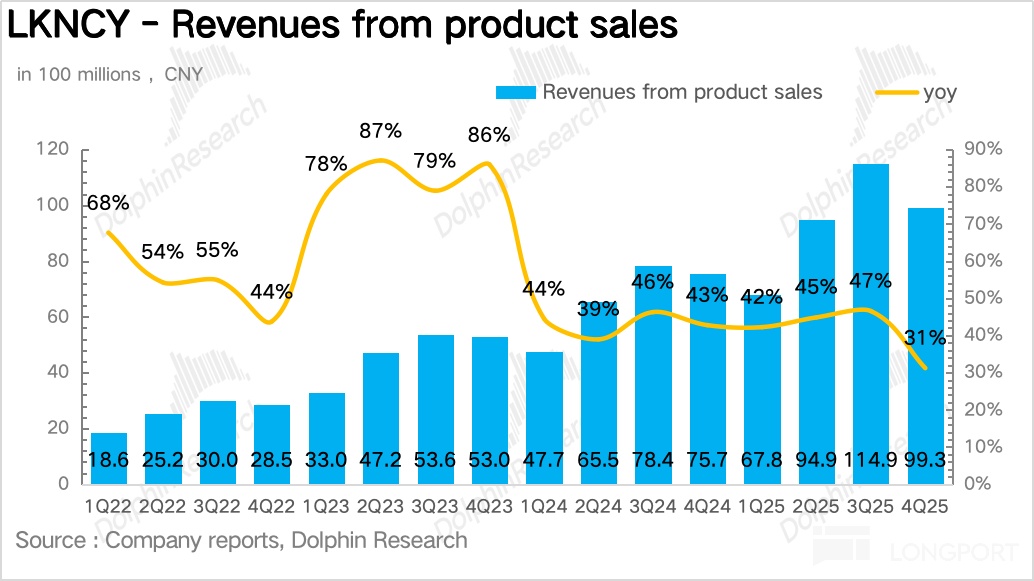
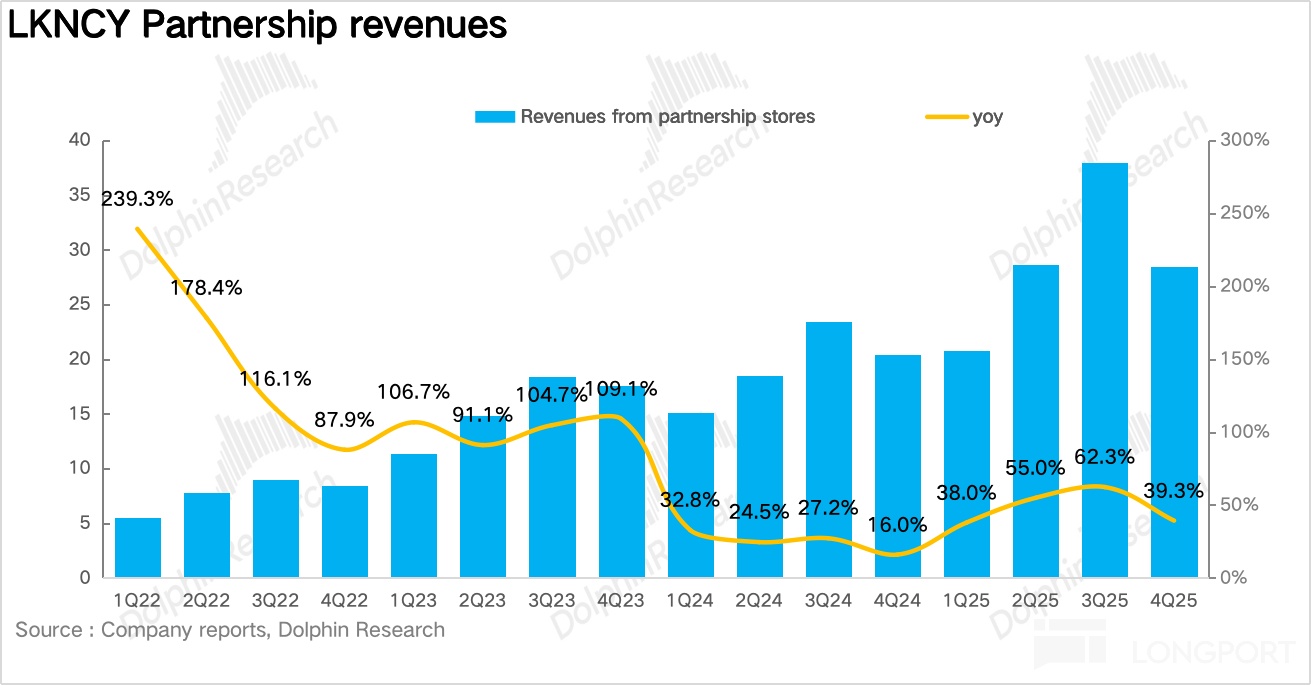
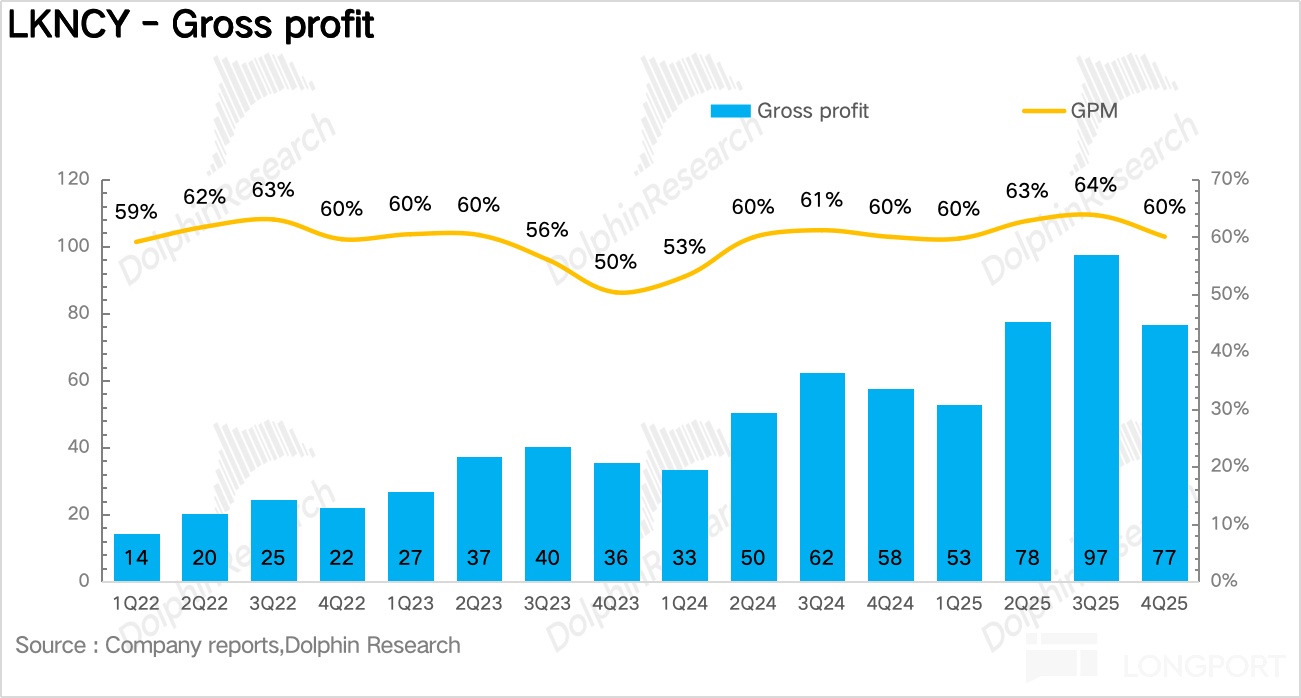
Q4 GPM was stable overall. On costs, delivery expenses were RMB 1.63 bn, up 94% YoY, with delivery expense ratio rising sharply from 8.7% a year ago to 12.8%, still the largest drag on margins. Medium term, delivery subsidies are not sustainable; as self-pickup recovers, delivery expense ratio should normalize below 10%.
Other expense ratios, including selling and G&A, were stable. Non-GAAP OP was RMB 960 mn, down 13% YoY.
Recommended Articles








Comments (0)
Click the $ button, enter the symbol, and select to link a stock, ETF, or other ticker.