


1 High Yield Dividend Growth Stock Down 13% to Buy Right Now



Realty Income (NYSE: O) has increased its dividend payout every single year for 30 consecutive years, which is an impressive streak. But Realty Income is a real estate investment trust (REIT), so most investors view it as nothing more than an income stock. It does, indeed, offer a high yield.
But if you change your framework just a little, you'll see how the stock could be attractive to growth-minded investors, too. Let's dive in and see why.
What does Realty Income do?
Real estate investment trusts operate under a specific corporate structure that is designed to pass their income on to their investors in a tax-advantaged manner. As long as REITs distribute at least 90% of their taxable income to shareholders through dividends each year, they avoid corporate-level taxation. Most REITs, including Realty Income, own physical properties that they lease out to tenants.

Image source: Getty Images.
Realty Income uses a net lease model that makes its tenants responsible for most of the property-level costs of the real estate they occupy, like maintenance and taxes. Most of the company's assets are occupied by single tenants, which means that there's a higher level of risk with regard to the rents from each individual property.
However, with over 15,400 properties spread across North America and Europe, Realty Income is the world's largest net lease REIT, so the actual risk to its finances is pretty low. Add in its investment-grade-rated balance sheet and concerns about risk should fade even further.
In fairness, however, most investors correctly see Realty Income as a conservative income investment. At the current share price, its dividend yields an attractive 5.5%, and it has boosted its payouts annually for three decades. The dividend growth rate over that time? About 4.3% a year. That's great if you are trying to live off of the dividend income your portfolio generates, but it doesn't really sound like something that growth-minded investors of any kind would appreciate.
Wait, one second though. What happens if you reinvest those dividends?
How Realty Income beat the market
One of Realty Income's most attractive qualities for a certain type of investor is its consistency. It is a slow and steady tortoise. That's boring -- but boring can be powerful when it comes to compound growth. With income stocks, much of that compound growth comes from reinvesting the dividends into more shares. With REITs, that effect becomes even more powerful if done within a Roth IRA, since there will be no taxes paid on the dividend (ever). The numbers speak for themselves.
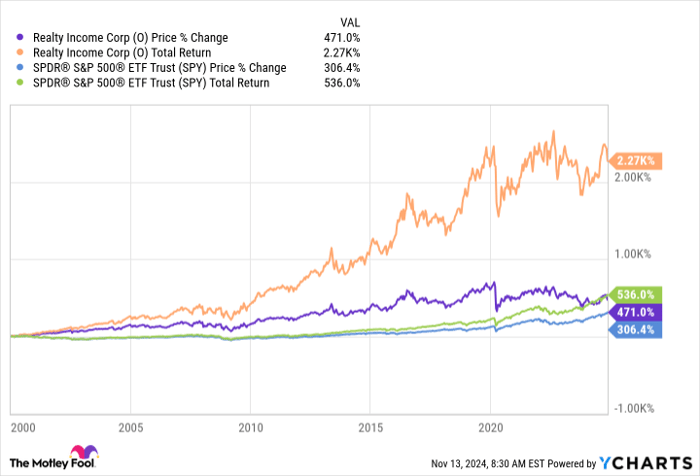
Since the turn of the 21st century, Realty Income's stock price has risen by 470%. That's actually a better performance than the S&P 500 index -- its level is only up by around 300% over that period. With dividend reinvestment, however, the S&P 500's total return clocks in at over 530%. But do the same thing with high-yield Realty Income and it wins again, with an impressive total return of more than 2,000%.
That's an amazing number for any company, let alone a REIT that has only grown its dividend at an average of 4.3% a year for the past three decades. The key is that it has always delivered high yields, meaning that investors using dividend reinvestment were adding a material amount of new shares with every payment. Steady dividend growth and a large yield combined to turbo-charge the long-term total returns for Realty Income investors. And, it is worth noting that the compounding effect grows even more powerful when the stock pulls back.
Realty Income is down 13%
In recent weeks, Realty Income's stock price has nosedived by about 13%. It is nearly 30% below where it was before the start of the coronavirus pandemic. However, if your investment mindset is to think in terms of decades, and you can look past the dividend yield to see the long-term power of compound growth via dividend reinvestment, Realty Income might just be the type of total return stock you could fall in love with right now.
Don’t miss this second chance at a potentially lucrative opportunity
Ever feel like you missed the boat in buying the most successful stocks? Then you’ll want to hear this.
On rare occasions, our expert team of analysts issues a “Double Down” stock recommendation for companies that they think are about to pop. If you’re worried you’ve already missed your chance to invest, now is the best time to buy before it’s too late. And the numbers speak for themselves:
- Amazon: if you invested $1,000 when we doubled down in 2010, you’d have $22,819!*
- Apple: if you invested $1,000 when we doubled down in 2008, you’d have $42,611!*
- Netflix: if you invested $1,000 when we doubled down in 2004, you’d have $444,355!*
Right now, we’re issuing “Double Down” alerts for three incredible companies, and there may not be another chance like this anytime soon.
*Stock Advisor returns as of November 11, 2024
Reuben Gregg Brewer has positions in Realty Income. The Motley Fool has positions in and recommends Realty Income. The Motley Fool has a disclosure policy.
Recommended Articles









Comments (0)
Click the $ button, enter the symbol, and select to link a stock, ETF, or other ticker.