


Bitcoin May Not Be as Decentralized as You Think. Why That's a Good Thing.



When it launched in 2009, Bitcoin (CRYPTO: BTC) was designed to be a decentralized, peer-to-peer digital currency. In fact, Bitcoin was so decentralized that it was considered to be beyond the reach of any central bank or sovereign government, and that was part of its appeal to early crypto enthusiasts.
But what about now? Bitcoin skeptics continue to point to growing centralization within the Bitcoin network, citing it as a potential warning signal. But from my perspective, many of those fears are overblown. In fact, if Bitcoin is ever going to tip into the mainstream, then a certain amount of centralization is going to be needed. Let's take a closer look.
What does decentralization mean for Bitcoin?
There's a lot to unpack here, and a good starting point is the very concept of decentralization itself. The easiest way to explain decentralization is that it means that no central authority owns or controls Bitcoin. Most importantly, it means that nobody -- not a central bank, not a group of malicious hackers, and not a profit-seeking corporation -- can ever manipulate Bitcoin.
Thus, from a very high-level view, it's obvious why decentralization is such a highly prized feature of the Bitcoin network. And it's also why warning signals go up anytime there is a real threat to this decentralization. According to Bitcoin purists, centralization of any kind could impact the long-run viability of Bitcoin.
Bitcoin mining
Bitcoin mining is a good example of how the Bitcoin network has become more centralized over time. Back in 2009, it was possible to mine Bitcoin on your personal computer at home. And it was routine to hear stories about everyday people all over the world making a nice chunk of change on the side from mining Bitcoin.
But flash forward to today, and Bitcoin mining has become much more centralized. According to some estimates, just four Bitcoin miners control 80% of the computing power required to mine Bitcoin. Instead of individuals mining Bitcoin at home, there are now vast Bitcoin server farms and huge, deep-pocketed corporations in control of Bitcoin mining.
But is this really such a bad thing? Think about Bitcoin mining from the perspective of gold mining. Does anyone worry that large corporations control the mining of gold? Without the centralization of gold mining, many of today's financial innovations -- such as the ability to invest in gold via gold ETFs -- would not be possible. Gold mining has come a long way from the days of the California Gold Rush, when individuals were able to make a fortune by panning for gold.
Institutional ownership of Bitcoin
And there's another way that Bitcoin has become more centralized over time, and that's ownership. This is a recent phenomenon created by the launch of the new spot Bitcoin ETFs in January. All of a sudden, some of the biggest names on Wall Street are emerging as the largest owners of Bitcoin, something that has never happened before.
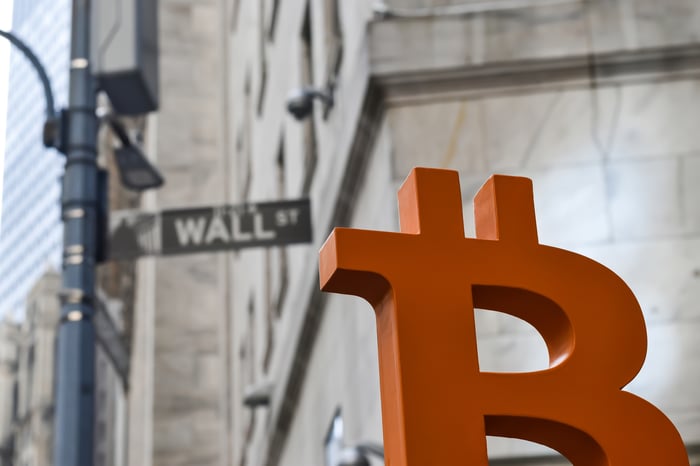
Image source: Getty Images.
It's possible to divide the largest Bitcoin owners into several different categories. First and foremost, there's Satoshi Nakamoto, the pseudonymous creator of Bitcoin, who owns an estimated 1.1 million Bitcoins. That's approximately 5% of all Bitcoin in circulation.
And then there are sovereign governments, which own a surprising amount of Bitcoin. The United States, for example, owns 210,000 Bitcoins, while China owns 190,000 Bitcoins. After that, there are huge publicly traded corporations that have Bitcoin on their balance sheets. The clear leader here is MicroStrategy (NASDAQ: MSTR), which owns 252,220 Bitcoins.
The real emerging players, though, are the large Wall Street firms that are buying Bitcoin for their ETF offerings. Given the growing demand for spot Bitcoin ETFs, these firms will continue to be more and more important over time in terms of overall Bitcoin ownership.
For example, BlackRock (NYSE: BLK), which launched the iShares Bitcoin Trust (NASDAQ: IBIT) back in January, now holds 369,640 Bitcoins. Not too far behind are Grayscale (220,177 Bitcoins) and Fidelity Investments (178,503 Bitcoins), both of which also have popular Bitcoin ETFs.
The institutional era of Bitcoin
Certainly, this growing amount of centralized ownership does pose a risk to Bitcoin's original thesis of being a completely decentralized currency. But we're still in the early days here, and even the biggest Wall Street players own less than Satoshi Nakamoto.
As investment firm Bernstein recently suggested, we are entering a new institutional era of Bitcoin. This refers to this growing amount of institutional ownership, as well as the growing role of trusted centralized intermediaries. If you are buying ETFs on a stock exchange via a brokerage firm, for example, it requires a certain amount of centralization to happen.
And that's why I'm not nearly as concerned about centralization as some of the original Bitcoin purists. If Bitcoin is ever going to go mainstream, it needs large institutional owners to embrace Bitcoin. It requires Wall Street to "buy in" on Bitcoin. It also requires large centralized exchanges where everyday people can buy Bitcoin ETFs easily and cheaply.
So, yes, Bitcoin may not be as decentralized as you think. However, over time, centralization will likely turn out to be a long-term positive catalyst for Bitcoin's growth.
Should you invest $1,000 in Bitcoin right now?
Before you buy stock in Bitcoin, consider this:
The Motley Fool Stock Advisor analyst team just identified what they believe are the 10 best stocks for investors to buy now… and Bitcoin wasn’t one of them. The 10 stocks that made the cut could produce monster returns in the coming years.
Consider when Nvidia made this list on April 15, 2005... if you invested $1,000 at the time of our recommendation, you’d have $829,746!*
Stock Advisor provides investors with an easy-to-follow blueprint for success, including guidance on building a portfolio, regular updates from analysts, and two new stock picks each month. The Stock Advisor service has more than quadrupled the return of S&P 500 since 2002*.
*Stock Advisor returns as of October 28, 2024
Dominic Basulto has positions in Bitcoin. The Motley Fool has positions in and recommends Bitcoin. The Motley Fool has a disclosure policy.
Recommended Articles





Comments (0)
Click the $ button, enter the symbol, and select to link a stock, ETF, or other ticker.