


ICICI Bank Ltd Stock (IBN) Moved Up by 3.98% on Nov 6: What Signal Does It Send?


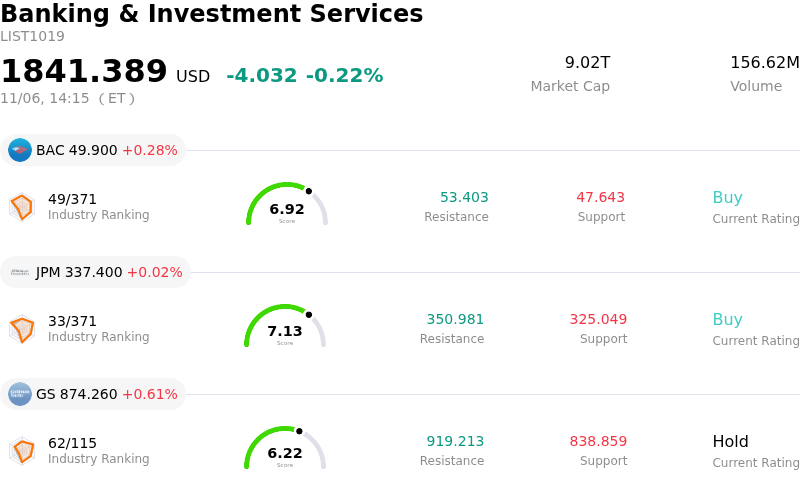
ICICI Bank Ltd (IBN) moved up by 3.98%. The Banking & Investment Services sector is down by 0.22%. The company outperformed the industry. Top 3 stocks by turnover in the sector: Bank of America Corp (BAC) up 0.28%; JPMorgan Chase & Co (JPM) up 0.02%; Goldman Sachs Group Inc (GS) up 0.61%.
What is driving ICICI Bank Ltd (IBN)’s stock price up today?
ICICI Bank shares experienced solid upward momentum as institutional investors responded favorably to sustained operational outperformance and robust credit demand across its core domestic franchise. Indian private-sector lenders continue to exhibit healthy balance sheet expansion, driven by resilient retail loan disbursements, corporate credit demand, and disciplined underwriting standards. Market participants are increasingly directing capital toward high-quality Indian financial assets as domestic macroeconomic stability and structural capital expenditure cycles reinforce long-term earnings visibility.
Reinforcing this positive sentiment is the bank's consistent execution in preserving sound asset quality and delivering industry-leading return ratios. Even as elevated competition for deposits has placed sector-wide scrutiny on funding costs, ICICI Bank continues to distinguish itself through superior digital banking capabilities, an expanding low-cost deposit franchise, and stable core operating profitability. Furthermore, broader foreign institutional inflows into emerging-market financial equities have provided a supportive tailwind, driven by global portfolio rebalancing and favorable sovereign growth differentials that structurally advantage India relative to other emerging markets.
From a market strategy perspective, the upward trajectory reflects strong valuation support and constructive analyst sentiment, with institutional desks favoring the lender due to its premium return on assets and robust capital adequacy buffer. While near-term considerations persist around margin trajectory and systemic liquidity conditions, the bank's strong provisioning coverage and diversified revenue profile provide significant balance sheet resilience, reinforcing investor confidence in its sustained medium-term compounding potential.
Technical Analysis of ICICI Bank Ltd (IBN)
Technically, ICICI Bank Ltd (IBN) shows a MACD (12,26,9) value of 0.865, indicating a buy signal. The RSI at 80.251 suggests overbought condition and the Williams %R at 4.566 suggests overbought condition. Please monitor closely.
Fundamental Analysis of ICICI Bank Ltd (IBN)
ICICI Bank Ltd (IBN) is in the Banking & Investment Services industry. Its latest annual revenue is $25.32B, ranking 21 in the industry. The net profit is $6.14B, ranking 21 in the industry. Company Profile
Over the past month, multiple analysts have rated the company as Buy, with an average price target of $37.75, a high of $40.00, and a low of $36.00.
More details about ICICI Bank Ltd (IBN)
Company Specific Risks:
- Net Interest Margin (NIM) Compression: Persistent sequential moderation in net interest margins—declining from prior 4.36% peaks toward 4.18%—is driving institutional concern as the impending Reserve Bank of India monetary easing cycle threatens to reprice floating-rate loan books faster than sticky deposit liabilities.
- Intensified Deposit Mobilization and Funding Costs: A persistent industry-wide disparity between domestic credit expansion and low-cost CASA deposit growth is forcing aggressive competition for retail term deposits, keeping liability acquisition costs elevated and eroding core spread margins.
- Unsecured Lending Deceleration and Rising Credit Costs: Heightened regulatory scrutiny and tightened risk-weight mandates from the central bank on unsecured personal credit have constrained high-yield retail disbursements, setting expectations for normalizing provisioning expenses and higher delinquency recognition.
- Foreign Portfolio Capital Outflows and Valuation Resistance: With the stock trading near historical valuation resistance levels around 3x forward core book value, the ADR remains acutely vulnerable to cross-border institutional selling and foreign portfolio outflows triggered by rising bond yields and currency volatility.
This article may include AI-generated content that is human-reviewed, which is for reference and general information purposes only and does not constitute investment advice.
Recommended Articles










Comments (0)
Click the $ button, enter the symbol, and select to link a stock, ETF, or other ticker.