


SAP SE Stock (SAP) Moved Down by 3.49% on Nov 6: Drivers Behind the Movement


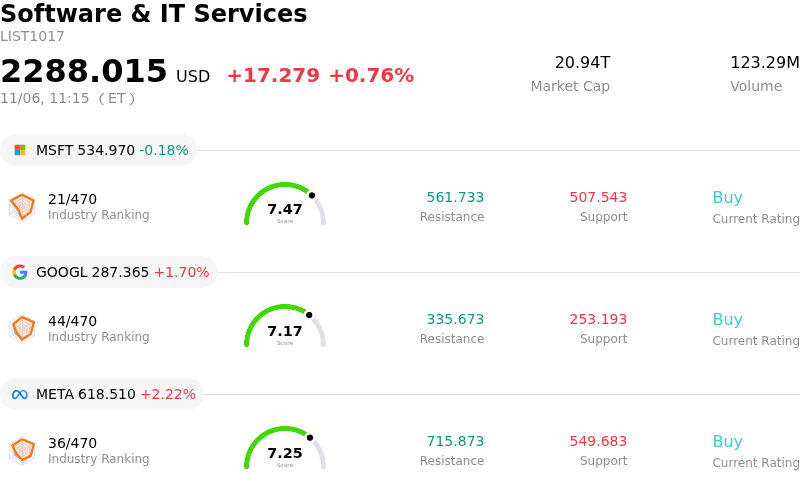
SAP SE (SAP) moved down by 3.49%. The Software & IT Services sector is up by 0.76%. The company underperformed the industry. Top 3 stocks by turnover in the sector: Microsoft Corp (MSFT) down 0.17%; Alphabet Inc Class A (GOOGL) up 1.70%; Meta Platforms Inc (META) up 2.31%.
What is driving SAP SE (SAP)’s stock price down today?
SAP experienced downward pressure during the trading session as institutional investors engaged in profit-taking and re-evaluated the company's valuation following its recent post-earnings advance. Although third-quarter results showcased resilient demand for the flagship Cloud ERP Suite, market focus has pivoted toward management's cautionary commentary regarding an anticipated deceleration in current cloud backlog growth heading into the final quarter of the year. In a premium-valued software environment, any sign of slowing pipeline conversion or extended enterprise sales cycles prompts immediate multiple compression from growth-sensitive funds.
Compounding this sentiment are rising investor questions surrounding the near-term monetization of SAP's generative and sovereign artificial intelligence initiatives. While the company continues to integrate specialized models and automated agents across its Business AI Platform, the commercial payoff remains difficult to quantify in the immediate term. Dedicated infrastructure outlays, computational delivery costs, and lengthy purchasing reviews among heavily regulated enterprise clients are creating margin friction. Market participants are seeking concrete evidence that these deployments will translate into high-margin, incremental recurring revenue rather than simply driving up operational overhead.
Broader sector dynamics and macroeconomic factors also contributed to the pullback. Enterprise software providers have faced heightened scrutiny over corporate IT budgets, with organizations prioritizing hardware and core infrastructure over discretionary software upgrades. This macro caution, alongside sector-wide valuation adjustments and persistent overhang from regulatory investigations into public sector procurement practices, spurred institutional de-risking. Without an immediate fundamental catalyst to offset these growth and margin anxieties, shares trended lower as capital rotated toward more defensive or near-term cash-generative technology assets.
Technical Analysis of SAP SE (SAP)
Technically, SAP SE (SAP) shows a MACD (12,26,9) value of -0.413, indicating a neutral signal. The RSI at 57.361 suggests neutral condition and the Williams %R at 52.881 suggests neutral condition. Please monitor closely.
Fundamental Analysis of SAP SE (SAP)
SAP SE (SAP) is in the Software & IT Services industry. Its latest annual revenue is $41.49B, ranking 15 in the industry. The net profit is $8.07B, ranking 14 in the industry. Company Profile
Over the past month, multiple analysts have rated the company as Buy, with an average price target of $278.90, a high of $367.98, and a low of $210.00.
More details about SAP SE (SAP)
Company Specific Risks:
- Cloud Backlog Deceleration and Growth Moderation: Management guidance and institutional analyst commentary highlight an impending slowdown in current cloud backlog (CCB) growth into the fourth quarter, pressured by challenging year-over-year comparables and enterprise IT budget scrutiny that threatens full-year cloud revenue targets and free cash flow conversion.
- AI Infrastructure Cost Overhang and Unproven Monetization: Expanding Business AI and agentic capabilities across client workflows are driving substantial token, compute, and model maintenance expenses—forcing the substitution of costly models with budget alternatives—which compresses cloud gross margins while direct, recurring software monetization remains nascent.
- Profitability Compression from Legacy Support Runoff: The accelerating decline of legacy on-premise license and maintenance streams is shedding highly profitable revenue faster than cloud ERP margins can compensate, while heavy utilization of migration credits under the RISE with SAP program further dilutes near-term operating margins.
- S/4HANA Migration Complexity and Deployment Friction: Independent enterprise surveys and partner channel reports indicate that multi-instance fragmentation, custom codebase dependencies, and governance barriers are delaying transitions away from ECC ahead of support deadlines, heightening the risk of implementation bottlenecks and client churn.
This article may include AI-generated content that is human-reviewed, which is for reference and general information purposes only and does not constitute investment advice.
Recommended Articles









Comments (0)
Click the $ button, enter the symbol, and select to link a stock, ETF, or other ticker.